Rock Castle Sloup
Skalní hrad Sloup
Czech republic · Liberec Region — Sloup v Čechách, Česká Lípa District, Northern Bohemia · Near Česká Lípa
Built 1340 · Medieval rock castle carved directly into a massive sandstone formation — the castle was built into and on top of a large free-standing sandstone rock in the centre of Sloup v Čechách, with rooms, passages, and defensive elements carved from the living rock; the sandstone is Cretaceous-era sedimentary rock approximately 100 million years old, deposited as seabed sediment and subsequently exposed by erosion into the free-standing massive that forms the castle's entire physical fabric; the rock rises approximately 30 metres from the surrounding valley floor; medieval construction added wooden elements, iron fittings, and later masonry components to the carved interiors, but the rock itself is both the building material and the building; the rock castle typology — carved rather than constructed — is characteristic of Northern Bohemia's Cretaceous sandstone landscape and found in several other sites in the region
This page is part of an independent travel guide and is not affiliated with, endorsed by, or operated by Rock Castle Sloup.

© Castles & Palaces
Quick Facts
- Hours
- Mon Closed (during open season). Tue–Sun 09:00–17:00
- Guided tour from
- €186
- Duration
- 45 minutes–1 hour (guided tour of the carved rock interior, upper terrace view, and outer fortification)
- Best time
- May to September
- Nearest city
- Česká Lípa
Featured Tour
From Prague: Hike in the volcanic landscape, glass & beer
Cancellation available · Instant confirmation
Highlights
- ✦A castle carved from the inside of a 100-million-year-old rock — the sandstone formation that forms Sloup castle is Cretaceous-era sedimentary rock deposited as seabed sediment; the medieval builders did not construct a castle on the rock but inside it, carving rooms, stairways, and passages from the living sandstone; the rock itself is both the building material and the building, a typology unique to landscapes where erosion-resistant sandstone creates isolated free-standing massifs
- ✦Panská Skála — the basalt 'organ pipe' columns — approximately 12km from Sloup, the Panská Skála (Lord's Rock) formation is a basalt column structure of hexagonal-section columns created by the cooling of volcanic lava, visually similar to the Giant's Causeway in Northern Ireland; the GYG day tour combines both Sloup castle (sandstone/marine geology) and Panská Skála (basalt/volcanic geology), making the tour a remarkable comparison of two entirely different geological formation processes in the same Northern Bohemia landscape
- ✦A historic glassmaking workshop and brewery — the same GYG day trip adds a glassmaking workshop visit (Northern Bohemia has been a European centre of glass production since the 17th century, and the local tradition of hand-blown and engraved glass is one of the region's defining cultural inheritances) and a stop at a historic brewery, giving the day a regional-culture dimension beyond the geological and historical
- ✦Northern Bohemia's sandstone landscape — the broader region between the Elbe sandstone of Saxon Switzerland (Sächsische Schweiz, straddling the Czech-German border) and the interior Bohemian sandstone formations contains some of the most distinctive geological scenery in Central Europe; Sloup's rock castle is one of several carved sandstone sites in the area (Kamenický Šenov, Bezděz, and others), all exploiting the same Cretaceous-era geology
- ✦Seasonal access requires careful planning — the castle is closed November through March and open weekends only in April and October; this is a more restrictive schedule than most Czech heritage sites, and any visit must confirm current access dates before travel
Skip the queue with a guided tour
Skip-the-line tickets & expert guides
The sandstone rock at Sloup v Čechách is approximately 30 metres high, free-standing, and approximately 100 million years old. It was deposited as seabed sediment during the Cretaceous period — when a shallow inland sea covered much of what is now Bohemia — and shaped over millions of years of erosion into the isolated massif that now rises from the centre of a small Northern Bohemian village. Medieval builders, recognising its defensive potential, did not build a castle on top of it in any conventional sense. They built inside it.
The Rock Castle Sloup is a castle carved from living rock. Rooms, stairways, passages, and defensive positions were cut directly into the sandstone, using the natural properties of the material — relatively soft when first exposed, hardening with time — to create spaces that could not have been assembled from quarried stone and mortar. The carved interior is the castle: the rock walls are the castle walls, the rock floor is the castle floor, and the same sandstone that is visible on the exterior of the formation is visible from the inside as the ceiling. Medieval wooden elements — platforms, doors, ladders — were fitted into the carved rock; iron hooks and fittings secured them to the stone. Almost nothing of these organic elements survives, but the carved spaces themselves are as the medieval builders left them, reshaped only by the slow compression of centuries and by the occasional conservation work that has kept them accessible to visitors.
The rock castle typology — carved rather than constructed — is characteristic of Northern Bohemia's Cretaceous sandstone landscape. The same geological conditions that produce free-standing sandstone massifs (resistant rock isolated by erosion) produce the raw material for rock architecture, and Sloup is one of several examples in the region where medieval inhabitants found it easier to carve their way into the rock than to build on its surface. The scale and completeness of the Sloup rock castle make it the most fully realised example of the type in the area.
The broader Northern Bohemia landscape around Sloup adds a geological dimension that the GYG day tour from Prague (t1176718) exploits intelligently. The day combines the rock castle (Cretaceous sandstone, marine origin) with a visit to Panská Skála — a basalt column formation approximately 12km from Sloup whose hexagonal-section columns were created by the cooling of volcanic lava in an entirely different geological episode. The contrast between the smooth layered sedimentary sandstone and the angular crystalline basalt columns is as sharp a geological comparison as any single region in Europe offers within a short distance. The Panská Skála columns are frequently compared to the Giant's Causeway in Northern Ireland or to the basalt formations of Fingal's Cave in Scotland — the same process, the same geometry, a different European latitude.
The same day tour adds a glassmaking workshop visit and a stop at a historic brewery. Northern Bohemia has been a centre of European glass production since the 17th century; the Jizera Mountains and the border region with Germany developed a tradition of hand-blown and engraved glass that competed with Venetian and Bohemian crystal as the dominant luxury glass in European markets from the Baroque period onward. A workshop visit gives the craft a direct, material dimension that museum presentations cannot provide. The brewery stop reflects Northern Bohemia's equal tradition in beer — a landscape that produced the sandstone for one of medieval Europe's more unusual castles also produced the hops and the groundwater for some of Bohemia's oldest brewing sites.
Visitors need to take the seasonal access restrictions at Sloup seriously. The castle interior is closed from November 1 through March 31 entirely, and open only on weekends in April and October. This is a more restrictive schedule than most Czech heritage sites, and the castle cannot be visited outside these windows. The GYG day tour operates across the summer season; visitors planning an independent visit must check current dates before travel.
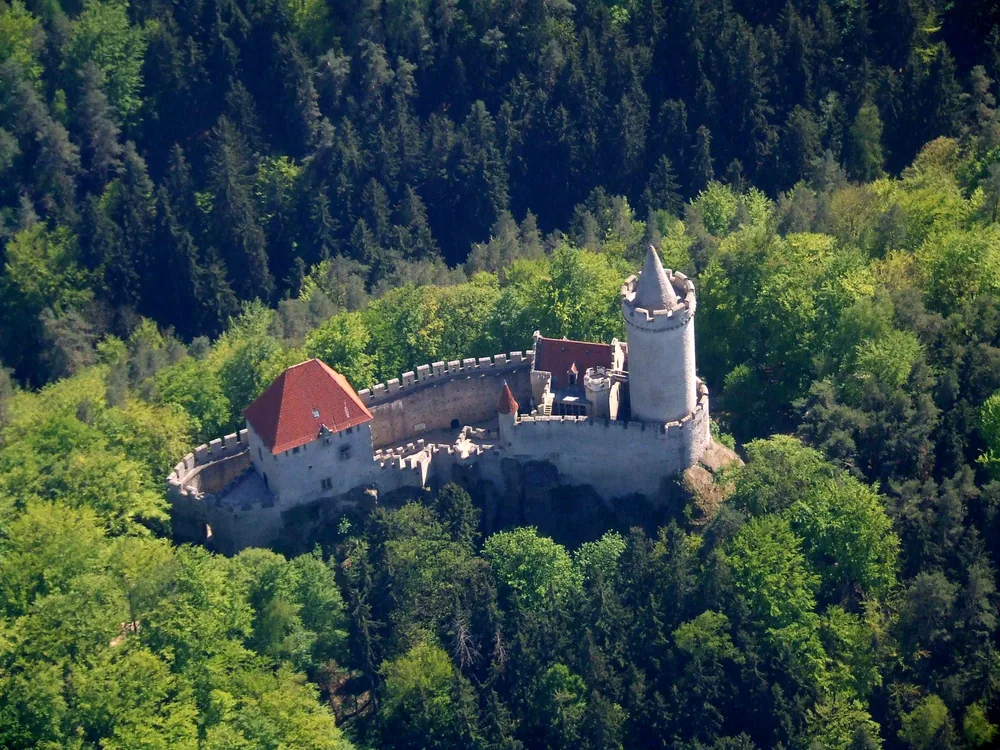
[Kokorin Castle](/castles/czech-republic/kokorin-castle) — a Gothic castle on a sandstone promontory above a forested valley in Northern Bohemia, approximately 40km southwest — is the closest comparable site combining medieval architecture with sandstone landscape.
History
Cretaceous period (c. 100 million years ago): sandstone deposited as seabed sediment; erosion eventually isolates the Sloup rock massif as a free-standing formation. Medieval period (approximately 13th–14th century): the first rock-carved defensive use of the sandstone formation at Sloup; the rock castle is developed over several generations as the carved spaces become more elaborate. 14th–16th century: Sloup rock castle in active use as a medieval fortification; the village of Sloup develops around the base of the rock. 16th–17th century: changing military technology and defensive needs reduce the castle's function; the village grows while the castle falls from primary use. 18th–20th century: the rock castle increasingly serves as a curiosity and tourist attraction; visits documented from the 18th century. Present day: administered as a heritage site by the town of Sloup v Čechách; open May–September Tuesday–Sunday, April and October weekends only, closed November–March.
How to Visit
Getting there: Sloup v Čechách is 95 km north of Prague via the D8 motorway and local roads (~1 hour by car). By public transport, take a bus to Česká Lípa (25 km south), then a connecting bus to Sloup; the rock castle is in the centre of the village.
Tickets: Walk-up entry is €5 adult, €3 child. The GYG full-day tour from Prague (t1176718, from €186, 5★/1 review) includes Rock Castle Sloup with 1.5 hours of hiking around the rock, Panská Skála basalt column formation, a glassmaking workshop, and a historic brewery stop.
Practical tips: The castle interior is closed November through March and open weekends only in April and October — confirm current access at mestosloup.cz before any visit. The carved interior involves very steep narrow passages; not suitable for visitors with mobility impairments or claustrophobia.
Combine with: [Kokořín Castle](/castles/czech-republic/kokorin-castle) — the Gothic sandstone-ridge castle 40 km southwest, another Northern Bohemia sandstone landscape destination.
Frequently Asked Questions
At Rock Castle Sloup, the castle is not a building placed on or against the rock — it is rooms, stairways, and passages cut directly from the inside of the sandstone massif. The sandstone was carved away to create interior spaces, leaving the remaining rock as the walls, ceilings, and floors. This was possible because Cretaceous-era Bohemian sandstone is relatively soft when freshly exposed (easier to cut) and hardens over time. The resulting spaces are permanent and stable, but the walls are literally the rock of the massif — not stone masonry assembled from quarried blocks. Medieval wooden elements (platforms, ladders, doors) were fitted into these carved spaces; very little organic material survives, but the carved rock itself remains as the medieval builders left it.
Location
Skalní hrad Sloup, Sloup v Čechách 1, 471 52 Sloup v Čechách, Czech Republic
Nearby Castles
Tours & Tickets
Powered by GetYourGuide
From
€186/ person