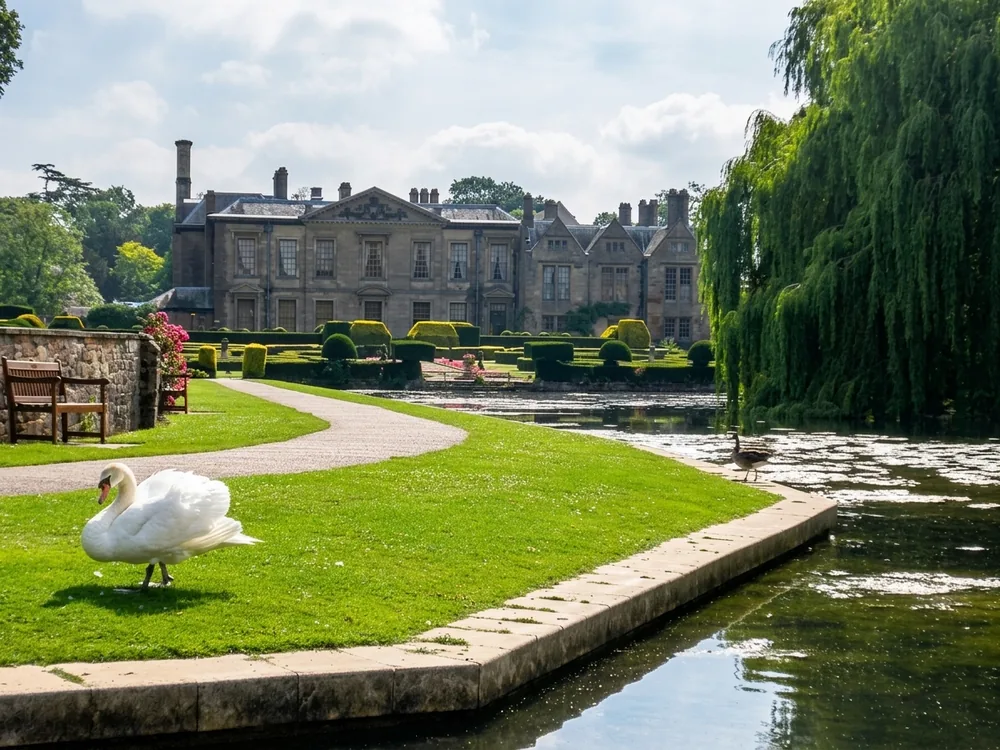
Coombe Abbey
England · Warwickshire — near Coventry · Near Coventry
Built 1150 · Founded as a 12th-century Cistercian abbey, converted to a country house after the Dissolution, with gardens later landscaped by Capability Brown — Grade I listed
This page is part of an independent travel guide and is not affiliated with, endorsed by, or operated by Coombe Abbey.
© Castles & Palaces
Quick Facts
- Rooms from
- £77 / night
- Day-visit entry
- Free
- Hotel rating
- 4-Star Hotel
- Duration
- Coombe Abbey Country Park: free entry, no ticket required, open year-round; restaurant dining or afternoon tea separately, with reservation; overnight stay separately bookable
- Best time
- Year-round
- Nearest city
- Coventry
Stay Here
Coombe Abbey Hotel
4-Star HotelBooked via Booking.com · Free cancellation on most rates
Open to day visitors without booking a room — see How to Visit below.
Highlights
- ✦Founded in the 12th century as the Abbey of Cumbe, Warwickshire's largest and most influential monastery, remaining in monastic hands until the Dissolution of the Monasteries in 1539
- ✦Passed to Henry VIII after the Dissolution; bought in 1581 by Sir John Harrington, a close friend of King James I, who was entrusted with the education of the King's daughter, Princess Elizabeth
- ✦Princess Elizabeth's stay at the Abbey was overshadowed by a real plot connected to the 1605 Gunpowder Plot to kidnap her
- ✦The Craven family acquired the estate in 1622 and held it for 300 years; during this period, the celebrated landscape architect Capability Brown transformed the grounds into the parkland that survives today
- ✦Sold in 1923; acquired by Coventry City Council in 1964, the country park opened to the public in 1966 and the hotel in 1995 — the 500-acre park remains completely free to enter, with no ticket required, the same access model as Barony Castle's Great Polish Map in the Scotland pilot
Stay in the castle itself
Book a room via Booking.com
Coombe Abbey stands within its own extensive parkland a short distance from Coventry in Warwickshire, and its origins reach back to the 12th century, when it was founded as the Abbey of Cumbe — Warwickshire's largest and most influential monastery, a genuinely significant religious institution rather than a minor local foundation. The abbey remained in continuous monastic hands for roughly four centuries, until the Dissolution of the Monasteries in 1539 swept away England's monastic institutions under Henry VIII's break with Rome, transferring Coombe's substantial landholdings to the crown.
The estate passed through royal hands before being purchased in 1581 by Sir John Harrington, a close friend of King James I who was entrusted with an extraordinary responsibility: the education of the King's daughter, Princess Elizabeth. That royal connection brought genuine danger to Coombe Abbey in 1605, when the Gunpowder Plot — the notorious conspiracy to assassinate James I by blowing up Parliament — included a real plan to kidnap Princess Elizabeth from Coombe during her stay there, intending to install her as a puppet Catholic monarch had the plot succeeded. The plot's failure spared both the King and his daughter, but the episode places Coombe Abbey directly within one of the most consequential conspiracies in English history.
The Craven family acquired Coombe Abbey in 1622 and held the estate for three centuries, and it was during this long tenure that the grounds received their most significant and lasting transformation: Capability Brown, the era's most celebrated landscape architect, responsible for reshaping the grounds of numerous major English estates, redesigned Coombe's parkland into the naturalistic landscape that substantially survives today — a genuine work by one of English garden history's most influential figures, still walkable by any visitor to the park.
Coombe's 20th-century history moved from private ownership into public stewardship: the estate was sold in 1923, and Coventry City Council acquired the property in 1964. The resulting country park opened to the public in 1966, and the abbey buildings themselves were converted into a hotel that opened in 1995, giving Coombe a genuinely unusual dual identity as both a working luxury hotel and a fully public municipal park sharing the same historic grounds.
What makes Coombe Abbey the strongest visitable_by_public case in this entire batch, and one of the strongest in the whole pilot, is the completeness and simplicity of its free public access: the 500-acre Coombe Abbey Country Park is entirely free to enter, with no ticket required at any point, matching the access model already established at Barony Castle's Great Polish Map of Scotland elsewhere in this collection. The park includes woodland, formal gardens, an arboretum, open grassland and a lake, along with a dedicated Visitor Centre offering information, a café, and a craft market — genuine public amenities distinct from the hotel's own commercial offerings. The hotel's Garden Room Restaurant separately welcomes non-resident visitors for meals and afternoon tea with reservation, giving guests a paid dining option alongside the park's free access, but it is the sheer scale and completeness of that free 500-acre public park — not a restaurant reservation — that defines Coombe Abbey's public accessibility above almost every other property in this collection.
Coombe Abbey Country Park also functions as a genuine wildlife and recreation destination in its own right, popular with birdwatchers drawn to its lake and woodland habitats, families using its play areas and woodland trails, and walkers exploring grounds that retain much of Capability Brown's original naturalistic design intent more than two centuries after he completed his work here. This dual identity — a fully public, free municipal park wrapped around a working luxury hotel occupying genuinely historic monastic and country-house buildings — gives Coombe Abbey a breadth of everyday local use that few other castle-hotels in this collection can match.
History
Coombe Abbey was founded in the 12th century as the Abbey of Cumbe, Warwickshire's largest monastery, remaining in monastic hands until the Dissolution of the Monasteries in 1539. It passed to Henry VIII and was bought in 1581 by Sir John Harrington, a close friend of King James I entrusted with educating the King's daughter, Princess Elizabeth, whose stay at the Abbey became entangled with a real 1605 Gunpowder Plot scheme to kidnap her. The Craven family acquired the estate in 1622 and held it for 300 years, during which Capability Brown landscaped the grounds into the parkland that survives today. The estate was sold in 1923, and Coventry City Council acquired it in 1964; the country park opened to the public in 1966 and the hotel in 1995.
Frequently Asked Questions
No. The 500-acre Coombe Abbey Country Park is entirely free to enter, with no ticket required at any point — the same access model as Barony Castle's Great Polish Map of Scotland elsewhere in this collection. The park includes woodland, formal gardens, an arboretum, grassland and a lake, plus a Visitor Centre with a café and craft market.
Location
Brinklow Road, Binley, Coventry, Warwickshire CV3 2AB, England
Nearby Castles
Rooms from
£77/ night