
Royal Pavilion Brighton
The Royal Pavilion
England · East Sussex — Brighton, seafront city on the English Channel coast · Near Brighton
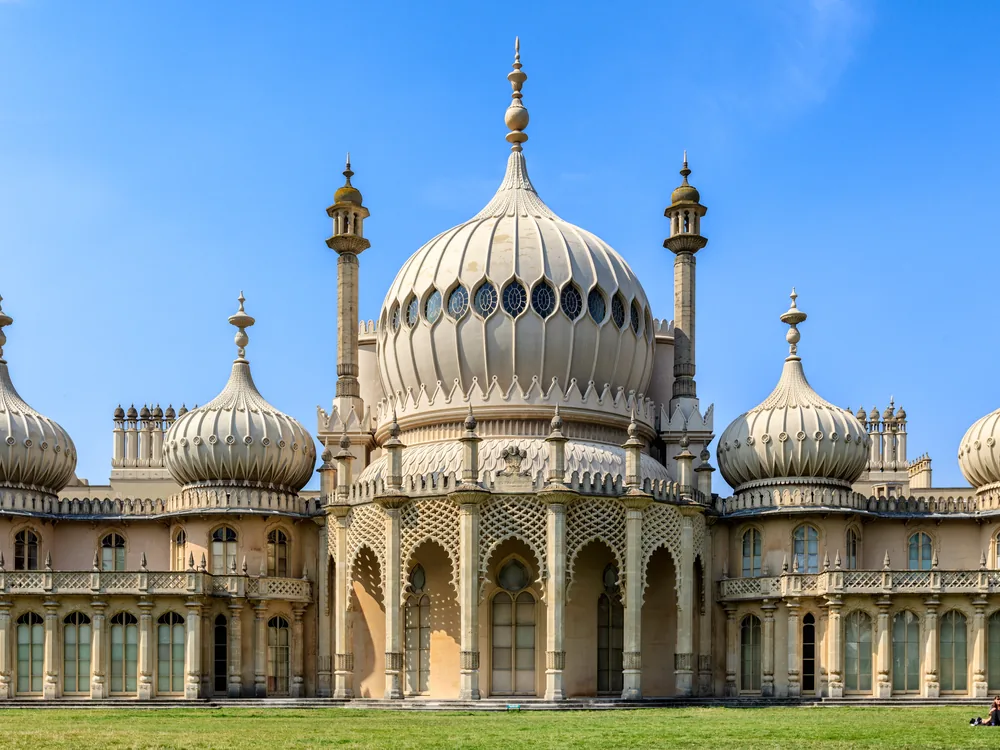
Built 1787 · Regency Orientalist; Indian-style exterior with onion domes, minarets, and decorative pinnacles by architect John Nash (major reconstruction 1815–1823); Chinese-inspired Regency interiors throughout the state rooms; cast-iron palm-tree columns in the Great Kitchen
This page is part of an independent travel guide and is not affiliated with, endorsed by, or operated by Royal Pavilion Brighton.
© Castles & Palaces
Quick Facts
- Hours
- Daily 10:00–17:15
- Entry via GetYourGuide
- €25
- Duration
- 1.5–2 hours (self-guided)
- Best time
- Year-round
- Nearest city
- Brighton
Featured Tour
Brighton: Royal Pavilion Admission Ticket
Cancellation available · Instant confirmation
Highlights
- ✦The Banqueting Room chandelier — nearly a tonne of glass and bronze, over six metres long, suspended by a life-size silvered dragon from a painted ceiling — is one of the most extraordinary single decorative features in any European royal interior
- ✦Architect John Nash transformed the original 1787 neoclassical marine pavilion into a palace of onion domes and minarets between 1815 and 1823, producing an exterior unlike any other royal building in Europe
- ✦During the First World War the Royal Pavilion served as a convalescent hospital for Indian soldiers fighting for the British Empire — the building's Indian aesthetic was chosen deliberately to offer familiar visual comfort to wounded troops far from home
- ✦The Music Room features a ceiling of overlapping lotus-petal scales and gas lamps modelled on lotus flowers — Chinese-inspired Regency decoration that contrasts with the Indian exterior to create a deliberately eclectic royal fantasy
- ✦Queen Victoria sold the Pavilion to Brighton Corporation in 1850, finding it too exposed for comfortable royal use — it has been managed as a public heritage site ever since, with the state rooms restored to their original Regency splendour
Skip the queue with a guided tour
Skip-the-line tickets & expert guides
There is no building quite like the Royal Pavilion in Britain, and possibly not in Europe. Standing in the centre of Brighton, surrounded by the largely Georgian streetscape of a busy coastal city, it announces itself with onion domes and minarets that belong — architecturally — somewhere on the Rajput plains of northwest India rather than the English Channel coast. The interior is even more disorienting: the Banqueting Room is dressed as a Chinese imperial hall, its chandelier held aloft by a silvered dragon, its walls hung with painted serpents and lotus-bud gas lamps, while the Music Room presents a ceiling of overlapping crimson and gold lotus-petal scales. None of it is accidental, and none of it is naive — it is a deliberate, expensive, and rather brilliant exercise in Regency Orientalism that tells a specific story about its patron and the cultural moment he inhabited.
The Prince Regent — later George IV — began using Brighton as a seaside retreat in the late 1780s, when the town was establishing itself as a fashionable alternative to London's social pressures. The original marine pavilion built for him in 1787 was modest by his standards. Between 1815 and 1823, architect John Nash transformed the structure entirely: the exterior acquired its dramatic Indian silhouette of domes, pinnacles, and minarets; the Great Kitchen was rebuilt around cast-iron columns in the shape of palm trees capable of bearing the roof load; and the state rooms were fitted out in Chinese-inspired Regency style at considerable royal expense. The result was a palace that made no pretensions to English architectural tradition — a pleasure retreat designed by and for a prince with an exceptionally generous attitude toward pleasure.
The Pavilion's history extends well beyond its Regency origins. Queen Victoria used it intermittently but found the building's visibility in the expanding resort town incompatible with royal privacy, and sold it to Brighton Corporation in 1850. The chapter that most unexpectedly complicates the Pavilion's identity came in 1914, when the building was requisitioned as a convalescent hospital for Indian soldiers fighting on the Western Front. The decision to use a building with Indian architectural features was deliberate — the familiar visual language of domes and decorative detail was hoped to provide some comfort to men who were wounded, in an alien climate, and far from home. Photographs from this period show the state rooms filled with hospital beds, the banqueting tables replaced with medical equipment, the Music Room serving purposes its architect had not imagined.
The GetYourGuide admission ticket gives access to the full interior and the Pavilion Gardens and is the most convenient way to book in advance, particularly on summer weekends when walk-up queues build quickly.
History
The site in central Brighton first attracted royal attention in the 1780s, when the Prince of Wales — later the Prince Regent and then George IV — began visiting the fashionable seaside town. A modest neoclassical marine pavilion was built for him in 1787, adequate for the moment but entirely inconsistent with the scale of his tastes. Between 1815 and 1823, architect John Nash was commissioned to transform the building comprehensively: the exterior received its now-famous Indian silhouette of onion domes, minarets, and pinnacles, and the state rooms were decorated in a Chinese-inspired Regency style that owed more to the Regency appetite for Orientalist fantasy than to any specific Asian tradition. The Great Kitchen, rebuilt around cast-iron palm-tree columns, became one of the most technically advanced catering facilities in Regency England. Queen Victoria used the Pavilion after her accession but found its public prominence in the growing resort increasingly unsuitable for royal occupation, and sold it to Brighton Corporation in 1850, removing much of the original furniture in the process. The Corporation undertook gradual restoration and opened the building to the public, a process interrupted but also enriched by the building's requisition as a hospital for Indian soldiers during the First World War — a chapter that gave the Orientalist exterior an unexpected humanitarian resonance. Systematic restoration of the state rooms to their Regency appearance continued through the 20th century. The building has been managed by the Royal Pavilion & Museums Trust since 2018.
How to Visit
Getting there: Brighton is served by frequent direct trains from London Victoria (50–55 minutes) and London Bridge (60–70 minutes). The Royal Pavilion is in the city centre, a 15-minute walk from Brighton station or a short taxi ride. There is no practical on-site parking; the nearest multi-storey car parks are signposted from the A23 approaches to the city.
Tickets: Walk-up entry is £25 for adults and £12 for children. The GetYourGuide admission ticket covers the full interior and all state rooms and is bookable online — advance booking is recommended on summer weekends and bank holidays when walk-up queues can be lengthy.
Practical tips: The Banqueting Room and Music Room are the highlights — allow time to stand in each rather than moving through quickly. The Pavilion Gardens surrounding the building are free to enter and offer the best exterior views of the domes and minarets; the north and east elevations are the most dramatic. An audio guide is available at the entrance for an additional charge and adds considerable depth to the visit.
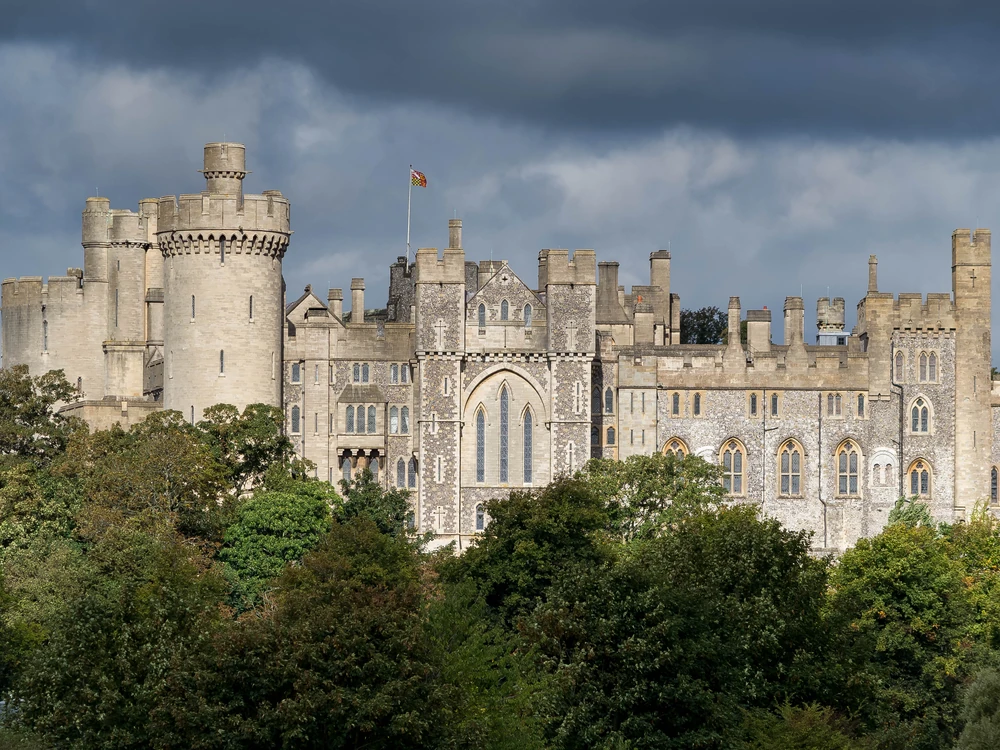
Combine with: Arundel Castle (30 km west — the medieval seat of the Dukes of Norfolk on the Sussex Downs, one of the grandest continuously inhabited castle-houses in England; a natural day-trip pairing from Brighton combining the Regency seafront palace with a working medieval castle).
Frequently Asked Questions
The Regency period had a broad enthusiasm for Orientalist decoration that drew freely on South Asian, East Asian, and Middle Eastern visual traditions without concern for geographical accuracy. The Indian-style exterior was chosen by architect John Nash partly for its dramatic visual impact — onion domes and minarets made an instantly striking statement on the Brighton seafront — while the Chinese-inspired interiors reflected a different strand of Regency taste that George IV and his decorators found equally appealing. Both traditions were understood as aesthetic resources rather than ethnographic documentation, and the mixing of them was deliberate and confident rather than confused.
Location
4-5 Pavilion Buildings, Brighton BN1 1EE, England
Nearby Castles
Tours & Tickets
Powered by GetYourGuide
From
€25/ person