
Château de Bournel
Château de Bournel
France · Cubry, Doubs (Franche-Comté, Bourgogne-Franche-Comté) · Near Besançon
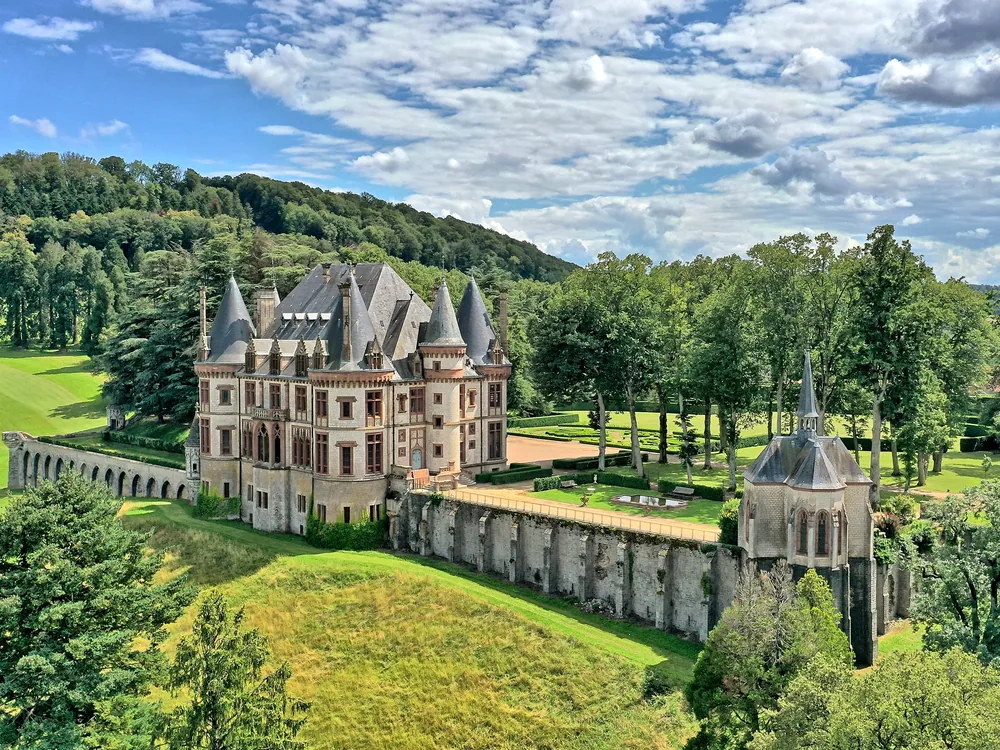
Built 1860 · The estate holds two genuinely historic châteaux: the 18th-century "old château" (orange roof) and a mid-19th-century neo-Gothic "new château" (grey roof, a separate building), designed by Clément Parent, a disciple of Viollet-le-Duc
This page is part of an independent travel guide and is not affiliated with, endorsed by, or operated by Château de Bournel.
© Castles & Palaces
Quick Facts
- Rooms from
- €127 / night
- Duration
- Overnight stay only
- Best time
- Year-round
- Nearest city
- Besançon
Stay Here
Château de Bournel
Rooms are split between the historic building and a newer wing
Booked via Booking.com · Free cancellation on most rates
No confirmed independent day-visit product was found; access is primarily for hotel guests.
Highlights
- ✦The Bournel estate entered the Moustier family in 1496, through the marriage of Jean de Moustier and Marguerite de Granvillars — the same family has held it for over five centuries
- ✦Around 1860, Léonel de Moustier, fifth marquis and senior diplomat (ambassador to Berlin, Vienna and Constantinople, and foreign minister under Napoleon III), built a new neo-Gothic château designed by Clément Parent, a disciple of Viollet-le-Duc
- ✦His son, Pierre-René, completed the interior decoration, built a chapel inspired by the Château d'Amboise, and designed French and English-style gardens
Stay in the castle itself
Book a room via Booking.com
The Bournel estate entered the Moustier family in 1496, through the marriage of Jean de Moustier and Marguerite de Granvillars — the same family has held it for over five centuries. Around 1860, Léonel de Moustier, fifth marquis and a senior diplomat (ambassador to Berlin, Vienna and Constantinople, and foreign minister under Napoleon III), decided to build a new neo-Gothic château, designed by architect Clément Parent, a disciple of Viollet-le-Duc. His son, Pierre-René, completed the interior decoration, built a chapel inspired by the Château d'Amboise, designed French gardens, and planted an English-style park. The 80-hectare estate also includes an 18-hole golf course.
Today the property offers 26 rooms in total, split between two genuinely distinct historic buildings: 16 rooms in the 18th-century "old château," plus 4 more in its private tower, and 6 luxury suites in the mid-19th-century neo-Gothic "new château," a separate building.
The estate's continuous ownership by the Moustier family since 1496 gives Bournel one of the longer single-family tenures documented in the France collection, spanning over five centuries.
The presence of two architecturally distinct but equally genuine historic châteaux on one estate — classic 18th-century versus Viollet-le-Duc-influenced neo-Gothic — distinguishes Bournel from properties where a single château is paired with a modern or converted annex.
Léonel de Moustier's career as ambassador to three major European capitals and foreign minister under Napoleon III ties Bournel directly to the diplomatic history of the Second French Empire.
The estate's position in Cubry, Doubs, between Burgundy and Alsace, an hour from Switzerland, gives guests staying at Bournel a central base for exploring the wider Franche-Comté region.
History
The Bournel estate entered the Moustier family in 1496 and has remained with them for over five centuries. Around 1860, Léonel de Moustier, fifth marquis and a senior diplomat under Napoleon III, built a new neo-Gothic château designed by Clément Parent, a disciple of Viollet-le-Duc, alongside the existing 18th-century château. His son Pierre-René completed its interior and gardens. Today the estate offers 26 rooms split between the two genuinely historic buildings: 20 in the 18th-century old château (including its tower) and 6 luxury suites in the neo-Gothic new château.
How to Stay
Getting there: In Cubry, Doubs, between Burgundy and Alsace, an hour from Switzerland.
Rooms & rates: 26 rooms split between two distinct historic châteaux on the same estate — the old one (18th century, 16+4 rooms) and the neo-Gothic new one (mid-19th century, 6 suites); from about €127 per night.
On-site: 18-hole golf course, chapel inspired by the Château d'Amboise, French gardens, English-style park.
Good to know: A five-century family estate (Moustier, since 1496) with two genuinely historic châteaux — confirm which building you're booking, as they have distinct architectural character (classic baroque vs. neo-Gothic).
Combine with: Château de Villersexel (30 min), Besançon (1h).
Frequently Asked Questions
Yes — the 18th-century "old château" and the mid-19th-century neo-Gothic "new château" are both real historic buildings on the same family estate, not a modern annex.
Location
Route de Bournel, 25680 Cubry, France
Nearby Castles
Rooms from
€127/ night