
Hohlandsbourg Castle
Château du Hohlandsbourg
France · Alsace — Haut-Rhin, near Wintzenheim and Colmar · Near Colmar
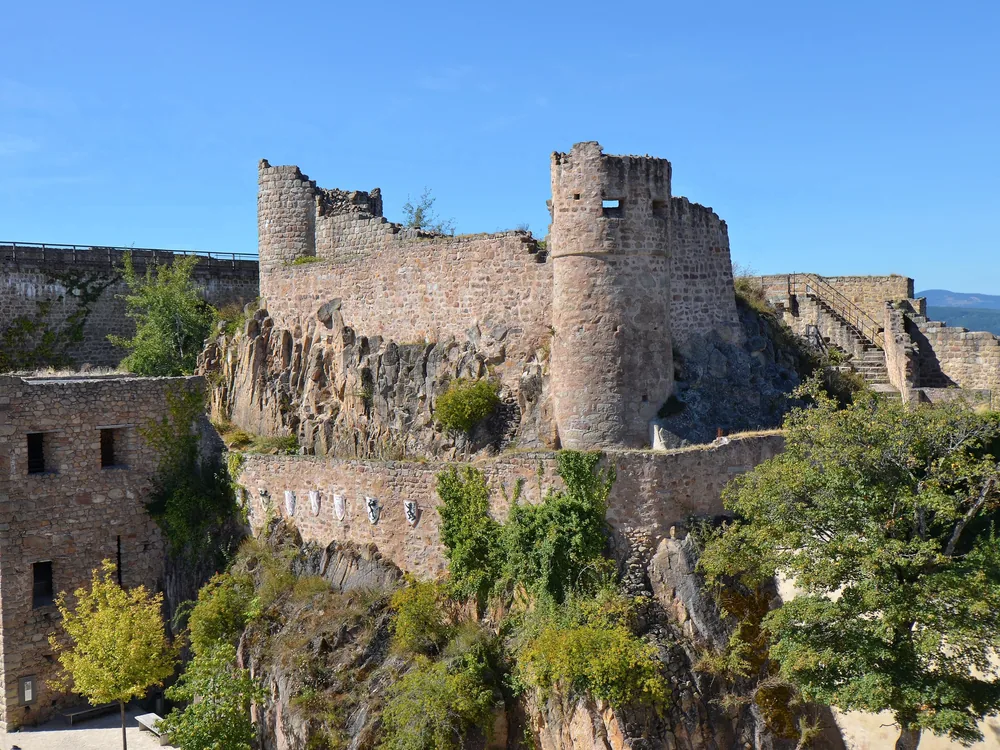
Built 1279 · 13th-century castle founded by Count Rudolf of Habsburg on a commanding hilltop above the Munster Valley; the original 1279 plan established a courtyard enclosed by curtain walls with round towers in the pattern of upper Rhine Habsburg military architecture; the Thirty Years' War reduced much of the structure to ruins, and a late 20th-century programme of partial restoration consolidated the surviving curtain walls, two round towers, and the panoramic terrace without attempting a full reconstruction; the partial ruin character gives the site an intermediate state between a working restored castle and a romantic ruin; the warm grey limestone of the Vosges foothills is the primary building material throughout
This page is part of an independent travel guide and is not affiliated with, endorsed by, or operated by Hohlandsbourg Castle.
© Castles & Palaces
Quick Facts
- Hours
- Tue–Sun 10:00–18:00. Closed Mon
- Entry from
- €6
- Duration
- 1–1.5 hours
- Best time
- April to October
- Nearest city
- Colmar
Highlights
- ✦The Habsburg founding — Count Rudolf of Habsburg commissioned the castle in 1279, three years after becoming Holy Roman Emperor; Hohlandsbourg is one of the few surviving fortifications with a direct connection to the founding generation of the Habsburg dynasty, giving a Colmar half-day excursion a link to the family that would dominate European politics for five centuries
- ✦Panoramic views over the Alsatian plain — from the castle terrace, the view extends east across the Rhine to the German Black Forest, south toward the Vosges mountains, and north toward Colmar's Gothic cathedral spire; the position above the Munster Valley gives Hohlandsbourg one of the widest and most instructive sight lines of any Haut-Rhin castle site
- ✦The annual Fête Médiévale — Hohlandsbourg's summer medieval festival is one of the most significant in Alsace, bringing costumed demonstrations, medieval markets, and period performances into the castle courtyard; visiting during the festival gives a dramatically different experience from a standard heritage visit
- ✦The partial restoration — unlike a fully reconstructed castle or a complete ruin, Hohlandsbourg occupies an intermediate state: consolidated walls and towers that show their age, with the surviving structure giving a clear reading of the original castle plan without erasing its ruin character
- ✦Proximity to Colmar — twelve kilometres from one of Alsace's most visited historic cities, Hohlandsbourg is the natural castle excursion from a Colmar base; the D417 drive west through the Wintzenheim vineyards is as atmospheric as the castle itself, and the wine-route villages below the hilltop are worth stopping at on the return
Skip the queue with a guided tour
Skip-the-line tickets & expert guides
Hohlandsbourg Castle commands the Munster Valley from a hilltop above Wintzenheim, twelve kilometres west of Colmar, at an elevation that gives it panoramic views across the Alsatian plain to the Rhine and — on clear days — to the Black Forest in Germany. Founded in 1279 by Count Rudolf of Habsburg, who had become Holy Roman Emperor three years earlier, the castle was conceived as a stronghold expressing Habsburg territorial authority over the strategically and economically significant Haut-Rhin region. It is today one of the most visited medieval sites in the Haut-Rhin department and the closest major castle to Colmar, Alsace's most celebrated historic city.
The Habsburg founding gives Hohlandsbourg an unusual historical weight. Rudolf I is one of the pivotal figures in medieval European history: elected King of the Romans in 1273 and crowned emperor in 1276, he established the Habsburg claim to the imperial title that the dynasty would exercise, with interruptions, for the next six centuries. His construction of Hohlandsbourg in 1279 was part of a wider programme of consolidating Habsburg authority in the upper Rhine through a network of fortifications — the castle's hilltop position above the Munster Valley was chosen to command both the valley routes and the visual approaches to the surrounding territory.
The castle functioned as a Habsburg territorial stronghold through the 14th and 15th centuries, its role primarily administrative and symbolic rather than the site of major military engagements. The defining catastrophe was the Thirty Years' War: the repeated campaigns through Alsace between the 1620s and 1648 left Hohlandsbourg substantially ruined, the curtain walls breached and the interior buildings collapsed. When the Peace of Westphalia in 1648 absorbed Alsace into France, the castle lost both its Habsburg owners and its strategic purpose simultaneously. Three centuries of gradual decay followed before a late 20th-century programme of partial restoration consolidated the surviving structure — the curtain walls, the two round towers, and the panoramic terrace — creating a working cultural heritage site rather than simply a stabilised ruin.
The contemporary identity of Hohlandsbourg is shaped as much by its annual Fête Médiévale as by its medieval architecture. The summer festival, typically held over a July weekend, fills the castle courtyard with costumed participants, medieval market stalls, demonstrations, and performances, drawing thousands of visitors in what has become one of the major popular heritage events in Alsace. For visitors who arrive outside the festival, the castle's principal draw is the panoramic terrace — the views across the Alsatian plain from the consolidated walls are among the most expansive of any accessible viewpoint in the Haut-Rhin.
The castle is accessible from Colmar in approximately twenty minutes by car, and the drive west along the D417 through Wintzenheim passes through the lower Munster Valley vineyards, giving a context of wine-growing landscape and Alsatian village architecture that frames the hilltop castle appropriately. Hohlandsbourg rewards a focused half-day visit, best combined with a morning in Colmar's old city before the afternoon drive to the hilltop.
History
Hohlandsbourg's founding connects this Haut-Rhin hilltop directly to one of the most consequential figures in medieval history. Count Rudolf of Habsburg, who had become Holy Roman Emperor three years before construction began in 1279, built the castle as part of his systematic consolidation of Habsburg authority in the upper Rhine — a region whose prosperous wine and textile trade routes made it one of the most economically significant territories in the medieval Empire. The Munster Valley below the castle was commercially important, and the hilltop position served both military and symbolic purposes, asserting Habsburg presence visibly over the productive Haut-Rhin landscape. Through the 14th and 15th centuries, Hohlandsbourg remained in Habsburg-affiliated hands, functioning as a territorial stronghold whose role was primarily administrative rather than the site of frequent military action. The Thirty Years' War ended that quiet administrative continuity: the repeated campaigns through Alsace between the 1620s and 1648 left Hohlandsbourg substantially ruined, and the Peace of Westphalia that transferred Alsace to France in the same year removed both the castle's Habsburg owners and its strategic rationale simultaneously. Centuries of slow decay followed until a late 20th-century partial restoration programme consolidated the surviving curtain walls and towers, installed a panoramic terrace, and established the infrastructure that now supports the castle's use as a heritage site and the venue for its celebrated annual Fête Médiévale.
How to Visit
Getting there: From Colmar by car: approximately 20 minutes west on the D417 through Wintzenheim (~12 km). No direct public transport serves the hilltop site — the nearest bus connections reach Wintzenheim village but not the castle itself; a car, taxi, or organised excursion is the practical option for most visitors.
Tickets: Walk-up entry €6 adult, €3 child. There is no standalone GetYourGuide ticket for Hohlandsbourg; if you're visiting multiple Alsace attractions, the Pass Alsace (~€30, valid 1–5 days, covers 60+ sites including this castle) may offer value — check passalsace.com.
Practical tips: Allow 1 to 1.5 hours for the castle circuit and terrace views. The castle is closed November to March; in summer, extended evening hours make Hohlandsbourg a good late-afternoon visit after a morning in Colmar's old city. If visiting during the Fête Médiévale (typically July), arrange transport early — the festival significantly changes the on-site experience and draws large crowds. The panoramic terrace views are clearest in early morning or after rain, when the Rhine plain is free of haze.
Combine with: Haut-Kœnigsbourg (15 km northeast, the most comprehensively restored Alsace castle and the natural comparison piece for a Haut-Rhin castle day).
Frequently Asked Questions
The Fête Médiévale at Hohlandsbourg typically takes place over a summer weekend in July, though the exact dates change year to year — check hohlandsbourg.com for the current schedule. Visiting during the festival gives a dramatically different experience from a normal castle visit, with the courtyard given over to costumed participants, medieval demonstrations, market stalls, and period performances. The festival draws large crowds, which means parking and accommodation in Colmar and Wintzenheim should be arranged well in advance if you plan to attend.
Location
Hohlandsbourg, 68920 Wintzenheim, France
Nearby Castles
Tours & Tickets
Powered by GetYourGuide
Entry from
€6/ adult