
Drachenburg Castle
Schloss Drachenburg
Germany · North Rhine-Westphalia · Near Bonn
Built 1882 · Neo-Gothic and Historicist; built 1882–1884 by stockbroker Baron Stephan von Sarter; architects Ludwig von Jacobi and Bernhard Tüshaus; built at remarkable speed (2 years) as a personal showcase; never lived in by its owner; interiors include stained glass, painted mythology cycles, and elaborate woodcarving; located on the Drachenfels ridge above the Rhine
This page is part of an independent travel guide and is not affiliated with, endorsed by, or operated by Drachenburg Castle.
© Castles & Palaces
Quick Facts
- Hours
- Tue–Sun 10:00–18:00. Closed Mon
- Day trip from
- €100
- Duration
- 1.5–2 hours
- Best time
- April to October
- Nearest city
- Bonn
Featured Tour
Cologne: Drachenburg Castle & Bonn Tour with Tickets
Cancellation available · Instant confirmation
Highlights
- ✦Built in just two years (1882–1884) on an almost unlimited budget for Baron Stephan von Sarter, a self-made stockbroker who wanted a visible statement of his new status
- ✦A great hall decorated with an ambitious painted cycle illustrating German mythology and the Nibelungenlied, the medieval epic that inspired Wagner's Ring cycle
- ✦Stained glass windows by the Munich studio of Franz Xaver Zettler, among the finest historicist glasswork in Germany
- ✦Set on the Drachenfels ridge above the Rhine, beside the ruins of a 12th-century fortress and reached by Germany's oldest rack railway (opened 1883)
- ✦Rescued from near-total decay through a restoration completed in 2010 at a cost of over €17 million, after decades of neglect and wartime institutional use
Skip the queue with a guided tour
Skip-the-line tickets & expert guides
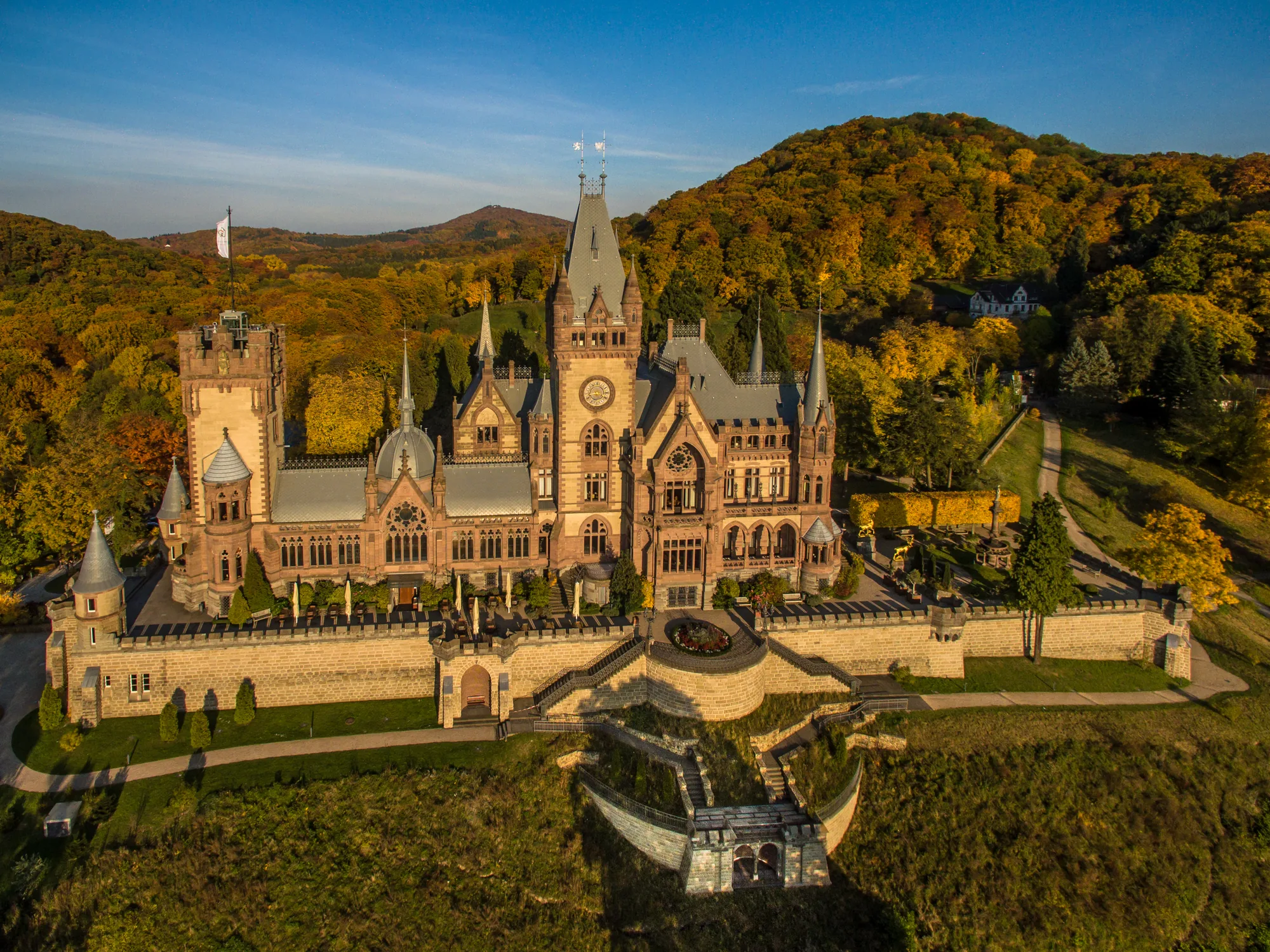
On the Drachenfels ridge above the Rhine, halfway up the slope between the ruined medieval fortress at the summit and the river town of Königswinter below, stands a castle that was built in two years and never lived in. Schloss Drachenburg is one of the great confections of 19th-century German Historicism, a neo-Gothic fantasy of towers, turrets, stained glass and painted mythology, conceived in 1882 by a self-made millionaire who wanted a visible statement of arrival and then, having built it, appears to have lost interest. It took a century, several catastrophic changes of ownership, and a major restoration project to bring the castle to the immaculate state in which visitors see it today.
Stephan Sarter was born in 1833, the son of a Cologne merchant, and made an enormous fortune as a stockbroker in Paris during the boom years of the Second Empire and the early Third Republic. He returned to Germany with his wealth, purchased the Drachenfels hillside, commissioned the architects Ludwig von Jacobi and Bernhard Tüshaus, and gave them an almost unlimited budget along with a single clear instruction: build fast. The result, completed in just two years, is a structure of around 80 rooms, three towers, a baronial great hall, stables, outbuildings and formal terraces descending the hillside. Sarter was finally ennobled in 1889, receiving the 'von' he had effectively built Drachenburg to deserve. He died in 1902, having used the castle for occasional visits but never as his primary residence — a fact that gives the whole project a faintly melancholic undertone, however spectacular the result.
The interior decoration of Drachenburg is the most elaborate of any 19th-century private castle in the Rhine region. The great hall contains an ambitious series of paintings illustrating German mythology and the Nibelungenlied, the medieval German epic that occupied roughly the same cultural position for Richard Wagner that the Arthurian legends occupied for Tennyson. The stained glass windows, designed by the Munich studio of Franz Xaver Zettler, rank among the finest examples of historicist stained glass anywhere in Germany. The woodcarving, decorative tiling and painted ceilings throughout the castle reflect the combined effort of dozens of craftsmen working simultaneously under Sarter's open-ended budget — a display of newly minted 19th-century industrial wealth marshalled entirely into the service of medieval fantasy.
Drachenburg sits on the Drachenfels, the Dragon's Rock, the single most famous point in the Mittelrhein landscape: a ridge rising 321 metres above the river, topped by the ruins of a 12th-century castle and traditionally identified as the site of the legendary dragon-slaying recounted in the Nibelungenlied. Lord Byron wrote about the Drachenfels in Childe Harold's Pilgrimage, and the hill has drawn tourists since the late 18th century. A rack railway, the Drachenfels Railway, opened in 1883 — the oldest of its kind in Germany — and still connects Königswinter to the summit, with a stop directly at Schloss Drachenburg. The combination of the ruined medieval fortress at the top, the neo-Gothic palace halfway up the slope, and the sweeping Rhine panorama visible from both levels makes this one of the most complete castle-landscape experiences anywhere in Germany.
After Sarter's death in 1902, Drachenburg passed through a sequence of owners who progressively stripped, damaged and neglected the building. During the Nazi period it served as a NAPOLA, a political training school for the regime's future elite; after 1945 it functioned as a school for the children of German emigrants. By the 1970s the castle had fallen into advanced decay, stripped of most of its portable contents and structurally compromised in several areas. The state of North Rhine-Westphalia purchased the property in 1989 and undertook a restoration that continued until 2010, at a cost exceeding €17 million. The clean, detailed interior visitors encounter today, largely re-furnished in period style, is the direct result of that two-decade project — a reminder of how close one of Germany's most distinctive 19th-century buildings came to being lost entirely.
History
Baron Stephan von Sarter, a self-made stockbroker who had built his fortune in Paris during the Second Empire, commissioned Schloss Drachenburg in 1882, engaging the architects Ludwig von Jacobi and Bernhard Tüshaus to design an elaborate neo-Gothic showcase on the Drachenfels ridge above the Rhine. Construction proceeded at remarkable speed, completing in just two years, though Sarter himself, ennobled only in 1889, used the finished castle relatively little before his death in 1902.
In the decades following Sarter's death, the castle passed through a series of owners and institutional uses, including service as a National Socialist political school during the Nazi era and, after the Second World War, as a school for the children of German emigrants, suffering progressive neglect and the loss of much of its original furnishing along the way. By the 1970s the building was in serious disrepair. The state of North Rhine-Westphalia acquired Drachenburg in 1989 and carried out an extensive restoration completed in 2010, returning the castle's interiors, including its painted mythological cycles and historicist stained glass, to public view in close to their original condition.
How to Visit
Getting there: From Bonn, take S-Bahn line S66 to Königswinter (20 minutes), then either the Drachenfels rack railway up to the Schloss Drachenburg stop (8 minutes, the oldest rack railway in Germany, opened 1883) or walk up Drachenfelsstraße (about 25 minutes).
Tickets: Direct castle entry costs €12 for adults; children are admitted free. The GetYourGuide day trip from Cologne combines Drachenburg with the Drachenfels summit ruins and includes all transport — practical for visitors without a car based in Cologne.
Practical tips: The rack railway stops directly at the castle and is more comfortable than the uphill walk in summer; buy a round-trip ticket in Königswinter and get off at the Schloss stop. The castle is closed Mondays and in winter (November–March) — confirm current hours at schloss-drachenburg.de before visiting.
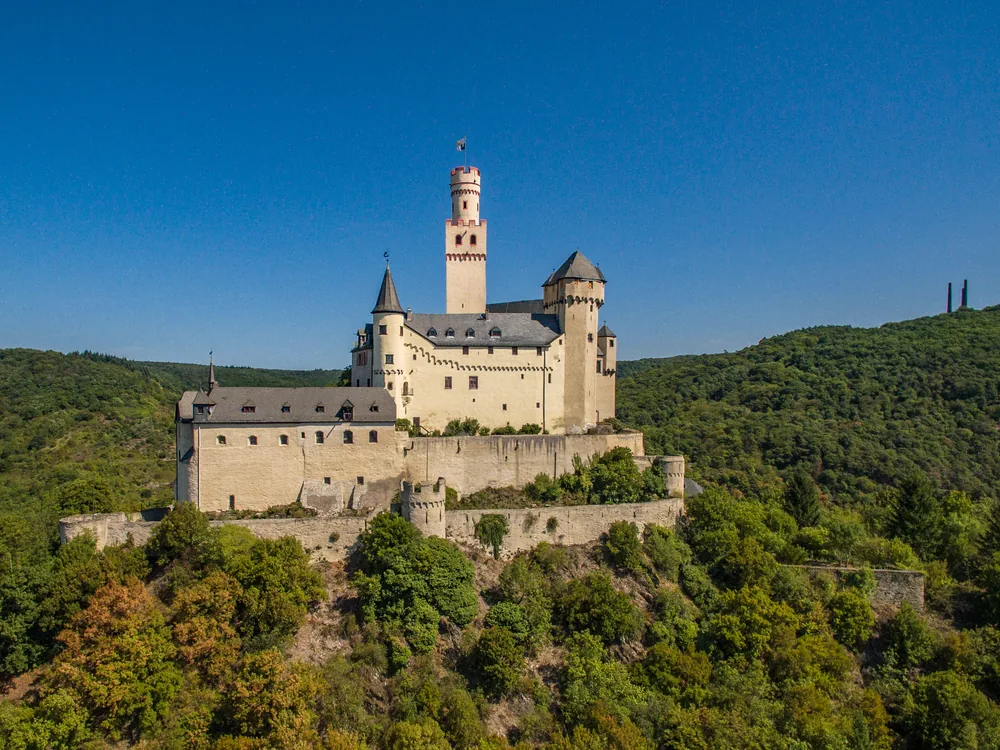
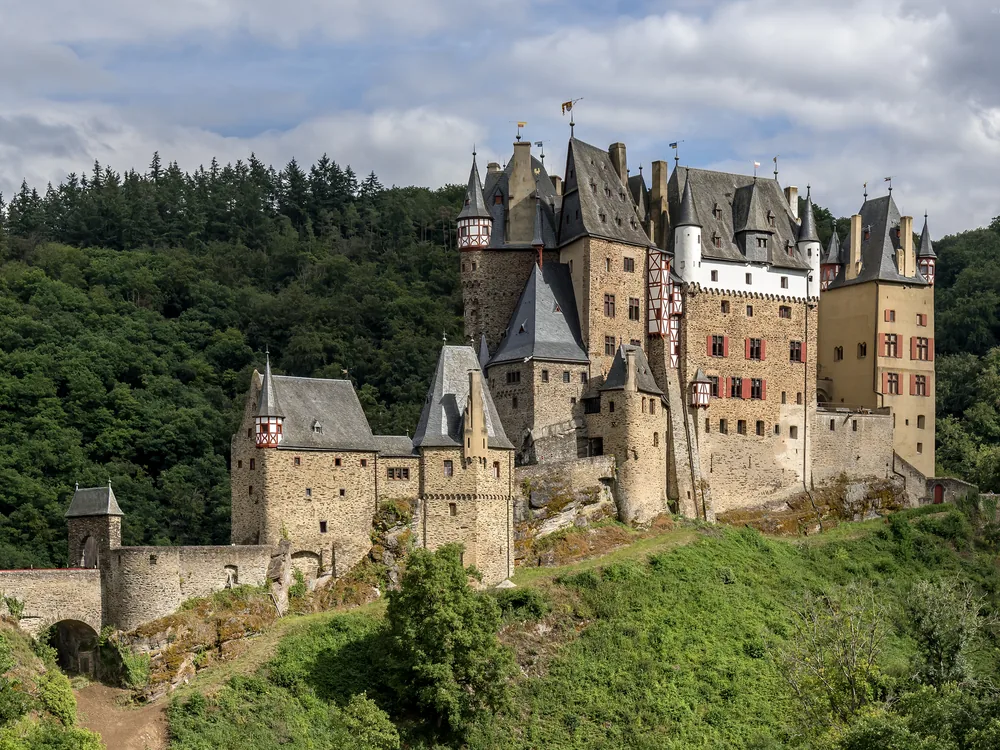
Combine with: Marksburg Castle and Eltz Castle are both on the Rhine–Moselle corridor — together they make a strong one-day Rhine Valley castle circuit.
Frequently Asked Questions
Not as a primary residence. Stephan von Sarter built Drachenburg between 1882 and 1884 as a showcase of his newly acquired wealth and, after his ennoblement in 1889, his new aristocratic status, but he used the finished castle mainly for occasional visits rather than as a permanent home. He died in 1902, and the building's subsequent history of neglect and institutional use meant it was rarely, if ever, lived in by any single owner in the way a traditional family seat would have been.
Location
Drachenfelsstraße 118, 53639 Königswinter, Germany
Nearby Castles
Tours & Tickets
Powered by GetYourGuide
From
€100/ person