
Rheinfels Castle
Hotel Schloss Rheinfels (Burg Rheinfels)
Germany · Rhineland-Palatinate — St. Goar, Rhine Gorge, opposite the Loreley rock · Near Koblenz
Built 1245 · Medieval fortress ruins, the largest on the Middle Rhine, with a later Art Nouveau villa and apartment house added on the same grounds
This page is part of an independent travel guide and is not affiliated with, endorsed by, or operated by Rheinfels Castle.
© Castles & Palaces
Quick Facts
- Rooms from
- €108 / night
- Duration
- Overnight stay; the fortress ruins are free to explore for hotel guests, separately ticketed for day visitors
- Best time
- April to October
- Nearest city
- Koblenz
Stay Here
Hotel Schloss Rheinfels
Rooms are split between the historic building and a newer wing
Booked via Booking.com · Free cancellation on most rates
Access to the real Rheinfels Castle ruins (one of the largest fortress ruins on the Middle Rhine) is free for hotel guests and separately ticketed for day visitors — see Highlights above
Highlights
- ✦The largest medieval fortress on the Middle Rhine, built in 1245, considered impregnable for 450 years until French forces razed it in 1794
- ✦One of the largest and best-preserved fortress ruins in the Rhine Gorge, opposite the Loreley rock
- ✦The hotel's 67 rooms are split across three separate structures: the historic castle building, an Art Nouveau villa (Villa Rheinfels), and an apartment house on the Gut Rheinfels grounds
- ✦Access to the extensive ruins — one of the region's most substantial castle sites — is included free for overnight guests
- ✦Set in the UNESCO-listed Upper Middle Rhine Valley
Stay in the castle itself
Book a room via Booking.com
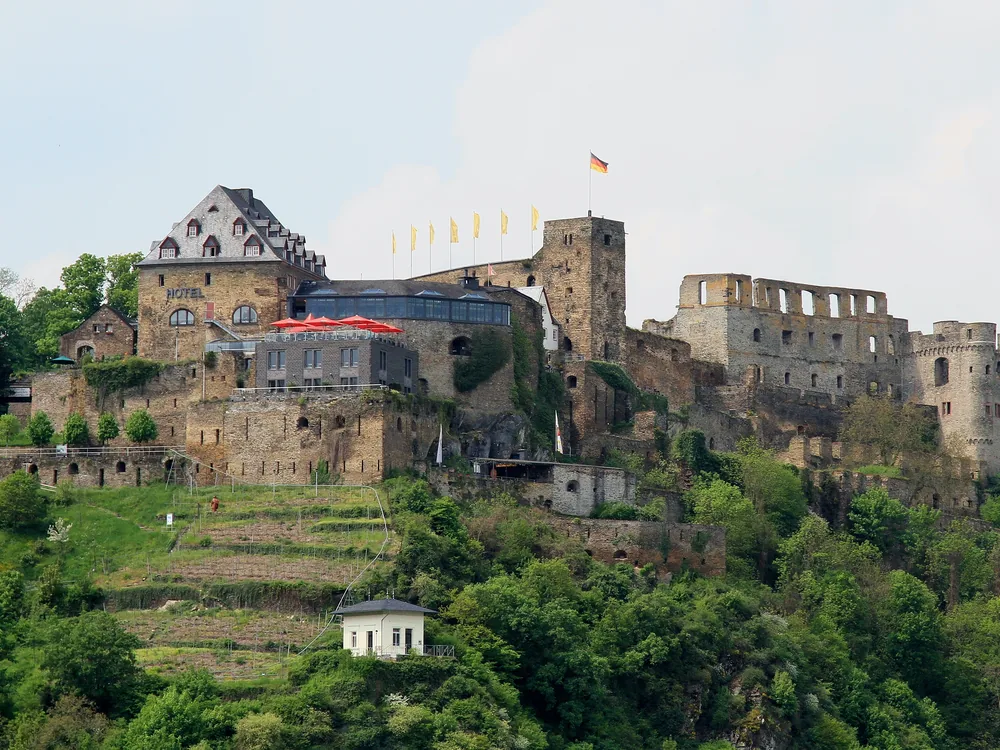
Rheinfels Castle, built in 1245, was the largest medieval fortress on the Middle Rhine and earned a reputation for near-invincibility that lasted roughly 450 years — surviving sieges that destroyed lesser Rhine strongholds. That long defensive record ended in 1794, when French revolutionary forces swept through the region and razed the fortress, leaving behind the extensive ruins that still dominate the hillside above St. Goar today, directly across the river from the famous Loreley rock.
Rather than being rebuilt as a single reconstructed building, Rheinfels today operates as a hotel spread across three distinct structures on the historic grounds: the ruined castle itself, an Art Nouveau villa (Villa Rheinfels) built later on the estate, and a separate apartment house at Gut Rheinfels. The 67 rooms across these three buildings give guests free access to explore one of the most substantial fortress ruins on the entire Rhine, a genuinely different experience from castle-hotels where the historic structure has been fully rebuilt into a conventional hotel building.
The scale of Rheinfels' surviving ruins sets it apart even among the Rhine Gorge's many castle sites: extensive underground passages, gun batteries and fortification walls remain explorable, giving visitors a far more immersive sense of a genuine medieval-to-early-modern fortress than the smaller ruins or fully rebuilt castles found elsewhere along the river. For day visitors not staying overnight, the ruins are separately ticketed, making Rheinfels one of the more substantial standalone visitor attractions among the castle-hotels covered in this collection.
The castle's position directly opposite the Loreley rock places it at one of the most photographed and mythologised points on the entire Rhine. The Loreley legend — a siren whose song lured sailors to their deaths on the rocks below — has drawn visitors and artists to this stretch of the gorge for centuries, and Rheinfels' hillside position gives hotel guests a direct, elevated view across the river to the rock itself.
The Upper Middle Rhine Valley's UNESCO World Heritage designation recognises exactly this combination found at Rheinfels: dramatic fortress ruins, terraced vineyards and a river landscape that together tell the story of centuries of trade, conflict and settlement along one of Europe's most strategically important waterways. Rheinfels' scale and survival as ruins, rather than a fully reconstructed building, make it one of the more historically legible sites within that wider UNESCO landscape.
St. Goar itself, the small Rhine town beneath the castle, retains much of its historic character and gives guests a walkable base for exploring both the ruins above and the riverfront below, including boat excursions that pass directly beneath the Loreley rock on the opposite bank.
The division of Rheinfels' guest accommodation across three separate historic and later buildings reflects the practical reality of operating a hotel within a genuine ruin: rather than compromising the fortress's authenticity with extensive new construction inside the ruins themselves, the hotel expanded into the Art Nouveau villa and the Gut Rheinfels apartment house nearby, preserving the ruins largely as they have stood since their 1794 destruction while still offering modern hotel accommodation on the same historic estate.
Among the surviving structures, visitors can explore extensive underground passages and gun batteries cut into the hillside, remnants of the fortress's defensive engineering that go well beyond the wall fragments and foundations typical of many smaller Rhine ruins. These passages give a genuinely tangible sense of the scale and sophistication of Rheinfels' original fortifications, built to withstand exactly the kind of prolonged siege warfare that eventually proved impossible to resist against Napoleonic-era artillery.
St. Goar's own riverfront, a short walk downhill from the ruins, offers boat excursions along this stretch of the Rhine Gorge, giving guests a complementary river-level perspective on the same landscape they survey from the fortress heights above — a useful pairing for visitors wanting both the historical and scenic dimensions of a Rhine Gorge stay in a single visit.
History
Rheinfels Castle was built in 1245 and became the largest medieval fortress on the Middle Rhine, considered impregnable for roughly 450 years until French revolutionary forces razed it in 1794. The extensive ruins that resulted still dominate the hillside above St. Goar, directly across the Rhine from the Loreley rock. Today the site operates as a hotel spread across three structures — the ruined castle, the Art Nouveau Villa Rheinfels, and an apartment house at Gut Rheinfels — with free ruins access for overnight guests, within the UNESCO-listed Upper Middle Rhine Valley.
How to Stay
Getting there: St. Goar, Rhineland-Palatinate, on the Rhine Gorge opposite the Loreley rock.
Rooms & rates: The 67 rooms are split across three separate buildings on the historic grounds: part of the ruined castle itself, the Art Nouveau Villa Rheinfels, and an apartment house at Gut Rheinfels. From €108/night.
On-site: Restaurant, gardens, free guest access to the fortress ruins.
Good to know: This is one of the more architecturally complex properties in the collection — ask specifically which of the three buildings a room is in if sleeping within the actual medieval ruins (rather than the villa or apartment house) is the priority.
Combine with: The Loreley rock and visitor centre, directly across the river.
Frequently Asked Questions
Yes — the extensive fortress ruins, among the largest on the Middle Rhine, are separately ticketed for day visitors. Overnight hotel guests receive free access as part of their stay.
Location
Schlossberg 47, 56329 St. Goar, Germany
Nearby Castles
Rooms from
€108/ night