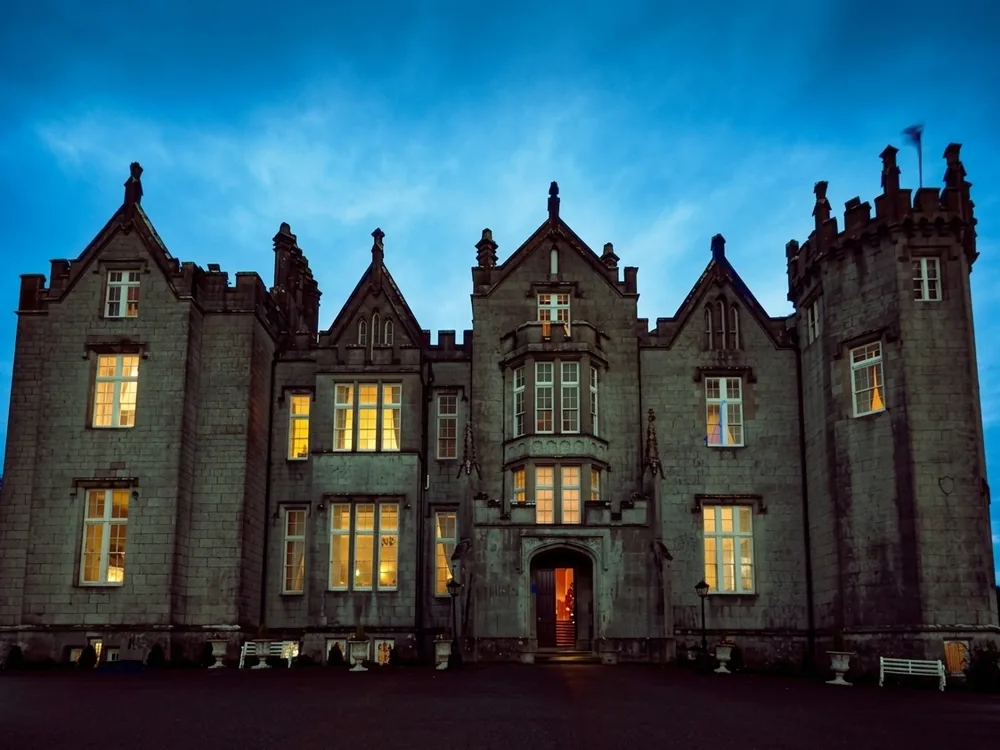
Kinnitty Castle
Caisleán Chionn Eitigh
Ireland · Kinnitty, County Offaly · Near Birr
Built 1630 · Gothic Revival castle expanded to its present form in 1811 by the architect brothers James and George Richard Pain, built on the site of a 1630 O'Carroll castle beside an Augustinian abbey
This page is part of an independent travel guide and is not affiliated with, endorsed by, or operated by Kinnitty Castle.
© Castles & Palaces
Quick Facts
- Rooms from
- €139 / night
- Hotel rating
- 4-Star Hotel
- Duration
- Overnight stay only — no day-visit access; the Kinnitty High Cross and abbey wall on the grounds are a separate historical point of interest
- Best time
- Year-round
- Nearest city
- Birr
Stay Here
Kinnitty Castle
4-Star HotelBooked via Booking.com · Free cancellation on most rates
Open to day visitors without booking a room — see How to Visit below.
Highlights
- ✦The site dates to the 5th century, with a druidic monastery followed by a Christian monastery in the 6th century; an Augustinian abbey was later established nearby during the Norman period, and its High Cross and abbey wall still stand on the estate
- ✦The Gaelic O'Carroll clan of Ely expelled the Normans; in 1630, William O'Carroll built a new castle beside the old abbey, confiscated by English forces in 1641
- ✦In 1664, the Crown granted the property to Colonel Thomas Winter; his descendants sold it to Thomas Bernard, who renamed it 'Castle Bernard.' In 1811, the architect brothers Pain expanded the castle to its present Gothic Revival form
- ✦Burned by republican forces in 1922 during the Irish Civil War, rebuilt in 1928; the Bernard family lived there until 1946
- ✦Today a 37-room hotel in the Slieve Bloom Mountains
Stay in the castle itself
Book a room via Booking.com
Kinnitty Castle sits within the Slieve Bloom Mountains of County Offaly, and its documented history reaches back further than almost any property in this collection, stretching into the very earliest centuries of recorded Irish religious life. The site is associated with a druidic monastery dating to the 5th century, predating Ireland's widespread Christianisation, followed by the establishment of a Christian monastery on the same ground in the 6th century — placing Kinnitty within the same broad continuity of pre-Christian and early Christian religious use found at many of Ireland's oldest sacred sites. During the later Norman period, an Augustinian abbey was established near this original monastic foundation, and remarkably, physical remnants of that medieval religious complex survive today directly on the estate grounds: a High Cross and a section of the abbey wall still stand, giving visitors a tangible connection to more than a thousand years of continuous religious use on this single piece of land.
The site's transition from religious foundation to fortified secular stronghold came under the Gaelic O'Carroll clan of Ely, who expelled the Normans from this territory and established their own control over the surrounding lands. In 1630, William O'Carroll built a new castle directly beside the old abbey, a construction that placed a fortified secular residence in immediate physical proximity to centuries of accumulated religious heritage. That O'Carroll castle's independence, however, was short-lived in historical terms: it was confiscated by English forces in 1641, part of the wider pattern of land seizure that swept across Ireland during the turbulent mid-17th century conflicts between Gaelic, Catholic and English Protestant interests.
The property passed through several hands following this confiscation. In 1664, the Crown granted Kinnitty to Colonel Thomas Winter, and his descendants eventually sold the estate to Thomas Bernard, who renamed the property 'Castle Bernard' — a rebranding that reflected the new owning family's identity, in keeping with a common pattern of Irish estates taking on the surname of whichever family currently held them. The castle achieved its present Gothic Revival architectural form in 1811, when the celebrated architect brothers James and George Richard Pain undertook a substantial expansion, transforming the building into the castellated silhouette that gives Kinnitty its striking appearance today, set dramatically against the backdrop of the Slieve Bloom Mountains.
Kinnitty's 20th-century history includes a genuinely dramatic episode connected to Ireland's fight for independence: the castle was burned by republican forces in 1922 during the Irish Civil War, part of the widespread pattern of attacks on 'Big House' estates associated with the Anglo-Irish landed class during this turbulent period of Irish state formation. The castle was rebuilt in 1928, restoring the property to habitable condition, and the Bernard family continued to live at Kinnitty until 1946, bringing their long tenure at the estate to a close in the mid-20th century.
Today Kinnitty Castle operates as a 37-room hotel, its Gothic Revival towers and turrets rising dramatically from the wooded grounds of the Slieve Bloom Mountains, one of Ireland's less-visited but genuinely scenic upland regions in the country's midlands. The surviving High Cross and abbey wall on the estate grounds remain a distinct point of historical interest separate from the hotel experience itself, offering guests the chance to walk among physical remnants of the site's much older religious history alongside their stay in the considerably more recent castle building.
For visitors interested in a single Irish estate carrying genuine continuity from a 5th-century druidic and monastic foundation through Gaelic clan control, Cromwellian-era confiscation, 19th-century Gothic architectural transformation, and a dramatic 20th-century burning and rebuilding, Kinnitty Castle offers one of the more historically layered stays found anywhere in this collection, set within a genuinely peaceful and scenic corner of Ireland's midlands.
The Slieve Bloom Mountains surrounding Kinnitty, though modest in elevation compared to Ireland's more famous mountain ranges further west and south, offer genuinely rewarding walking trails through blanket bog, forest and open upland terrain, giving guests staying at the castle a substantial outdoor recreation option immediately on their doorstep. This combination of deep historical layering and accessible natural scenery gives Kinnitty a well-rounded appeal for visitors seeking both cultural depth and outdoor activity during a stay in Ireland's often-overlooked midlands region.
History
Kinnitty's site dates to a 5th-century druidic monastery, followed by a Christian monastery in the 6th century and a later Augustinian abbey, whose High Cross and abbey wall survive on the grounds. The Gaelic O'Carroll clan expelled the Normans, and in 1630 William O'Carroll built a castle beside the old abbey, confiscated by English forces in 1641. In 1664 the Crown granted the property to Colonel Thomas Winter; his descendants sold it to Thomas Bernard, who renamed it Castle Bernard. In 1811, architect brothers James and George Richard Pain expanded the castle to its present Gothic Revival form. The castle was burned by republican forces in 1922 and rebuilt in 1928; the Bernard family lived there until 1946.
Frequently Asked Questions
A High Cross and a section of an Augustinian abbey wall survive on the estate grounds, remnants of a religious site whose history stretches back to a 5th-century druidic monastery followed by a 6th-century Christian monastery — a distinct point of historical interest separate from the current castle hotel.
Location
Kinnitty, Birr, Co. Offaly, R42 AY44, Ireland
Nearby Castles
Rooms from
€139/ night