
Alfonsino Castle
Castello Alfonsino (Forte a Mare)
Italy · Isola di Sant'Andrea, Brindisi, Puglia · Near Brindisi
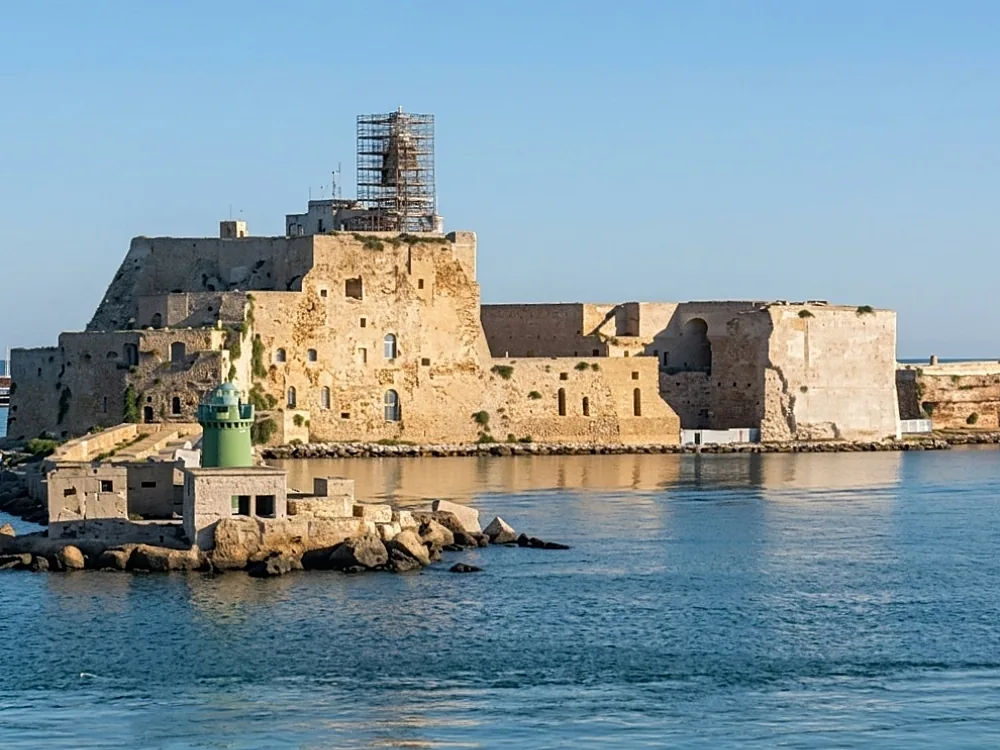
Built 1445 · 15th-century Aragonese coastal fortress with a distinctive triangular plan formed by two original towers (one cylindrical, one square) and a third polygonal tower added by Philip II of Spain, expanded in 1583 with a horn-shaped fortification
This page is part of an independent travel guide and is not affiliated with, endorsed by, or operated by Alfonsino Castle.
© Castles & Palaces
Quick Facts
- Hours
- Daily By guided tour departure only
- Guided tour from
- €37
- Duration
- Half-day, including round-trip transfer, castle tour and Brindisi audio guide
- Best time
- Spring through autumn, for comfortable outdoor transfer and walking conditions
- Booking
- Required — book 1+ days ahead
- Nearest city
- Brindisi
Featured Tour
Brindisi: Alfonsino Castle Transfer, Guided Tour & Audio Guide
Cancellation available · Instant confirmation
Highlights
- ✦Construction began in 1445, commissioned by Ferdinand I of Aragon for his son Alfonso, to fortify the entrance to the port of Brindisi and monitor naval traffic — giving the castle its name, 'Alfonsino'
- ✦Alfonso of Aragon expanded the fortress with an outer bastioned wall; its two original towers, one cylindrical and one square, were later joined by a third polygonal tower, giving the castle its distinctive triangular form
- ✦Feared enemies nicknamed it 'the red castle' for the colour its stone took on at sunset
- ✦In 1583, Philip II of Spain ordered a dramatic expansion, adding a horn-shaped fortification that wrapped around nearly the entire Isola di Sant'Andrea, turning it into a key military bastion of the Kingdom of Aragon and later Spain for defending the port
- ✦Located on its own island, the Isola di Sant'Andrea, and not accessible on foot from central Brindisi — the GetYourGuide tour (€37) includes round-trip air-conditioned transport, castle entry and guided tour, plus a Brindisi city audio guide
Skip the queue with a guided tour
Skip-the-line tickets & expert guides
Alfonsino Castle occupies its own small island, the Isola di Sant'Andrea, guarding the entrance to the harbour of Brindisi on Italy's Adriatic coast in Puglia. Construction began in 1445, commissioned by Ferdinand I of Aragon — then ruler of the Kingdom of Naples — for his son Alfonso, with the explicit military purpose of fortifying the port entrance and monitoring the naval traffic passing in and out of Brindisi's harbour, one of the most strategically valuable natural ports on Italy's eastern coast. The castle's name, Alfonsino, derives directly from Alfonso, the prince for whom it was built, and it carries the alternative names Forte a Mare ('sea fort') and simply 'the castle of the island' in local usage.
Alfonso of Aragon expanded his father's original fortress considerably, adding an outer bastioned wall to strengthen the castle's defensive perimeter. The fortress's distinctive architectural signature — a triangular plan unusual among coastal fortifications of this period — developed from the combination of two original towers, one cylindrical and one square, later joined by a third, polygonal tower. This triangular arrangement gave the castle a genuinely unusual silhouette compared to the more conventional square or rectangular coastal forts common elsewhere along the Italian peninsula's shorelines, and it became a recognisable landmark for anyone approaching Brindisi by sea.
The castle's reputation among its adversaries carried its own memorable nickname: enemies of Aragonese and later Spanish rule in the region feared and referred to Alfonsino as 'the red castle,' a name earned from the striking colour its stonework took on at sunset, when the fortress's walls would glow with a reddish hue visible from a considerable distance across the water — a detail that speaks both to the castle's imposing visual presence and to the genuine fear it inspired among those who found themselves on the wrong side of Aragonese naval power in this stretch of the Adriatic.
The castle's most dramatic transformation came more than a century after its initial construction, when in 1583 King Philip II of Spain — by then ruling over the Kingdom of Naples as part of the vast Spanish Habsburg empire — ordered a major expansion of the fortress. Philip's engineers designed a horn-shaped fortification that wrapped around nearly the entire Isola di Sant'Andrea, an ambitious engineering undertaking that transformed what had begun as a single fortified tower complex into a comprehensive island-wide military bastion. This expansion cemented Alfonsino Castle's role as one of the key military strongholds of the Kingdom of Aragon and subsequently the Spanish crown for the defence of Brindisi's harbour, a strategically vital Adriatic port that connected Spanish Mediterranean interests to the eastern approaches of the peninsula.
Visiting Alfonsino Castle today requires planning around its genuinely unusual access constraints: the fortress sits entirely on its own island and cannot be reached on foot from central Brindisi, meaning any visit necessarily depends on organised transport by boat or vehicle rather than an independent walking approach. The GetYourGuide tour reflects this reality directly, bundling round-trip transportation in an air-conditioned vehicle together with castle entry, a guided tour of the fortress itself, and an audio guide covering the wider city of Brindisi — a comprehensive package designed specifically around the practical challenge of reaching an island fortress that most visitors would otherwise struggle to access independently.
Brindisi itself, though less visited than Puglia's more famous towns such as Lecce or Ostuni, carries its own substantial historical weight as one of the most important ports of the ancient and medieval Mediterranean, the eastern terminus of the Roman Via Appia and a key departure point for Crusader fleets heading to the Holy Land in the medieval period. Alfonsino Castle's guardianship of the harbour approach places it directly within this longer story of Brindisi's strategic maritime importance, a role the fortress continued to serve, in successively expanded form, from its 15th-century Aragonese origins through the Spanish Habsburg period and beyond.
History
Alfonsino Castle was begun in 1445, commissioned by Ferdinand I of Aragon for his son Alfonso, to fortify the entrance to the port of Brindisi and monitor naval traffic. Alfonso of Aragon expanded the fortress with an outer bastioned wall, and its two original towers — one cylindrical, one square — were later joined by a third, polygonal tower, giving the castle its distinctive triangular plan. In 1583, Philip II of Spain ordered a major expansion, adding a horn-shaped fortification that wrapped around nearly the entire Isola di Sant'Andrea, turning the castle into a key military bastion of the Kingdom of Aragon and Spain for the defence of Brindisi's harbour.
Frequently Asked Questions
Enemies of Aragonese and Spanish rule in the region feared and nicknamed the fortress 'the red castle,' a name earned from the reddish colour its stonework took on at sunset, visible from a considerable distance across the water approaching Brindisi's harbour.
Location
Isola di Sant'Andrea, 72100 Brindisi BR, Italy
Nearby Castles
Tours & Tickets
Powered by GetYourGuide
From
€37/ person