
Bruneck Castle
Castel Brunico
Italy · South Tyrol, Puster Valley — Brunico/Bruneck · Near Brunico (Bruneck)
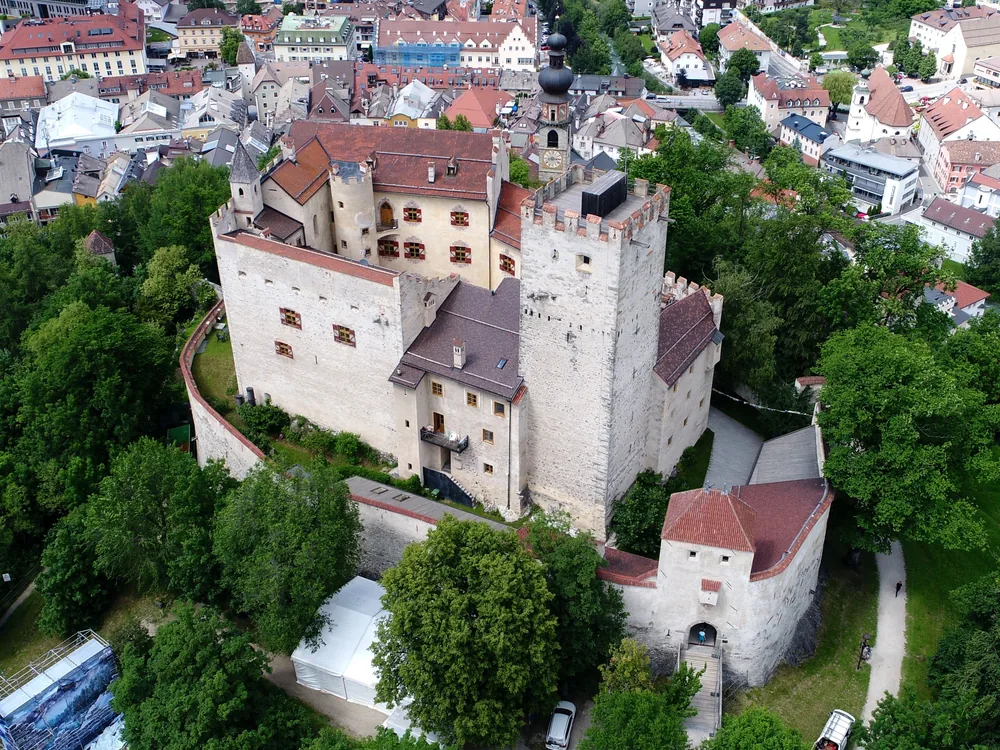
Built 1250 · Medieval episcopal fortress adapted as a cultural museum — built in the 1250s under Bishop Bruno von Kirchberg of Brixen as a summer residence and defensive stronghold for the prince-bishops who governed the Brixen diocese; the castle occupies a rocky spur above the medieval town of Brunico, commanding the confluence of the Rienza and the secondary valleys of the Puster; the original 13th-century construction established the main tower and residential wing in the compact style characteristic of South Tyrolean episcopal fortifications; successive bishop-administrators added and modified the residential quarters through the 14th and 15th centuries; the castle passed to Habsburg and later Italian administration after the end of the ecclesiastical prince-bishop system; since 2011 it has housed the Messner Mountain Museum Ripa, one of six museums in Reinhold Messner's MMM network, with contemporary exhibition spaces fitted within the medieval fabric
This page is part of an independent travel guide and is not affiliated with, endorsed by, or operated by Bruneck Castle.
© Castles & Palaces
Quick Facts
- Hours
- Tue–Sun 10:00–18:00. Closed Mon
- Entry via GetYourGuide
- €14
- Duration
- 1.5–2 hours (Messner Mountain Museum Ripa)
- Best time
- May to October
- Nearest city
- Brunico (Bruneck)
Featured Tour
Brunico: Messner Mountain Museum Ripa Entry Ticket
Cancellation available · Instant confirmation
Highlights
- ✦Messner Mountain Museum Ripa — one of six museums in Reinhold Messner's MMM network, Ripa (Tibetan for 'mountain man') is dedicated to the cultures and daily lives of mountain peoples from Asia, Africa, South America, and Europe; the permanent collection presents textile traditions, agricultural practices, religious objects, and photographic documentation from mountain communities on every inhabited continent, set within the rooms of the medieval castle
- ✦The castle that named a city — Bishop Bruno von Kirchberg of Brixen built the fortress in the 1250s and simultaneously founded the market town that grew up in its shadow; the town Brunico/Bruneck takes its name directly from Bishop Bruno; the castle and the town it generated have been inseparable for 770 years
- ✦Reinhold Messner: the man who built this museum — Messner (b. 1944, South Tyrol) is the first person to climb all 14 eight-thousanders (peaks above 8,000m), including the first solo ascent of Everest without supplemental oxygen (1980); his decision to create a network of museums in South Tyrolean castles, each focused on a different dimension of mountain culture, turned Bruneck Castle and five other fortresses into living institutions of mountain heritage
- ✦The view from the castle: Kronplatz and the Zillertal Alps — the castle's position on its spur above Brunico gives unobstructed views over the Puster Valley and toward the Kronplatz ski area and the Zillertal Alps to the north; the view is the same one the prince-bishops of Brixen chose as their summer residence outlook and that Messner's museum frames deliberately as the backdrop for exhibits on mountain peoples
- ✦The second Messner Mountain Museum in South Tyrol — the companion to already-published Sigmundskron Castle in Bolzano, which houses MMM Firmian (the flagship museum in the network, focused on Messner's personal mountaineering history and the mythology of the high peaks); the two museums are 75km apart in the same region and designed as complementary experiences in the same network
- ✦GetYourGuide Brunico: Messner Mountain Museum Ripa Entry Ticket — confirmed genuine interior castle access; the GetYourGuide ticket IS the museum entry admission
Tickets & tours
Book through GetYourGuide
The town of Brunico takes its name from Bishop Bruno von Kirchberg of Brixen, who founded both the castle and the market settlement beneath it in the 1250s. This is not a common relationship — most medieval castles predated or were independent of the towns that grew around them — but in Brunico's case the foundation was simultaneous and deliberate: the bishop built the fortress to control the Puster Valley crossing and immediately established the market town in the castle's shadow to generate revenue and population. Castle and town have been inseparable for seven and a half centuries, and Brunico/Bruneck's compact medieval centre, still organized around the main street that leads from the lower gate toward the castle spur, is the most legible surviving evidence of how a prince-bishop planned a settlement from scratch in 13th-century South Tyrol.
The prince-bishops of Brixen were secular rulers as well as ecclesiastical ones — a standard arrangement in medieval Central Europe, where dioceses functioned as territorial principalities within the Holy Roman Empire, the bishop governing as a prince with legal, administrative, and military authority over his diocese. The Brixen diocese in the Eisack and Puster valleys of South Tyrol was a substantial principality, and Bruneck Castle served as the bishops' summer residence and defensive stronghold — the cool valley altitude and the commanding position above the Rienza river junction made it a preferable summer seat to the hotter lowlands of Brixen itself. The castle's 13th-century construction established the main tower and residential wing; successive bishops modified and extended the residential quarters through the 14th and 15th centuries as the complexity of administering a prince-bishop's court increased.
The secular authority of the Brixen prince-bishops declined in the 18th and 19th centuries under Habsburg centralization — the Josephine reforms of the 1780s stripped the ecclesiastical territories of many of their administrative functions — and Bruneck Castle eventually passed entirely to civil administration before entering a long period without a clear institutional use. The castle that had housed seven centuries of episcopal administration stood on its spur above the town, visible from every direction, without a function proportionate to its presence.
The solution arrived in 2011, when the castle was opened as the Messner Mountain Museum Ripa — the fifth of the six museums that the South Tyrolean mountaineer Reinhold Messner has established across the region. Messner (born 1944 in Brixen itself, South Tyrol) is the defining figure of modern high-altitude mountaineering: the first person to climb all 14 eight-thousanders (the 14 peaks above 8,000 metres), the first to complete the Himalayan 14 without supplemental oxygen, and the first to summit Everest solo and without supplemental oxygen in 1980. His decision in the 1990s to create a network of mountain museums in South Tyrolean castles transformed six neglected historic structures — Sigmundskron, Juval, Dolomites, Ortles, Firmian, and Ripa — into a coherent institutional network devoted to different aspects of mountain culture.
Ripa takes its name from the Tibetan word for 'mountain man' and its subject matter from the broadest possible definition of mountain peoples. Where the flagship MMM Firmian at Sigmundskron focuses on Messner's personal mountaineering history and the mythology of the extreme high peaks, Ripa focuses on the cultures and daily lives of the people who have always lived in mountain environments — Tibetan communities, Ethiopian highland societies, Bolivian and Peruvian Andean cultures, and the mountain peoples of Europe including South Tyrol itself. The permanent collection presents textile traditions, agricultural implements, religious objects, photographic documentation, and ethnographic material from mountain communities on every inhabited continent. The curatorial approach treats mountain environments as a category of human habitat with recognizable cross-cultural characteristics — the specific challenges of altitude, cold, isolation, and terrain producing similar adaptive responses in communities separated by thousands of kilometres — rather than treating each mountain culture in isolation.
The medieval rooms of Bruneck Castle provide the setting for contemporary exhibition design without imposing a false thematic connection: the castle was built by the mountain people of South Tyrol to govern their mountain valley, and its rooms house a museum about mountain peoples globally. The connection is real rather than decorative. The views from the castle's position above the town — north toward the Kronplatz ski plateau and the Zillertal Alps, east down the Puster Valley toward Austria — are the same views the prince-bishops of Brixen chose as their summer outlook and that Messner's museum frames deliberately as the landscape backdrop for a collection about human relationships with mountains.
[Sigmundskron Castle in Bolzano](/castles/italy/sigmundskron-castle), 75 kilometres southwest in the Adige valley, houses MMM Firmian — the flagship of the Messner Mountain Museum network, focused on Messner's own mountaineering career and the mythology of the highest peaks; visiting both Firmian and Ripa gives the most complete picture of what Messner has built across South Tyrol's historic castle stock.
History
1250s: Bishop Bruno von Kirchberg of Brixen builds the castle and simultaneously founds the market town of Brunico (Bruneck) beneath it; the town's name derives directly from the bishop's name. 13th–15th century: Castle serves as summer residence and administrative stronghold for the prince-bishops of Brixen; successive bishops extend and modify the residential wings. 16th–17th century: Prince-bishops continue to govern from Bruneck and Brixen; Habsburg imperial pressure on diocesan territories begins. 18th century: Josephine reforms under Habsburg centralization reduce the secular authority of the Brixen prince-bishop. 19th–20th century: Castle passes to civil administration; long period without a primary institutional use. 2011: Reinhold Messner opens the Messner Mountain Museum Ripa in the castle — the fifth of six MMM museums in South Tyrol; the museum is dedicated to the cultures of mountain peoples worldwide. Present day: Open mid-March to mid-November; one of the primary cultural attractions in the Puster Valley.
How to Visit
Getting there: Bruneck/Brunico is in the Puster Valley of South Tyrol, accessible by train from Bolzano (approximately 1.5 hours) or Innsbruck (approximately 1.5 hours). The castle spur is a 10-minute uphill walk from the town centre.
Tickets: Entry to the Messner Mountain Museum Ripa costs approximately €14 per adult on-site. The GetYourGuide entry ticket is the museum admission and gives self-guided access to the full permanent collection; no guided tour is bundled. Open mid-March to mid-November, Tuesday–Sunday — confirm current hours at messner-mountain-museum.it.
Practical tips: Allow 1.5–2 hours for a thorough visit. The museum is densely curated across compact medieval rooms; work through the collection systematically rather than rushing. The views from the castle spur over the Puster Valley and toward the Kronplatz are worth pausing at between exhibition spaces.
Combine with: Sigmundskron Castle in Bolzano (75km southwest) houses MMM Firmian, the flagship of the Messner Mountain Museum network — visiting both gives the fullest picture of what Messner has built across South Tyrol's historic castles.
Frequently Asked Questions
The Messner Mountain Museum (MMM) is a network of six museums created by mountaineer Reinhold Messner and distributed across six historic castles and sites in South Tyrol and the Dolomites. Each museum addresses a different aspect of mountain culture: MMM Firmian at Sigmundskron (Bolzano) focuses on Messner's own career and the mythology of the high peaks; MMM Ripa at Bruneck Castle covers the cultures of mountain peoples worldwide; MMM Juval at Juval Castle covers shamanism and mountain mythology; MMM Dolomites in the Dolomites massif covers rock climbing and the history of the Dolomites; MMM Ortles in Sulden covers ice and the cryosphere; and MMM Corones at Plan de Corones covers altitude and the human experience of high mountains. The network opened progressively between 2002 and 2015 and collectively makes South Tyrol's castle stock one of the most intentionally programmed museum landscapes in Italy.
Location
Castel Brunico, Via del Castello 1, 39031 Brunico BZ, Italy
Nearby Castles
Tours & Tickets
Powered by GetYourGuide
From
€14/ person