
Castel Juval
Castel Juval / Schloss Juval
Italy · South Tyrol (Alto Adige), Vinschgau · Near Merano
Built 1278 · Medieval hilltop castle; first documented 1278; expanded through the 14th–15th centuries by the Counts of Tyrol; residential tower (Bergfried), chapel, and courtyard wings surviving from the medieval period; restored and adapted from 1983 by Reinhold Messner as a private residence and museum; the Messner Mountain Museum Juval occupies the renovated castle buildings
This page is part of an independent travel guide and is not affiliated with, endorsed by, or operated by Castel Juval.
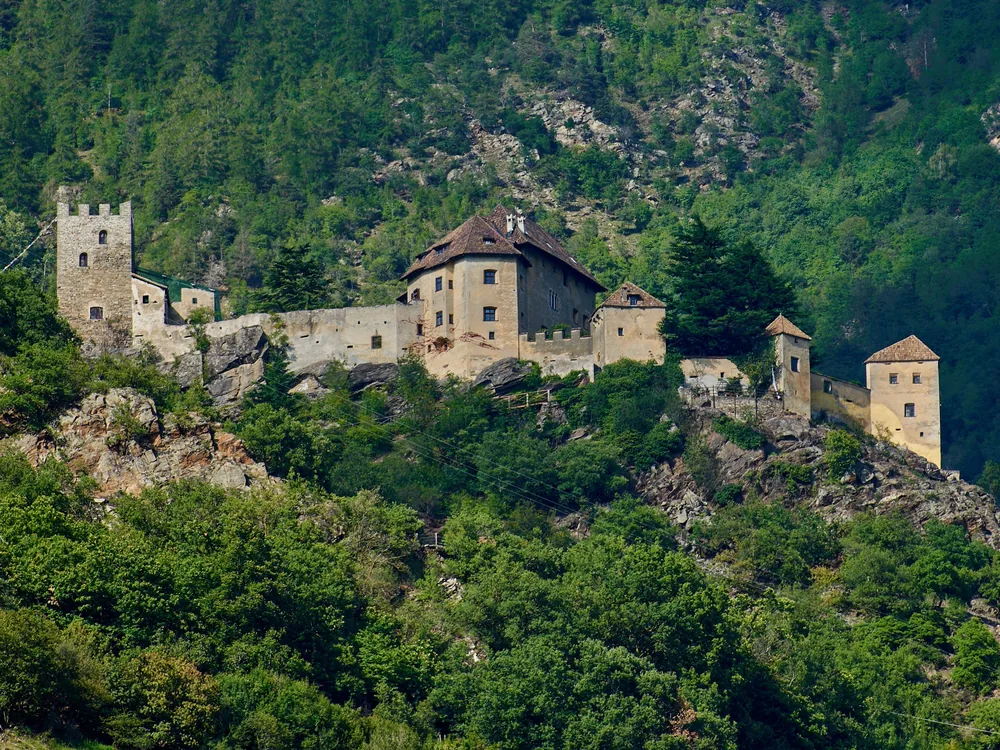
© Castles & Palaces
Quick Facts
- Hours
- Tue–Sat 10:00–16:00. Closed Mon, Sun
- Entry via GYG
- €14
- Duration
- 2–3 hours (including the walk up and museum visit)
- Best time
- May to September
- Nearest city
- Merano
Featured Tour
Castel Juval: Messner Mountain Museum Juval Entry Ticket
Cancellation available · Instant confirmation
Highlights
- ✦Messner Mountain Museum Juval — one of six MMM locations, this one dedicated to Messner's personal collection of Tibetan and Himalayan religious art: thangkas, bronze Buddhas, masks, and ritual objects acquired during 50 years of high-altitude expeditions
- ✦Reinhold Messner's private residence — the castle is the working home of the greatest mountaineer in history (first to summit all 14 eight-thousanders); the museum occupies the castle's historic rooms while Messner lives in a private section
- ✦The walk up through the estate — 30–45 minutes on foot through organic apple orchards and Messner's own Juval wine estate, one of the highest commercial vineyards in South Tyrol
- ✦Medieval tower and chapel — the 13th-century residential tower and a small chapel with Romanesque and Gothic elements survive from the original castle; the chapel contains medieval frescoes
- ✦Panoramic Vinschgau views — the castle looks south down the Vinschgau valley toward Merano and north toward the main Ötztal Alps ridge; on clear days the summit of Similaun (3,606 m) — where the Ötzi glacier mummy was found in 1991 — is visible
Skip the queue with a guided tour
Skip-the-line tickets & expert guides
Castel Juval is a medieval hilltop castle in the Vinschgau (Val Venosta) valley of South Tyrol — a narrow Alpine valley stretching west from Merano toward the Swiss and Austrian borders. The castle was first documented in 1278 as a possession of the Counts of Tyrol, and passed through various noble families through the medieval period. After centuries of agricultural use and partial neglect, it was acquired in 1983 by Reinhold Messner — the South Tyrolean mountaineer who became the first person to climb all 14 eight-thousand-metre peaks in the Himalayas and Karakoram, and the first to summit Everest without supplemental oxygen.
Messner's restoration transformed Juval into his private residence and one of six Messner Mountain Museum (MMM) locations distributed across South Tyrol. The MMM Juval houses his personal collection of Tibetan and Himalayan religious art and ethnographic objects — thangkas (Tibetan painted scrolls), bronze Buddha figures, wooden masks, ritual implements, and cultural objects accumulated during five decades of expeditions to the great ranges of Asia. The collection is presented in the castle's medieval rooms with a deliberate aesthetic: the objects are displayed in the context of their spiritual and cultural origins, not as trophies of Western adventure.
The access to the castle is itself part of the experience: no private vehicles are permitted on the castle road. Visitors park in the valley and walk for 30–45 minutes uphill through the estate's organic apple orchards and Juval wine estate, or take the horse-drawn carriage service. The isolation — intended — gives the castle a quality of arrival that purpose-built museums cannot replicate.
History
The Vinschgau valley was one of the most important north-south transit routes through the Alps in the medieval period — the route across the Reschen Pass (Reschenpass) connecting the Po plain with the Inn valley and the German-speaking world. The hilltop position of Castel Juval above this route gave it obvious strategic value; the Counts of Tyrol built a chain of observation and toll castles along the Vinschgau, of which Juval was one.
After the Counts of Tyrol's line died out in 1363 and their territories passed to the Habsburgs, Juval continued as a minor noble residence and administrative centre for the surrounding estate lands. The connection between the castle and the agricultural estate — apple orchards, vineyards, and alpine pasture — that characterises South Tyrolean castle ownership persists to the present day: Messner's Juval estate produces organic apples and wine under the Juval label.
South Tyrol's cultural history gives the castle a particular complexity: the Vinschgau is predominantly German-speaking (the village is called Juval in Italian and German alike), and the region was Austrian territory until 1919, when it was annexed by Italy after World War I. The tensions between Italian and German-speaking communities in South Tyrol persisted through the 20th century and are still politically active today. Messner himself is a German-speaking South Tyrolean who has been publicly critical of Italian cultural policies in the region.
How to Visit
Getting there: Castelbello-Ciardes is 30km west of Merano on the SS38 Val Venosta road. By train: the Vinschgau railway (Vinschgaubahn) runs from Merano to Mals via Castelbello — alight at Kastelbell station (about 10 minutes' walk from the valley car park). Merano is connected to Bolzano by train (1 hour).
Tickets: Entry costs €14 for adults (children €7); the GYG entry ticket (t985057, from €14, 4.8★/5 reviews) covers all museum rooms — the Tibetan and Himalayan collection, the medieval chapel with its frescoes, the residential tower, and the courtyard. A free museum app serves as the audio guide.
Practical tips: No private vehicles are permitted beyond the valley car park — walk uphill for 30–45 minutes through the estate's orchards and vineyards, or take the seasonal horse-drawn carriage (paid). Good footwear is required. Open Easter to early November, Tuesday–Saturday only; closed in winter and on Sundays and Mondays.
Combine with: [Castel Tirolo](/castles/italy/castel-tirolo) above Merano — the ancestral seat of the Counts of Tyrol — makes a natural pairing for a day of medieval South Tyrolean castles in the Merano and Val Venosta area.
Frequently Asked Questions
Reinhold Messner (born 1944) is widely considered the greatest mountaineer in history. Born in Brixen (Bressanone), South Tyrol, he became in 1978 the first person to summit Mount Everest without supplemental oxygen (with Peter Habeler). Between 1970 and 1986 he became the first person to climb all 14 eight-thousanders (peaks above 8,000 metres) — a record that stood as the definitive achievement in high-altitude mountaineering. He also completed solo traversals of Antarctica and Greenland and a crossing of the Gobi desert. Since retiring from active climbing, he has served as a member of the European Parliament (1999–2004) and founded the Messner Mountain Museum network across six South Tyrolean locations.
Location
Juval 1c, 39020 Castelbello-Ciardes BZ, Italy
Tours & Tickets
Powered by GetYourGuide
From
€14/ person