
Montesarchio Castle
Castello di Montesarchio
Italy · Campania — Province of Benevento (Caudine Valley) · Near Benevento
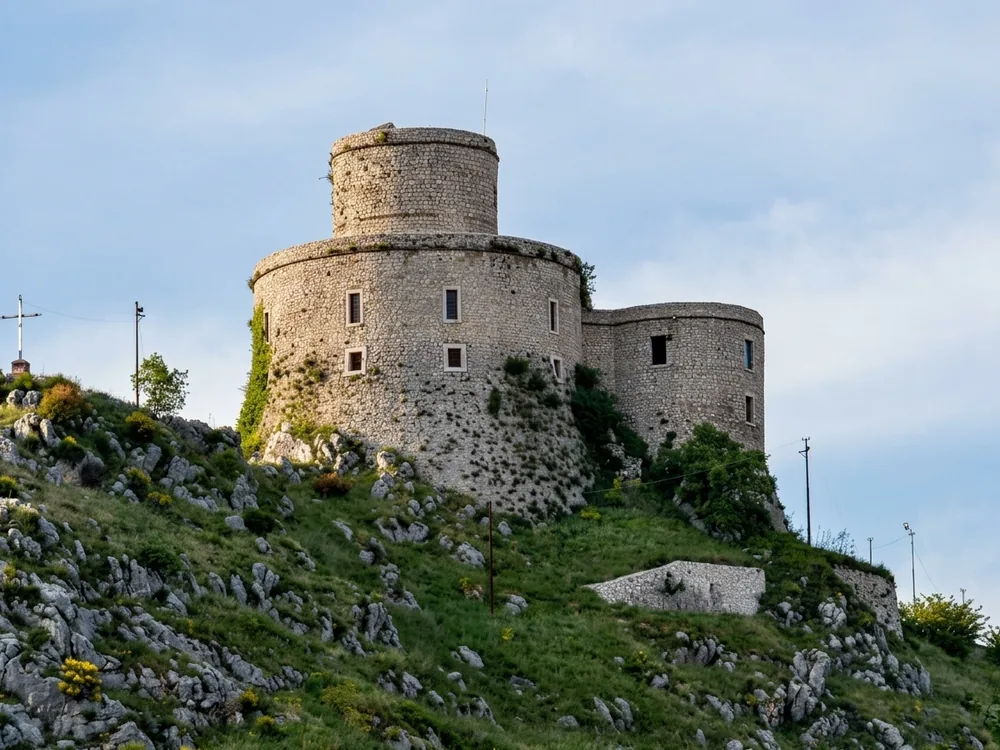
Probable Lombard-era origins; present form largely Aragonese, 15th century · A castle on a rocky spur above Montesarchio, probably of Lombard-era origin, taken by the Normans in 1137 and substantially rebuilt under Aragonese rule in the 15th century: two buildings around a central courtyard and a cylindrical tower
This page is part of an independent travel guide and is not affiliated with, endorsed by, or operated by Montesarchio Castle.
© Castles & Palaces
Quick Facts
- Guided tour from
- €72
- Duration
- 2 hours, guided walking tour
- Best time
- Year-round
- Nearest city
- Benevento
Featured Tour
Montesarchio: Guided Walking Tour with the Castle and the Crater of Assteas
Cancellation available · Instant confirmation
Highlights
- ✦Probable Lombard-era origins; taken by the Normans in 1137
- ✦Rebuilt into its present form largely under Aragonese rule in the 15th century, with two buildings around a central courtyard and a cylindrical tower
- ✦Granted to Alfonso II d'Avalos, Marquis of Vasto, in 1532
- ✦Used as a state prison from 1830 (with works carried out 1852–55), holding Risorgimento patriots including Carlo Poerio, Sigismondo Castromediano, Michele Pironti and Nicola Nisco
- ✦Since 2007, home to the Museo Archeologico del Sannio Caudino, including a krater by the painter Assteas (360–330 BC) looted in 1974 and returned to Italy in 2007
Skip the queue with a guided tour
Skip-the-line tickets & expert guides
Montesarchio Castle sits on a rocky spur above the town of the same name, in the Caudine Valley of Campania's Benevento province — a defensive position that has been fought over, rebuilt and repurposed across more than a thousand years. The castle's origins are probably Lombard, though the earliest phase is not precisely documented; what is firmly recorded is its capture by the Normans in 1137, bringing it within the orbit of the Kingdom of Sicily's new rulers.
The structure visitors see today, though, is largely the product of a later rebuilding under Aragonese rule in the 15th century: two buildings arranged around a central courtyard, anchored by a cylindrical tower, replaced whatever earlier medieval fabric had stood on the site. In 1532, the castle was granted to Alfonso II d'Avalos, Marquis of Vasto, a notable figure in 16th-century Habsburg Italy, tying the fortress into the wider politics of Spanish rule over southern Italy.
The castle's modern history takes a considerably darker turn. From 1830, it served as a state prison, with building works carried out between 1852 and 1855 to adapt it for that purpose. Montesarchio became one of the places where the Kingdom of the Two Sicilies held political prisoners during the Risorgimento, the movement for Italian unification — among those imprisoned here were Carlo Poerio, Sigismondo Castromediano, Michele Pironti and Nicola Nisco, names associated with the broader struggle against Bourbon rule. The prison function continued through to the Second World War, and the castle later served as an orphanage during the 1960s, before its eventual conversion to cultural use.
Since 2007, the castle has housed the Museo Archeologico del Sannio Caudino, displaying archaeological finds from the ancient settlements of Caudium, Saticula and Telesia. Its best-known single object is a krater attributed to the painter Assteas, active in Paestum between about 360 and 330 BC, depicting the Rape of Europa — a dating and attribution confirmed by Italy's Ministry of Culture. The krater was stolen and later returned to Italy in 2007, following an investigation by the Carabinieri's Cultural Heritage Protection Unit.
The standard visit is a two-hour guided walking tour combining the old town of Montesarchio with the castle and its museum, offered in English, French or Italian. GetYourGuide's own inclusions text for this listing mischaracterises part of the route as covering "the city of Benevento" — that appears to be an error on the supplier's side, since the tour is centred on Montesarchio itself, not the separate city of Benevento several kilometres away. Whether the museum's own entry ticket is bundled into the tour price isn't clearly stated on the listing, so it's worth confirming what's included at the time of booking.
History
Montesarchio Castle's origins are probably Lombard, and it was taken by the Normans in 1137. Its present form dates largely to a 15th-century Aragonese rebuilding. In 1532, the castle was granted to Alfonso II d'Avalos, Marquis of Vasto. From 1830 it served as a state prison, with building works in 1852–55, holding Risorgimento patriots including Carlo Poerio, Sigismondo Castromediano, Michele Pironti and Nicola Nisco; the prison function lasted until the Second World War, after which the castle served as an orphanage in the 1960s. Since 2007, it has housed the Museo Archeologico del Sannio Caudino, whose collection includes a krater by the painter Assteas (360–330 BC), looted in 1974 and returned to Italy in 2007.
How to Visit
What this is: A two-hour guided walking tour combining Montesarchio's old town with the castle and its archaeological museum — not a Benevento city tour, despite wording on some versions of the listing.
Tickets: It isn't clearly stated whether the museum's own entry ticket is included in the tour price — check what's included when booking.
Practical tips: Guides are available in English, French or Italian.
Frequently Asked Questions
Since 2007, the castle has housed the Museo Archeologico del Sannio Caudino, with archaeological finds from the ancient settlements of Caudium, Saticula and Telesia. Its best-known piece is a krater by the painter Assteas (about 360–330 BC) depicting the Rape of Europa.
Location
Nearby Castles
Tours & Tickets
Powered by GetYourGuide
From
€72/ person