
Ruthin Castle
Wales · Denbighshire — North Wales · Near Wrexham
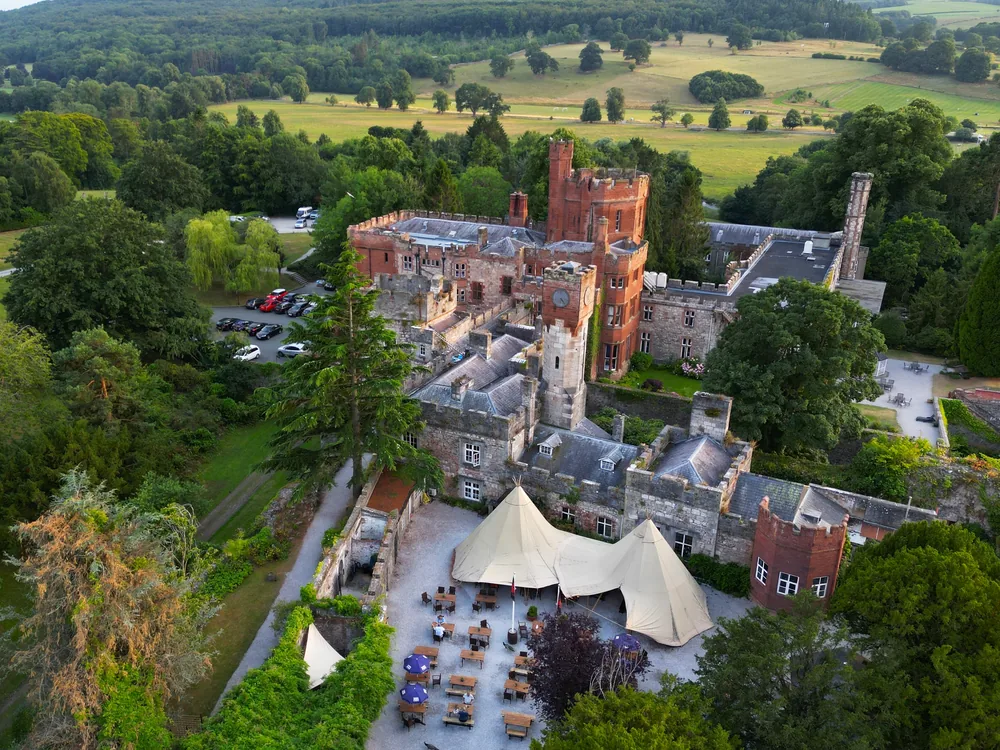
Built 1277 · Edwardian border castle begun in 1277 as part of Edward I's ring of fortifications, largely demolished after the Civil War and rebuilt as a Grade I listed country house in the 19th century
This page is part of an independent travel guide and is not affiliated with, endorsed by, or operated by Ruthin Castle.
© Castles & Palaces
Quick Facts
- Rooms from
- £77 / night
- Hotel rating
- 4-Star Hotel
- Duration
- Afternoon tea: 1–2 hours, served daily; overnight stay separately bookable
- Best time
- Year-round
- Nearest city
- Wrexham
Stay Here
Ruthin Castle Hotel and Spa
4-Star HotelBooked via Booking.com · Free cancellation on most rates
Open to day visitors without booking a room — see How to Visit below.
Highlights
- ✦Begun in 1277 by Edward I as part of his programme of border castles, alongside Flint and Rhuddlan
- ✦Passed in 1282 to Reginald de Grey, a Marcher Lord traditionally identified with the 'Sheriff of Nottingham' of Robin Hood legend; the De Grey family held it for 226 years
- ✦A land dispute between the 3rd Baron de Grey and Owain Glyndŵr triggered the Welsh uprising against Henry IV in 1400; Glyndŵr burned Ruthin to the ground, leaving only the castle standing
- ✦Survived an 11-week siege during the English Civil War in 1646, after which Parliament ordered its partial demolition
- ✦Rebuilt in the 19th century as a country house, home to the Cornwallis-West family — prominent Victorian and Edwardian society figures — from 1826 to 1921; later a private hospital through the 1920s to 1950, then a hotel from the 1960s
Stay in the castle itself
Book a room via Booking.com
Ruthin Castle stands in Denbighshire in North Wales, and its origins place it directly within Edward I's ambitious 13th-century campaign to secure English control over Wales through a coordinated network of border fortresses. Building began in 1277, part of the same programme of castle construction that produced Flint and Rhuddlan, a systematic effort to project royal authority into contested Welsh territory following Edward's military campaigns. The castle passed in 1282 to Reginald de Grey, a Marcher Lord — one of the powerful noble families granted extensive authority along the Anglo-Welsh border in exchange for maintaining royal control — and tradition holds that de Grey is the historical figure behind the 'Sheriff of Nottingham' of Robin Hood legend, a genuinely colourful footnote for a family whose documented tenure at Ruthin lasted 226 years.
Ruthin's role in one of the most consequential events in Welsh medieval history came through a land dispute between the 3rd Baron de Grey and the Welsh nobleman Owain Glyndŵr. That dispute is credited with triggering the great Welsh uprising against King Henry IV in 1400, one of the most significant rebellions against English rule in Welsh history. Glyndŵr's forces burned the town of Ruthin to the ground during the rising, leaving the castle itself as the only structure standing amid the destruction — a stark illustration of the castle's defensive strength even as the surrounding settlement was destroyed.
Ruthin's fortifications faced their most severe test during the English Civil War, surviving an 11-week siege in 1646 before finally submitting — a genuinely lengthy defence by the standards of Civil War sieges in Wales. In the aftermath, Parliament ordered the castle's partial demolition, part of the wider practice of slighting captured Royalist strongholds to prevent their future military use.
The castle was substantially rebuilt in the 19th century as a country house, becoming home to the Cornwallis-West family — prominent figures in Victorian and Edwardian high society — from 1826 to 1921. Ruthin's 20th-century history moved through further institutional uses, serving as a private hospital through the 1920s until 1950, before eventually opening as a hotel in the 1960s. The property holds Grade I listed status, England and Wales' highest tier of architectural protection, reflecting its exceptional significance as a great medieval border castle.
Today Ruthin Castle welcomes non-residents for afternoon tea, served seven days a week from 1pm to 4pm, priced at £19.50 on weekdays and £21.50 at weekends, available either within the castle's historic interior or outdoors in the gardens depending on the weather and season. This daily, clearly stated non-resident access makes Ruthin one of the more consistently open castle-hotel dining experiences in this collection, set within a genuinely significant piece of Welsh medieval and Civil War history.
Ruthin itself is one of Denbighshire's most attractive market towns, its half-timbered buildings and cobbled streets radiating out from the castle grounds and giving visitors a genuine sense of the settlement Glyndŵr's forces once burned to the ground while the fortress above survived intact. The town's own market charter dates back centuries, and Ruthin's compact historic centre remains easily walkable, making a stop at the castle for afternoon tea a natural complement to exploring the wider town rather than a destination requiring a special separate trip. For visitors touring North Wales's Vale of Clwyd, few stops combine a genuinely dramatic medieval and Civil War history with such straightforward, dependable daily access as Ruthin Castle offers.
History
Ruthin Castle was begun in 1277 by Edward I as part of his programme of Welsh border castles, alongside Flint and Rhuddlan. It passed in 1282 to Reginald de Grey, a Marcher Lord traditionally identified with the 'Sheriff of Nottingham' of Robin Hood legend; the De Grey family held it for 226 years. A land dispute between the 3rd Baron de Grey and Owain Glyndŵr triggered the Welsh uprising against Henry IV in 1400, and Glyndŵr's forces burned the town of Ruthin, leaving only the castle standing. Ruthin survived an 11-week siege during the Civil War in 1646, after which Parliament ordered its partial demolition. It was rebuilt in the 19th century as a country house, home to the Cornwallis-West family from 1826 to 1921, later serving as a private hospital through the 1920s to 1950 before opening as a hotel in the 1960s.
Frequently Asked Questions
Yes. Afternoon tea is served seven days a week from 1pm to 4pm, priced at £19.50 on weekdays and £21.50 at weekends, available either within the castle's historic interior or outdoors in the gardens depending on weather and season — explicitly open to non-residents.
Location
Castle Street, Ruthin, Denbighshire LL15 2NU, Wales
Nearby Castles
Rooms from
£77/ night