
Departing from Bratislava
Bojnice, Červený Kameň & Spiš Castle: Slovakia Castle & Wine Tour
Slovakia's most fairy-tale castle, its finest Renaissance château, and the largest castle ruins in Central Europe — with Little Carpathian wine tasting between stops
From
€523/ person
Duration
12 hours (small group, max 7)
Rating
New activity
Languages
English
Group size
Max 7 people
About This Tour
Slovakia has the highest density of castles per square kilometre of any country in Europe — over 180 fortifications spread across a territory smaller than Portugal. This full-day tour from Bratislava samples three that represent entirely different chapters of Central European history. Bojnice Castle, rising on a volcanic travertine hill above its spa town, is Slovakia's most visited castle — a neo-Gothic romantic fantasy that conceals a genuine 12th-century fortification under the late 19th-century reconstruction commissioned by Count Ján Pálffy. Červený Kameň, built in the 16th century as a Habsburg treasury and arsenal at the edge of the Little Carpathian wine country, is the finest Renaissance castle in Slovakia — its capacious cellars now house one of the largest intact early modern arsenals in Central Europe. And Spiš Castle, on its extraordinary isolated dolomite crag above the Spiš plain, is the largest castle complex in Central Europe by area — a UNESCO-listed ruin of extraordinary scale, covering over four hectares of hilltop, with a history that spans from the 12th to the 18th century. Between stops, the tour includes a wine tasting in the Little Carpathian region — one of Slovakia's oldest and most distinctive wine appellations, producing mineral whites from Welschriesling, Müller-Thurgau, and Grüner Veltliner grapes. The tour is offered in small groups (maximum 7) priced per person at €523, and is newly listed with no reviews at time of writing.
Highlights
- ✓Bojnice Castle — Slovakia's most romantic neo-Gothic castle above its thermal spa town; the most visited castle in the country and the setting for Slovakia's International Festival of Ghosts and Spirits
- ✓Little Carpathian wine tasting — the vineyard foothills north of Bratislava, one of the oldest wine regions in Central Europe; tasting of local Slovak whites
- ✓Červený Kameň (Red Stone Castle) — the finest Renaissance château in Slovakia, built as a Habsburg treasury and arsenal in the 1530s, with the largest intact early modern weapons collection in the country
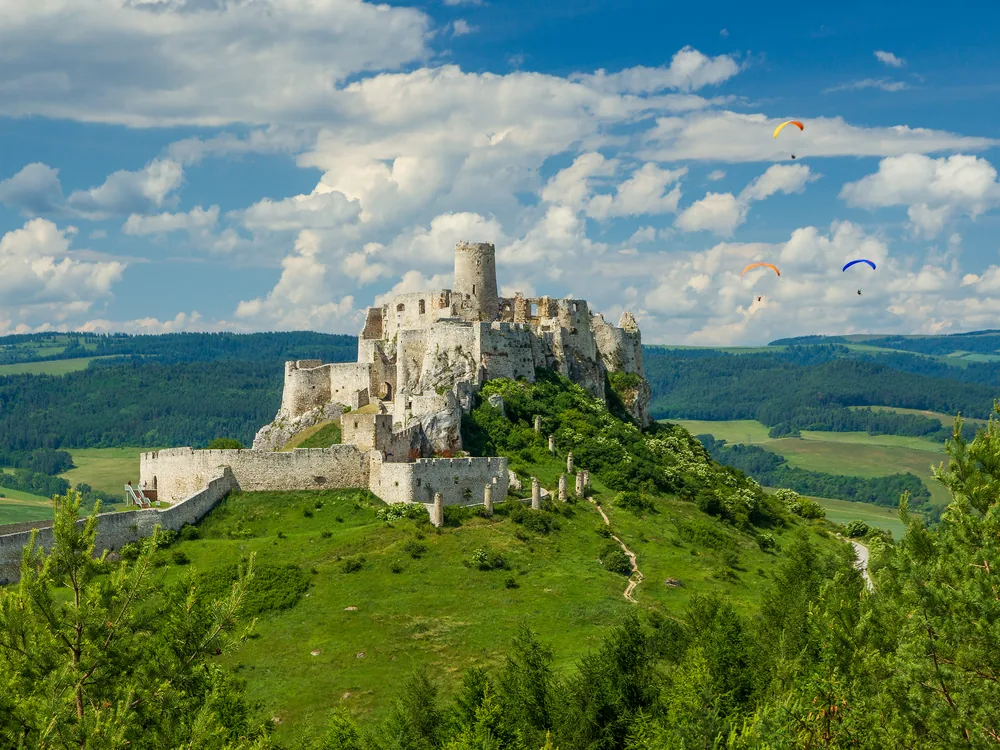
- ✓Spiš Castle (Spišský hrad) — the largest castle complex by area in Central Europe and a UNESCO World Heritage Site; 40,000 square metres of ruins on a solitary dolomite crag above the Spiš plain
- ✓Lunch included — traditional Slovak cuisine at a restaurant en route
Ready to book this tour?
Free cancellation · Instant confirmation
Itinerary
Červený Kameň sits at the edge of the Little Carpathian ridge north of Bratislava — a Renaissance château built in the 1530s on the foundations of a medieval fortification by the Habsburg court financial administrator Alexius Thurzo and subsequently acquired by the Fugger banking family of Augsburg, who transformed it into a treasury and arsenal for the Habsburg monarchy. The Fuggers — who at the height of their power in the early 16th century were the financiers of the Holy Roman Empire and the wealthiest non-royal family in European history — stored merchandise, bullion, and weapons at Červený Kameň as a secure depot along their Central European trade routes. The castle's most extraordinary feature is its cellar system: a network of underground storage chambers where the Fuggers and their successors kept a vast arsenal of weapons, armour, and military equipment. The collection that survives — now administered by the Slovak National Museum — is one of the largest intact early modern arsenals in Central Europe: crossbows, matchlock firearms, artillery pieces, plate armour, and siege equipment spanning the 15th to 18th centuries. The château's Baroque and Renaissance-period state rooms, accessible on the guided tour, were substantially refurbished by the Pálffy family (later owners) and contain period furniture, portraits, and tapestries of exceptional quality.
The Little Carpathian (Malé Karpaty) wine region runs along the ridge of low forested hills that separates the Bratislava basin from the Záhorie plain to the north — a viticultural area that has been continuously cultivated since at least Roman times and which represents Slovakia's oldest and most productive wine appellation. The region's soils — shallow, stony, and well-drained on the volcanic and crystalline substrates of the Carpathian foothills — produce mineral, high-acid white wines from the principal grape varieties: Welschriesling (called Rizling vlašský in Slovak), Grüner Veltliner (Veltlínske zelené), Müller-Thurgau, and Pinot Gris. The wines of the Little Carpathians are almost entirely unknown outside Slovakia; export quantities are negligible, and even within Central Europe the region is overshadowed by Austrian, Hungarian, and German neighbours. The tasting at a local winery between Červený Kameň and Bojnice is the opportunity to sample them in context — with the vineyards visible from the tasting room.
Bojnice Castle is Slovakia's most recognisable and most visited monument — a neo-Gothic château that appears to have been transplanted directly from the Loire Valley, set on a volcanic travertine hill at the edge of a thermal spa town in central Slovakia. The reality is more interesting: the core of Bojnice is a genuine 12th-century stone castle, documented from 1113, which passed through the hands of the Hunyadi, Thurzó, and Habsburg families before being acquired in 1852 by Count Ján Pálffy — the last private owner, who between 1889 and 1910 commissioned a comprehensive neo-Gothic reconstruction in the style of French medieval châteaux, guided by travels through the Loire and Normandy. Pálffy's reconstruction was meticulous and personal: he specified architectural details down to individual window traceries, imported French master craftsmen, and designed the interiors himself, filling them with European art from the Flemish, Italian, Dutch, and French schools over four decades of collecting. The interior is one of the most lavishly furnished castle interiors in Slovakia: tapestries, Renaissance and Baroque paintings, weapons collections, and period furniture are distributed across 17 accessible rooms. The castle's travertine hill is geologically unique — the thermal springs at the base of the hill created the mineral deposits over millennia — and the château's medieval chapel contains an altarpiece that has been attributed to Nino Pisano (14th century). Bojnice hosts the International Festival of Ghosts and Spirits annually in May — Slovakia's most popular cultural festival, with theatrical performances, ghost tours, and medieval markets in the castle grounds.
Lunch at a local Slovak restaurant en route to Spiš Castle. Traditional Slovak cuisine: bryndzové halušky (potato dumplings with sheep's cheese and bacon — the national dish), kapustnica (sauerkraut soup), svíčková (beef sirloin in cream sauce, a Central European preparation shared with Czech and Austrian cuisine), and lokše (potato flatbreads). Slovak beer — Zlatý Bažant or Pilsner Urquell from nearby Plzeň — is the standard accompaniment. Lunch is included in the tour price.
Spiš Castle is the largest castle complex by footprint in Central Europe — 41,420 square metres of fortifications spread across a solitary dolomite crag rising abruptly from the Spiš plain, with the Tatra Mountains visible as a white wall on the northern horizon. The scale is difficult to comprehend from photographs: the outer perimeter walls enclose an area larger than many medieval towns, containing within them the Romanesque lower castle (12th century), the Gothic middle castle and palace (13th–14th century), the Renaissance upper courtyard with the round bastions added by the Thurzó family in the late 15th century, a Romanesque chapel, garrison buildings, water cisterns, and the great square tower of the residential palace — all in various states of preserved ruin. The castle was inhabited continuously from the 11th century until it was destroyed by fire in 1780, after which it was abandoned; it is one of the largest ruined castles in Europe. UNESCO inscribed it as a World Heritage Site in 1993 as part of the Spiš Cultural Monuments group (together with Spišská Kapitula and Spišské Podhradie below the castle hill). The views from the upper castle battlements — across the entire Spiš basin to the High Tatras to the north and the Slovak Ore Mountains to the south — are among the most dramatic in Central Europe.
What's Included
- ✓Transportation in a comfortable minibus from Bratislava (max 7 passengers)
- ✓Expert English-speaking guide for the full 12 hours
- ✓Little Carpathian wine tasting
- ✓Lunch at a local Slovak restaurant
- ✓Castle entry fees for Červený Kameň and Bojnice
Not Included
- ✗Spiš Castle entry (paid on-site — modest admission)
- ✗Drinks beyond the included wine tasting
- ✗Tips for guide and driver
Insider Tips
Spiš Castle is the most important stop from a historical and architectural standpoint — the UNESCO designation and the sheer scale of the ruins make it unlike anything else in Central Europe. Wear sturdy shoes: the castle is accessed via a steep path from the parking area below the crag, and the interior terrain is uneven. In wet conditions the path can be slippery.
The 12-hour duration is genuine — this is a long day covering significant distances (Bratislava to Spiš Castle is approximately 300 km each way). The drive time alone is approximately 4 hours each way. Confirm with the operator what the actual day looks like: a 7am departure and 9pm return is not unusual for a tour of this scope.
Bojnice's neo-Gothic interiors are best understood if you know the backstory: Count Pálffy spent 21 years personally directing a reconstruction modelled on French châteaux because he genuinely wanted to live in a medieval castle — and he died at Bojnice in 1908, before the work was fully complete. The interior reflects his taste entirely, without the later committee interventions that dilute many aristocratic restorations.
The Little Carpathian wines are not internationally known and are unlikely to be familiar from any previous wine experience. The Welschriesling from this region — high acid, mineral, with a distinctive green-apple and citrus character — is different enough from Alsatian or Austrian Riesling to be worth approaching without preconceptions.
Červený Kameň's weapons collection in the cellars is the most underrated part of the tour — the assembled crossbows, plate armour, and early firearms represent one of the best-preserved early modern arsenals in existence, and it is almost unknown outside Slovakia. Allow the guide time in the cellar section.
Frequently Asked Questions
Is the €523 price per person or for the whole group?
€523 is the per-person price. The tour operates in small groups of up to 7 passengers — it is not a private tour. The total maximum group cost is approximately €3,661 for 7 people, but you will be joined by other booked travellers up to the maximum group size. This is the most significant structural difference from the other Castles & Palaces private tours listed at similar or higher prices.
Is Spiš Castle accessible with limited mobility?
Spiš Castle is not accessible for visitors with significant mobility limitations. Access requires a walk of approximately 15 minutes from the parking area, climbing a steep path on an exposed hillside, followed by uneven terrain within the castle ruins themselves. There is no lift or paved path to the castle interior. Červený Kameň and Bojnice are significantly more accessible — both have guided indoor tours with standard flooring, though older castle sections involve stone steps.
What is the connection between the Pálffy family and both Červený Kameň and Bojnice?
The Pálffy family are one of the most important noble dynasties in Slovak history — a Hungarian-origin family that held major positions in the Habsburg administration from the 16th century onwards and accumulated enormous landholdings in the Carpathian basin. They acquired Červený Kameň in 1591 (from the Fugger banking family) and held it until 1945; Count Ján Pálffy (1829–1908) was the owner of Bojnice who commissioned its neo-Gothic reconstruction between 1889 and 1910. The Pálffys' properties in what is now Slovakia were confiscated by the Czechoslovak communist government after 1948; both Červený Kameň and Bojnice are now administered as state museums. The Pálffy family's archives and art collections, partially preserved in Vienna and partially in Slovak state custody, represent one of the most significant documentary records of Central European noble life from the 16th to the 20th century.
More Tours from Bratislava
Powered by GetYourGuide
From
€523
per person
Free cancellation available on most dates · Secure booking
Meeting point
Central meeting point in Bratislava — confirmed at booking (typically main square or major hotel area)
From
€523/ person