
Porto Palermo Castle
Kalaja e Porto Palermos
Albania · Albanian Riviera · Near Saranda
Built 1810 · Early 19th-century Ottoman military architecture — a triangular bastion plan with three circular corner towers set on a rocky peninsula above the sea; integrated into the landscape with minimal masonry visible from the water
This page is part of an independent travel guide and is not affiliated with, endorsed by, or operated by Porto Palermo Castle.
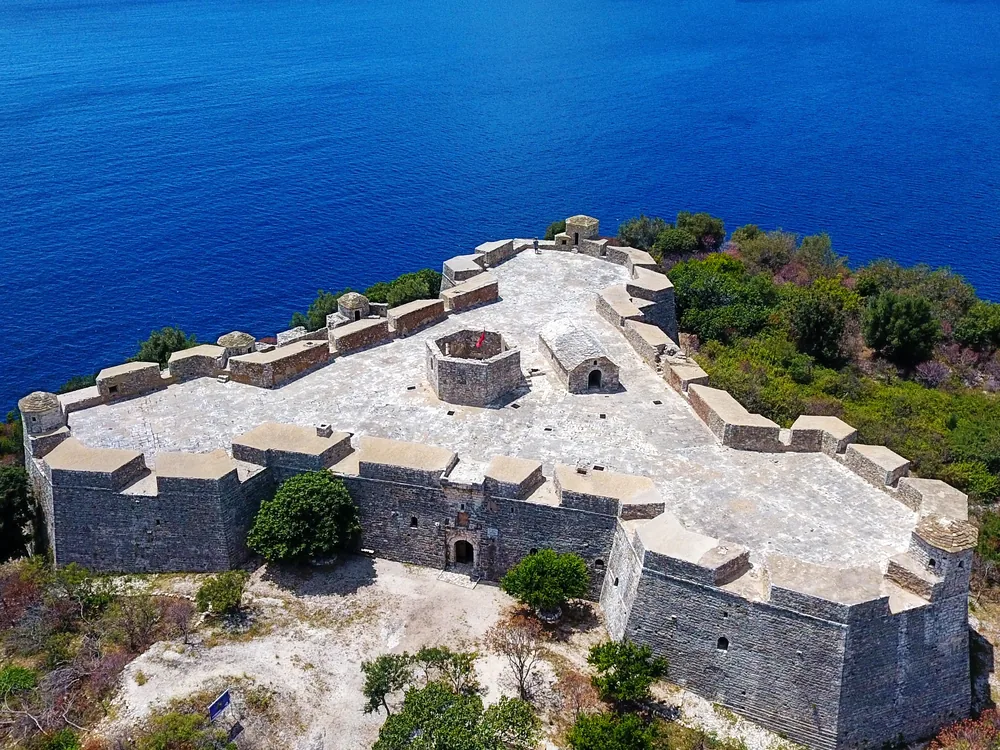
© Castles & Palaces
Quick Facts
- Hours
- Daily 08:00–17:00
- Day trip from
- €60
- Duration
- 30–45 minutes
- Best time
- June to September
- Nearest city
- Saranda
Featured Tour
Saranda: Waterfall, Castle, Himara Beach Tour
Cancellation available · Instant confirmation
Highlights
- ✦Triangular bastion plan with three circular corner towers — the most architecturally distinctive Ottoman military fortification on the Albanian coast, purpose-built to defend the Porto Palermo natural harbour
- ✦Built by Ali Pasha of Ioannina — commissioned around 1810 by Ali Pasha Tepelena, the Albanian-born Ottoman potentate whose territory stretched from Epirus to Macedonia and who was famously visited by the young Lord Byron in 1809
- ✦Porto Palermo bay — the natural harbour surrounded by cypress-forested hills that the castle was built to protect; the bay is one of the most sheltered anchorages on the eastern Adriatic/Ionian coast
- ✦Enver Hoxha-era submarine base — during the Communist period (1944–1991), the bay behind the castle was used as a submarine base and the area was closed to Albanian civilians; bunker infrastructure from this period is still visible around the castle perimeter
- ✦The Albanian Riviera context — Porto Palermo lies on the Riviera coast between Himarë and Saranda, a stretch of road considered the most scenic in Albania; the castle is the coast's most visually dramatic historic structure
- ✦A brief but memorable stop on the Saranda Riviera day trip — the GetYourGuide-listed tour covers the Albanian coast in 8 hours including the castle, the Borsh Waterfall, Qeparo village, and Himarë beach
Skip the queue with a guided tour
Skip-the-line tickets & expert guides
Porto Palermo Castle stands on a rocky peninsula above the natural harbour of Porto Palermo on the Albanian Riviera, roughly 25 kilometres north of Saranda and 15 kilometres south of Himarë. Its triangular plan with three circular corner towers is immediately recognisable from the coastal road, rising from the headland above one of the most sheltered natural anchorages on the eastern Ionian coast. It is one of the most visually distinctive military structures on the Albanian coast and one of the clearest surviving examples of early 19th-century Ottoman military architecture in the western Balkans.
The castle was built around 1810 by Ali Pasha of Ioannina — Ali Pasha Tepelena (1740–1822), the Albanian-born Ottoman governor of Epirus whose autonomous principality, nominally under Ottoman suzerainty, stretched from Ioannina across most of what is now northwestern Greece and southern Albania. Ali Pasha was one of the most remarkable political figures of the early 19th century: an effective administrator, a patron of Greek intellectual culture, and a ruthless military commander who played the European powers off against each other during the Napoleonic period. He was visited in 1809 at his court in Ioannina by the young Lord Byron and his companion John Cam Hobhouse — Byron describes the audience in Childe Harold's Pilgrimage, and the meeting with Ali Pasha became one of the most celebrated episodes in Romantic travel literature.
Ali Pasha built Porto Palermo Castle to control the harbour, which served as his naval base on the Ionian coast. The triangular plan — a design dictated partly by the shape of the peninsula and partly by Ottoman military practice of the period — places a circular tower at each corner, with the main gateway on the land-facing north side. The walls are thick enough for artillery emplacements, and the castle's low profile above the water makes it difficult to detect from the sea until a vessel is well into the harbour approach — a deliberate camouflage effect that reflected late 18th/early 19th-century understanding of the limitations of coastal artillery.
The Porto Palermo bay itself is the castle's strategic context. The natural harbour is unusually sheltered for this stretch of coast — the headlands at the bay's entrance funnel wind away from the anchorage, and the water depth is sufficient for reasonably sized vessels. Ali Pasha used the harbour as a rendezvous point during the period when he was negotiating simultaneously with the French (who held the Ionian Islands under Napoleon) and the British (who competed with France for influence in the eastern Mediterranean). The castle's guns could control which ships entered the harbour and which did not.
After Ali Pasha's execution by the Ottomans in 1822 — the central government in Istanbul had finally tired of his autonomous ambitions and sent an army to depose him — Porto Palermo passed through various Ottoman administrations until Albanian independence in 1912. The interwar period under Zog I saw the castle continue as a minor military installation. Under Enver Hoxha's Communist regime (1944–1991), Porto Palermo bay became a classified military zone: the bay was used as a submarine base, and the area was closed to Albanian civilians for decades. Bunker infrastructure and former military facilities from this period remain visible around the castle site and along the bay perimeter — the characteristic concrete mushroom-shaped Hoxha bunkers (over 173,000 were built across Albania between 1967 and 1986) dot the hillsides above the bay.
The GetYourGuide listing for visiting Porto Palermo Castle is a Saranda-based day trip (€60, 8 hours, driver in English and Albanian) that covers the Albanian Riviera coast: Borsh Waterfall (45 minutes, coffee break), Qeparo village (20-minute photo stop), **Porto Palermo Castle (approximately 30 minutes)**, and then Himarë beach for four hours of free time. **This is not a dedicated castle tour** — the castle is a 30-minute stop within a broader coastal day trip focused primarily on the beach and the Riviera scenery. Visitors specifically interested in the castle's Ottoman military architecture and Ali Pasha history should plan their own transport and allow more time at the site than the day trip provides.
For visitors with a hire car based in Saranda or Himarë, Porto Palermo is accessible in 20–30 minutes on the SH8 coastal road. The castle approach involves a short walk from the roadside parking area on an uneven rocky path. The site is small enough that 30–45 minutes is genuinely sufficient for the exterior and interior courtyard.
Lëkurësi Castle, above Saranda itself, is another Albanian Riviera castle reachable from Saranda — accessible via a separate day trip that focuses primarily on the Butrint UNESCO archaeological site. The two castles represent different aspects of Albania's layered history: Porto Palermo is Ottoman-era maritime fortification; Lëkurësi is earlier (medieval period) on a hill above the city. Visitors researching both should compare the two tour formats — neither is a dedicated castle tour, but both are worthwhile for the coastal and historical context they provide.
History
Around 1810, Ali Pasha Tepelena — the Albanian-born Ottoman governor of Epirus who had built himself a semi-autonomous principality stretching across northwestern Greece and southern Albania — commissioned Porto Palermo Castle on a rocky peninsula above one of the most sheltered natural anchorages on the Ionian coast. The triangular plan with three circular corner towers was dictated by the shape of the headland and by Ottoman military practice of the period; the castle's deliberately low profile above the water gave vessels approaching the harbour little warning of the guns inside.
Ali Pasha used the harbour as a naval base during the Napoleonic period, when he was simultaneously negotiating with the French (who held the Ionian Islands) and the British (who competed with France for eastern Mediterranean influence). His court at Ioannina attracted the young Lord Byron in 1809, and the encounter entered Romantic literature in Childe Harold's Pilgrimage. His ambitions eventually exhausted Ottoman patience: Istanbul sent an army to depose him in 1822, and Ali Pasha was executed — the castle passing back to direct Ottoman control.
After Albanian independence in 1912, Porto Palermo continued in military use through the interwar period and the communist decades, when Enver Hoxha's regime classified the bay as a submarine base and closed it to civilians entirely. The characteristic concrete bunkers installed across the surrounding hillsides remain as evidence of that period. The castle has been open to visitors as a heritage site since 1991.
How to Visit
Getting there: Porto Palermo is approximately 25 km north of Saranda on the SH8 coastal road toward Himarë, about 30–40 minutes by hire car (€30–50/day from local Saranda agencies). There is no dedicated public transport to the castle; parking is available near the approach path. The GetYourGuide day trip handles transport from Saranda.
Tickets: Walk-up entry is approximately €2 (200 ALL). The GetYourGuide Saranda Riviera day trip is an 8-hour coastal tour from Saranda stopping at Borsh Waterfall, Qeparo village, Porto Palermo Castle (approximately 30 minutes, entry included), and Himarë beach (4 hours of free time). This is not a dedicated castle tour — the castle stop is brief and the main time is at the beach; independent visitors wanting more time at the castle should drive themselves.
Practical tips: The drive along the SH8 coastal road between Saranda and Himarë is itself one of Albania's most scenic drives and worth doing slowly. The castle's triangular plan and corner towers are best seen from the approach path above the headland, not from the coastal road below — the deliberately low profile from the sea was an intentional feature of its design. The Hoxha-era concrete bunkers on the surrounding hillsides are a striking contrast with the Ottoman stonework below.
Combine with: Lëkurësi Castle — the 16th-century Ottoman hilltop fortress above Saranda with panoramic Ionian and Butrint lagoon views, approximately 30–40 km south along the coast road.
Frequently Asked Questions
No — the GetYourGuide listing (€60) is an 8-hour Albanian Riviera day trip from Saranda that stops at Porto Palermo Castle for approximately 30 minutes as one of four stops. The main time is spent at Himarë beach (4 hours). Visitors wanting more time at the castle should drive independently — the site is accessible by hire car from Saranda in about 30 minutes.
Location
Porto Palermo, Himarë, Albania
Nearby Castles
Tours & Tickets
Powered by GetYourGuide
From
€60/ person