
Rozafa Castle
Kalaja e Rozafës
Albania · Shkodër County · Near Shkodër
Built 400 · Illyrian-origin fortress on a rocky hill at the confluence of the Buna, Drin, and Kiri rivers; the site of ancient Scodra, capital of the Ardiaean Illyrian kingdom (captured by Rome 168 BC); successively held by Byzantine, medieval Albanian (Balshaj dynasty), Venetian, and Ottoman powers; the visible fortifications are primarily of Venetian construction (15th century) built over earlier foundations; associated with the most celebrated legend in Albanian oral tradition — the sacrifice of Rozafa; panoramic views over Lake Shkodër and the surrounding plain extending to Montenegro
This page is part of an independent travel guide and is not affiliated with, endorsed by, or operated by Rozafa Castle.
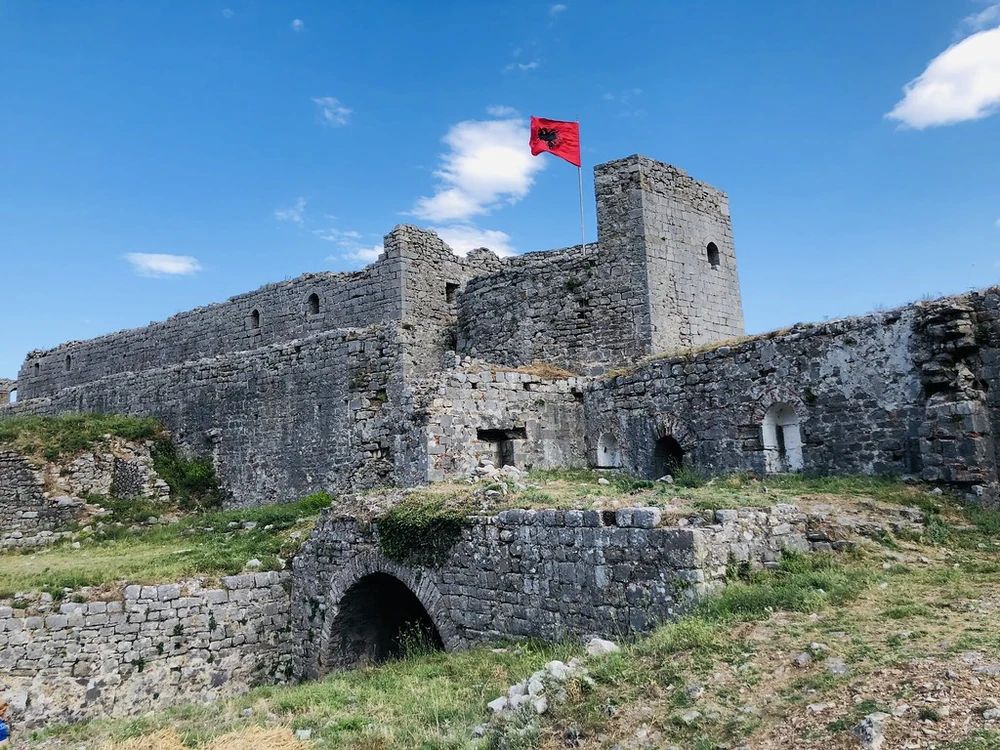
© Castles & Palaces
Quick Facts
- Hours
- Daily 09:00–19:00
- Entry via GetYourGuide
- €14
- Duration
- 2 hours
- Best time
- April to October
- Nearest city
- Shkodër
Featured Tour
Rozafa Castle and Marubi Museum Entry Tickets
Cancellation available · Instant confirmation
Highlights
- ✦Set at the confluence of three rivers — the Buna, the Drin and the Kiri — on a rocky hill 130 metres above Shkodër, one of the most strategically commanding positions in the western Balkans
- ✦The site of ancient Scodra, capital of the Ardiaean Illyrian kingdom defeated by Rome in 168 BC after the surrender of King Gentius — one of the earliest Roman interventions in the Balkans
- ✦Associated with the founding sacrifice of Rozafa — a woman walled into the castle's foundations so the walls would stand, whose request to leave openings for her nursing infant is considered the most fully developed version of this Balkan legend cycle
- ✦The visible fortifications are primarily Venetian (15th century), built after the Republic of Venice took control from the Albanian Balshaj dynasty in 1396 — a prolonged and celebrated defence before the Ottoman conquest of 1479
- ✦The GetYourGuide combo ticket (€14) pairs the castle with the Marubi National Museum of Photography, holding over 500,000 Albanian negatives from 1858 onward — the most significant photographic archive in the Balkans
Skip the queue with a guided tour
Skip-the-line tickets & expert guides
From the ramparts of Rozafa Castle, 130 metres above the city of Shkodër, three rivers are visible simultaneously. The Buna descends from Lake Shkodër to the northwest, the Drin arrives from the east carrying water from the Albanian Alps and the lakes of the interior, and the Kiri joins from the south. The confluence directly below the castle hill was, for two millennia, one of the most strategically important river junctions in the western Balkans. The site has been fortified since at least the 4th century BC, when it was the capital of the Ardiaean Illyrian kingdom. The castle that stands today — primarily a Venetian construction of the 15th century built on much older foundations — is Albania's most significant standing fortress, and the subject of one of the most haunting founding myths in European oral tradition.
The hill of Rozafa was known in antiquity as Scodra — the principal stronghold of the Ardiaean kingdom, the dominant Illyrian power of the eastern Adriatic coast in the 3rd century BC. Under Queen Teuta, widow of King Agron, the Ardiaei controlled much of the Adriatic sea trade and conducted raids that brought them into direct conflict with Rome. Rome's first military intervention in the Balkans came in response: in 229 BC, a combined Roman fleet and land force compelled Teuta to surrender and curtailed Illyrian maritime activity. The Ardiaean state survived as a Roman client kingdom until 168 BC, when Rome intervened in the Third Macedonian War. The consul Lucius Anicius Gallus defeated the Macedonian king Perseus and then turned on the Illyrian king Gentius, who had allied with Macedonia; Scodra fell after a brief siege, and Gentius surrendered. This ended Illyrian independence permanently. The Romans retained Scodra as an administrative centre; it later became a municipium and eventually an early Christian bishopric.
The founding myth of the castle is one of the most widely known stories in Albanian culture — a counterpart to legends of sacrifice embedded in walls that appear across the Balkans, with similar stories recorded in Serbia, Bulgaria and Romania, though the Albanian version is considered the most fully developed. Three brothers undertook the construction of a fortress, but each night the walls they built by day collapsed. An old man advised them that the walls would stand only if a living person were walled into the foundations — specifically, the wife of whichever brother brought food to the builders the following morning. The brothers swore to tell their wives nothing. Two of them broke the oath; only the youngest did not warn his wife. The next morning, a woman named Rozafa arrived with food and water. Chosen for the sacrifice, she did not resist but made one request: when the masons sealed her in, they must leave an opening at her right breast so she could continue to nurse her infant son; an opening at her right eye so she could see him; a gap for her right hand to reach out to him; and her right foot free to rock his cradle. The legend holds that the castle stands because of her sacrifice — and that a fissure in the western wall that seeps moisture is Rozafa's milk, still sustaining the child.
After the Roman period, Scodra passed through Byzantine control and then came under the rule of the medieval Albanian Balshaj dynasty in the 14th century, who used Rozafa as their principal stronghold. The Republic of Venice took control in 1396 and held it for eight decades, during which the visible Venetian fortifications — the towers, the triple ring of walls, the cisterns — were constructed over the earlier foundations. The Ottomans besieged the city repeatedly from 1474; the Venetian garrison conducted a celebrated defence before finally surrendering in 1479 after a prolonged siege. The castle served as an Ottoman garrison and administrative centre for over four centuries, until Albanian independence in 1912.
The GetYourGuide combo ticket pairs Rozafa Castle with the Marubi National Museum of Photography in central Shkodër — one of the most significant photographic archives in southeastern Europe and an entirely distinct experience from the castle itself. The Marubi collection documents Albanian society from 1858 onward, when Pietro Marubi, an Italian revolutionary who had fled Genoa after the failed uprisings of 1848, established the first photography studio in Albania in Shkodër. Marubi photographed Albanian nobility, Ottoman officials, merchants and ordinary citizens; his successors continued the studio across three generations, accumulating a collection that now holds over 500,000 negatives and prints. The archive is one of the most important photographic records of 19th- and early 20th-century Balkan life, and the museum housing it is among the finest in Albania. The two attractions are visited separately — castle on its hill, Marubi Museum in the city centre — and the combination fills a half-day comfortably.
Lake Shkodër — one of the largest lakes in Europe and the largest in the Balkans, straddling the Albanian-Montenegrin border — is visible from the castle ramparts on clear days, a broad expanse of water 43 km long and up to 14 km wide. The lake and its surrounding wetlands are a significant bird habitat; the view at sunset over the river confluence is one of the most memorable in Albania. Shkodër itself, historically the cultural capital of northern Albania, has a well-preserved Ottoman bazaar and a substantial collection of pre-Ottoman and early modern architecture that extends the visit naturally beyond the castle.
History
The rocky hill above the confluence of the Buna, Drin and Kiri rivers was fortified at least as early as the 4th century BC, when it served as the capital of the Ardiaean Illyrian kingdom. Known to the Romans as Scodra, it was the stronghold of King Gentius, the last independent Illyrian ruler, until his defeat and capture by the Roman consul Lucius Anicius Gallus in 168 BC. The site subsequently served as a Roman administrative centre, municipium and early Christian bishopric.
After the Roman period, the castle passed through Byzantine administration before coming under the control of the Albanian Balshaj dynasty in the 14th century, who held it as their principal stronghold. The Republic of Venice acquired the city in 1396 and undertook major construction of the defensive circuit — towers, walls and cisterns — that constitutes the bulk of the visible fortifications today. The Venetian garrison conducted a famous prolonged defence against Ottoman siege before surrendering in 1479; the castle subsequently served as an Ottoman garrison and regional administrative centre for over four centuries, until Albanian independence in 1912.
The founding sacrifice of Rozafa — a woman walled into the castle's foundations so the walls would stand, with her right side left open to nurse her infant — is the most fully developed version of a legend cycle found across the Balkans, and the name most closely associated with the site in Albanian oral and literary tradition.
How to Visit
Getting there: Shkodër is 110 km north of Tirana, served by regular express buses from Tirana's main bus terminal (approximately 2 hours; buses run every 30–60 minutes). The castle is 5 km from the city centre, accessible by taxi (approximately 10 minutes, ~300 ALL) or by bicycle.
Tickets: Walk-up castle-only entry is approximately €3 (300 ALL). The GetYourGuide combo ticket covers Rozafa Castle and the Marubi National Museum of Photography in central Shkodër; the two sites are visited separately and together fill a comfortable half-day.
Practical tips: The view from the ramparts over the river confluence is best in late afternoon when light comes from the west across Lake Shkodër — sunset from the upper ramparts is one of the finest vantage points in northern Albania. The Marubi National Museum in central Shkodër (not at the castle) holds over 500,000 negatives documenting Albanian society from 1858 onward and is one of the best museums in Albania; allow time for both before choosing between them.
Combine with: Lezhë Castle — Skanderbeg's burial site and the location of the League of Lezhë, 55 km south on the SH1 highway toward Tirana.
Frequently Asked Questions
Rozafa is the central figure of Albania's most widely known founding legend. According to the story, three brothers could not build a castle whose walls would stand — they collapsed each night. An old man advised them to wall a living woman into the foundations. Only the youngest brother kept the secret from his wife; when Rozafa arrived with food the next morning, she was chosen. She agreed to the sacrifice on the condition that openings be left for her right breast (to nurse her infant), her right eye (to see him), her right hand (to reach him) and her right foot (to rock his cradle). A fissure in the western wall that seeps moisture is traditionally identified as her milk. The legend is considered the most fully developed example of a sacrifice-in-walls story that appears across the Balkans.
Location
Rozafa Castle, Shkodër, Albania
Nearby Castles
Tours & Tickets
Powered by GetYourGuide
From
€14/ person