
Rodoni Castle
Kalaja e Rodonit
Albania · Durrës County (Cape Rodon) · Near Cape Rodon (Kepi i Rodonit)
Built 1450 · 15th-century coastal fortress built by Gjergj Kastrioti (Skanderbeg) on the remote headland of Cape Rodon on Albania's central Adriatic coast; the castle was constructed to provide a defensible coastal position complementary to Skanderbeg's inland stronghold at Krujë, allowing access to Venetian naval support and coastal escape routes during the resistance against Ottoman expansion; the ruins sit on a promontory requiring approximately 30 minutes' walking from the nearest road; no facilities on site; the Church of St. Anthony sits nearby and is a secondary stop on the same GetYourGuide day tour; NOTE: this is a different site from Krujë Castle (albania/kruje-castle), which is Skanderbeg's better-known inland mountain fortress
This page is part of an independent travel guide and is not affiliated with, endorsed by, or operated by Rodoni Castle.
© Castles & Palaces
Quick Facts
- Hours
- Daily Daylight hours
- Day trip from
- €55
- Duration
- 6-hour day tour from Tirana (including travel and walking)
- Best time
- April to October
- Booking
- Required — book 2+ days ahead
- Nearest city
- Cape Rodon (Kepi i Rodonit)
Featured Tour
From Tirana: Cape Rodon and Skanderbeg Castle Trip
Cancellation available · Instant confirmation
Highlights
- ✦NOTE: Rodoni Castle is a different site from Krujë Castle (albania/kruje-castle, already published), which is Skanderbeg's main inland mountain fortress; Rodoni Castle is approximately 40 km away on the Adriatic coast — the two sites are thematically connected (both built by Skanderbeg) but geographically separate and served different strategic functions
- ✦Gjergj Kastrioti Skanderbeg built Rodoni Castle in the 1450s as a coastal fortress complementary to his inland stronghold at Krujë — where Krujë anchored his resistance in the mountains, Rodoni gave him a defensible coastal position from which he could receive Venetian naval support and maintain maritime access for supplies and potential escape if the inland positions fell
- ✦The GetYourGuide tour's own guidance advises against visiting for children under 5 or visitors over 70, reflecting the physical demands of the site: approximately 30 minutes of walking on rough coastal terrain to reach the ruins, with no facilities (no café, no toilets, no ticket booth) at the castle itself
- ✦The Church of St. Anthony, a small medieval church near the castle ruins, is a secondary stop on the same GetYourGuide day tour — the headland's combination of fortress ruins, coastal views, and medieval church gives it more content than the castle alone would provide
- ✦Cape Rodon is one of the least developed stretches of Albania's Adriatic coast — the drive to the headland passes through flat agricultural land and scrubland, and the headland itself has no tourist infrastructure, giving the visit a genuinely remote, off-the-beaten-track quality that contrasts sharply with the developed coastal resorts north and south
Skip the queue with a guided tour
Skip-the-line tickets & expert guides
Gjergj Kastrioti — known in Albanian as Skënderbeu, in Western sources as Skanderbeg — understood two things about the war he was fighting against the Ottoman Empire: that his inland mountain stronghold at Krujë was difficult to take but ultimately depended on supply lines he could not fully control, and that the sea at his back was an asset as long as the Republic of Venice remained his ally and the Adriatic remained accessible. Rodoni Castle, built on the remote headland of Cape Rodon in the 1450s, addressed the second concern. It was not Skanderbeg's primary fortress — that was always Krujë, the mountain citadel he defended through four major Ottoman sieges and that bears his name in the cultural memory of Albanian national identity. Rodoni was his coastal position: the place from which Venetian ships could deliver aid, from which communications with the Venetian mainland could be maintained, and from which, in the event of a military disaster inland, a sea escape was possible.
Before visiting, two clarifications: first, Rodoni Castle and Krujë Castle (already published at albania/kruje-castle) are different sites approximately 40 kilometres apart, serving different functions in Skanderbeg's defensive system. Krujë sits in the mountains east of the coast; Rodoni sits on the Adriatic headland. Visitors who have read the Krujë Castle page will know it as the fortress explicitly described there as Skanderbeg's main headquarters and the site of his most famous resistance. Rodoni is complementary, not duplicative. Second, the site is genuinely remote and physically demanding to reach. The GetYourGuide tour's own guidance advises against the visit for children under five or visitors over seventy, reflecting the requirement to walk approximately 30 minutes on rough, unpaved coastal terrain to reach the ruins — the nearest road ends well short of the fortress, and the headland has no facilities of any kind.
Skanderberg's career requires some explanation for visitors encountering him for the first time. Born in 1405, he was the son of an Albanian nobleman who sent him as a hostage to the Ottoman court — a common arrangement in the Balkans, by which frontier nobles maintained their positions by surrendering children to Ottoman imperial service. Skanderbeg was raised at the Ottoman court, converted to Islam, served in the Ottoman military, and by his mid-thirties was a senior Ottoman officer. In 1443, at the Battle of Niš, he switched sides — deserted the Ottoman forces during the confusion of a Christian military victory, rode to Krujë with a forged document authorising him to take command of the castle, and raised the Albanian flag over the fortress he had known from childhood. For the next 24 years, until his death in 1468, he led a coalition of Albanian lords in continuous resistance against repeated Ottoman attempts to retake Albania.
The strategic value of a coastal position for this resistance was direct. Venice was Skanderbeg's most important external ally — the Venetian Republic controlled the Adriatic and had established trading posts and fortified towns along the Albanian coast (Durrës, then called Durazzo, was Venetian). Venetian naval power could deliver supplies, reinforcements, and communication that bypassed Ottoman-controlled land routes, but only if Skanderbeg had a coastal point of contact. Rodoni Castle, built on the cape that juts furthest into the Adriatic from this section of the coast, gave him exactly that. The headland's exposed position made it defensible from the sea while also giving clear sightlines over the surrounding water.
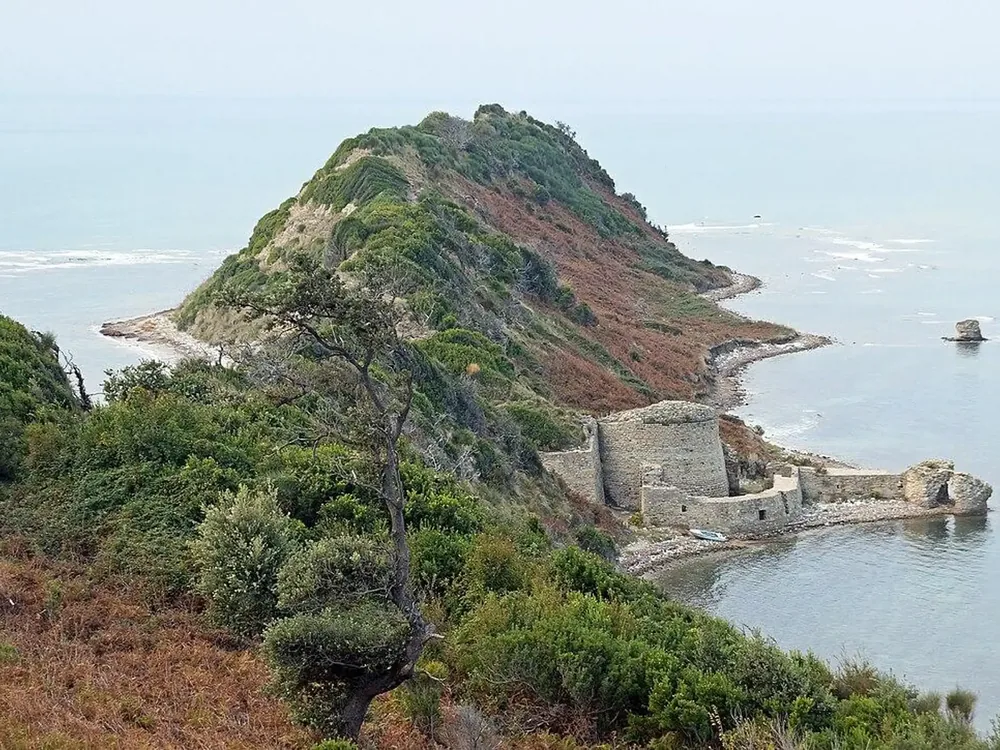
The ruins today are substantial in extent but minimal in sophistication. Rodoni was a working military installation rather than a palace or a display of wealth, and the surviving walls and tower structures reflect purely functional priorities. The setting does most of the work aesthetically: the cape's position on the Adriatic, with open sea in three directions, and the flat Myzeqe plain visible to the south, gives the ruins a windswept, elemental quality that more elaborately preserved medieval sites rarely achieve. The light in the late afternoon, when the sun comes from behind the Albanian mountains and falls directly on the sea, is extraordinary.
The Church of St. Anthony, a small medieval church on the same headland, is included as a secondary stop on the GetYourGuide day tour. The combination of fortress ruins and medieval church on a remote coastal cape gives the visit more content than the castle alone would provide, and the six-hour total tour duration from Tirana allows enough time for both sites plus the drive across the Durrës coastal plain.
Krujë Castle (already at albania/kruje-castle) is the natural companion piece. Where Rodoni represents Skanderbeg's coastal strategic thinking, Krujë represents his mountain defence at its most concentrated — the fortress he held through four major sieges, the site that bears his name in Albanian national memory, and the place where his presence as a symbol of resistance is most explicitly commemorated. The two sites together give a reasonably complete picture of how Skanderbeg structured his long resistance: mountain bastion for the core of his power, coastal fortress for the external connections that sustained it.
Albania's national relationship with Skanderbeg is worth brief contextualisation for visitors encountering the name for the first time. Skanderbeg died in 1468 without a military successor capable of continuing his resistance, and the Ottomans took full control of the Albanian coast within a decade. But the memory of his 25-year resistance became the organising narrative of Albanian national identity in the 19th century, when the Albanian National Awakening constructed a secular national mythology centred on his figure. His image appears on Albanian currency, the national flag's double-headed eagle is associated with his seal, and the main square in Tirana is named Skanderbeg Square. Visiting Rodoni Castle engages with the specific site where Albanian national memory intersects with a genuinely remote Adriatic landscape.
History
Rodoni Castle was built by Gjergj Kastrioti Skanderbeg in the 1450s on Cape Rodon on Albania's central Adriatic coast, as a coastal complement to his inland mountain fortress at Krujë. Where Krujë anchored his military resistance against Ottoman expansion in the mountains, Rodoni provided access to Venetian naval support and maritime communications. Skanderbeg died in 1468; within a decade, the Ottomans had taken control of the Albanian coast. The castle ruins survive on the remote headland, accessible by a 30-minute walk across rough coastal terrain. The site has no facilities. The nearby Church of St. Anthony is a secondary heritage stop on the same headland.
How to Visit
Getting there: Cape Rodon is approximately 50 km northwest of Tirana via Fushë-Krujë and the coastal plain, about 1 hour by car. The final approach to the headland requires a 30-minute walk each way on rough coastal terrain from the nearest road; there are no facilities at the castle itself. The GetYourGuide tour handles all transport from Tirana.
Tickets: The castle ruins are free (open access). The GetYourGuide day trip is a 6-hour small-group tour from Tirana (up to 3 people) with pickup included, covering the drive to Cape Rodon, the walk to the fortress, time at the ruins and the nearby Church of St Anthony, and the return journey. Advance booking required.
Practical tips: No facilities exist at the site — bring water, food, and sun protection. The tour operator advises against visiting for children under 5 or visitors over 70, reflecting the physical demands of the walk on rough, exposed coastal terrain. The late afternoon light falling across the Adriatic from the castle headland is the most atmospheric time to arrive.
Combine with: Krujë Castle — Skanderbeg's inland mountain fortress approximately 40 km southeast, and the natural thematic companion to this coastal position in the geography of his resistance.
Frequently Asked Questions
They are both Skanderbeg fortresses but in entirely different locations and serving different strategic purposes. Krujë Castle (already published at albania/kruje-castle) is in the mountains east of Tirana — Skanderbeg's primary inland stronghold, the site of his famous resistance against four Ottoman sieges. Rodoni Castle is on the Adriatic coast approximately 40 km northwest — a coastal fortress built to maintain access to Venetian naval support and maritime communications. The two sites are thematically linked but geographically separate and not a same-day combination.
Location
Cape Rodon (Kepi i Rodonit), Kavajë, Albania
Nearby Castles
Tours & Tickets
Powered by GetYourGuide
From
€55/ person