
Aggstein Castle
Ruine Aggstein
Austria · Lower Austria (Wachau Valley) · Near Aggstein, near Krems
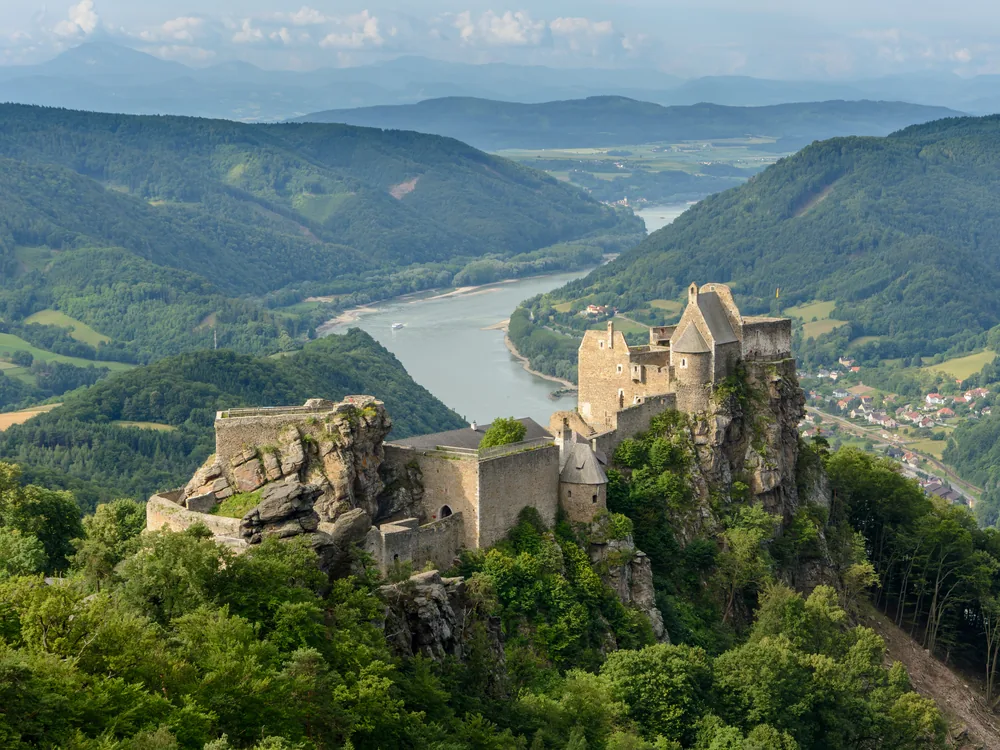
Built 1150 · Medieval castle ruins on a narrow rocky spur above a bend in the Danube in the Wachau Valley; the original construction dates to the 12th century, with the castle rebuilt and extended across multiple periods; the ruins include the remains of the main keep, perimeter walls, towers, and the inner courtyard, set on a spur of rock approximately 300 metres above the river; the Wachau Valley was inscribed as a UNESCO World Heritage cultural landscape in 2000, and Aggstein is among the most dramatically sited castles in the inscribed area; self-guided access with no time limit
This page is part of an independent travel guide and is not affiliated with, endorsed by, or operated by Aggstein Castle.
© Castles & Palaces
Quick Facts
- Hours
- Daily 10:00–17:00
- Entry via GetYourGuide
- €10.5
- Duration
- 1–2 hours
- Best time
- April to October
- Nearest city
- Aggstein, near Krems
Featured Tour
Aggstein Castle Ruins: Admission to the Medieval Castle Complex
Cancellation available · Instant confirmation
Highlights
- ✦Aggstein Castle is set on a narrow rock spur approximately 300 metres above a bend in the Danube in the Wachau Valley — one of the most dramatically positioned castle ruins in Austria, with views along the river in both directions and the terraced vine slopes and apricot orchards of the UNESCO Wachau cultural landscape visible below
- ✦The castle became notorious in the 15th century under Jörg Scheck vom Waldeck, known as Schreckenwald ('terror of the forest'), whose practice of extorting passing river merchants by force gave him the reputation of Austria's archetypal robber baron; the local legend that he confined prisoners in a small tower garden on the cliff edge — the 'Rosengärtlein' or rose garden — and forced them to leap or starve is the kind of dark specific detail that makes castle ruins memorable
- ✦The Wachau Valley UNESCO World Heritage inscription (2000) covers the entire stretch of the Danube between Melk and Krems as a cultural landscape where river, vineyard terraces, apricot orchards, monastic architecture, and castle ruins form a continuous historical environment — Aggstein is among the most visually prominent elements of this landscape, visible from the river far below
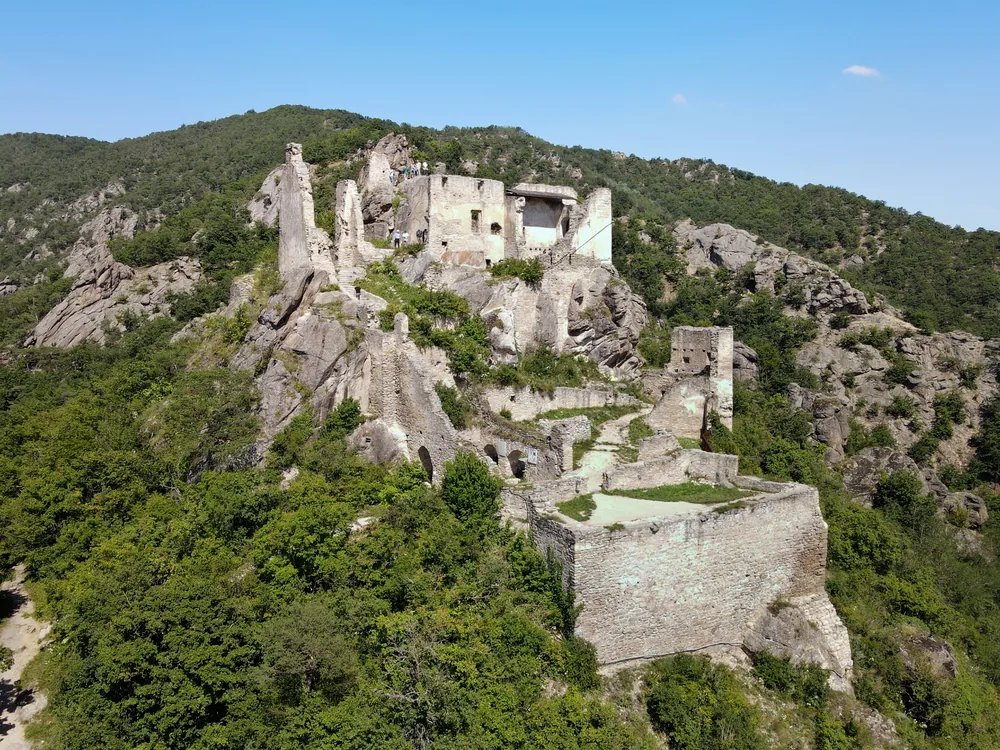
- ✦Dürnstein Castle, approximately 15 kilometres downstream and already on this site, is Aggstein's closest companion ruin on the same Wachau stretch of river — Dürnstein famous for the imprisonment of Richard I of England and Aggstein for its 15th-century robber baron, the two ruins anchoring the Wachau's most historically intense kilometre range from different directions
- ✦Access is self-guided with no time limit, allowing visitors to explore the ruins at whatever pace suits the terrain — the approach climb and the ruin circuit together take one to two hours, with the most dramatic views available from the upper sections of the remaining walls
Skip the queue with a guided tour
Skip-the-line tickets & expert guides
The Wachau Valley between Melk and Krems is the most visited stretch of the Austrian Danube, and the visual argument for that status is immediately obvious. For approximately 36 kilometres the river cuts through a narrow valley where terraced vineyard slopes rise steeply from the water's edge, apricot orchards flower white in spring, and medieval fortifications appear at intervals on rocky spurs above the bend. The UNESCO World Heritage inscription of 2000 recognised this as a cultural landscape rather than a collection of individual monuments — the whole valley as an environment shaped by human habitation, viticulture, religious institution-building, and defensive fortification across many centuries, none of which can be fully understood in isolation from the others.
Aggstein Castle is one of the most visually dominant elements of this landscape. The ruins sit on a narrow rock spur approximately 300 metres above the Danube at a bend in the river that makes the castle visible from a considerable distance in both directions. The combination of height, rock position, and the river bend's geometry means that no boat or cyclist passing along the Wachau fails to see Aggstein: the ruins are the dominant vertical element in the visual field for several kilometres of river travel, hovering above the vineyard terraces and the village below in a way that explains their strategic value immediately. Whoever controlled Aggstein controlled the view of the approach from both upstream and downstream, and the river traffic that represented the economic lifeline of the medieval Danube economy.
The castle's 12th-century origins place it in the broader pattern of Babenberg-era fortification in the Danube valley, when the march that would become Austria was being consolidated through castle-building on strategic high points along the river. It passed through various noble families across the medieval period before becoming associated with the figure who makes it historically specific: Jörg Scheck vom Waldeck, known in regional tradition as Schreckenwald — the terror of the forest — who held the castle in the mid-15th century and earned a regional reputation for the systematic extortion of river merchants passing below.
The robber-baron story of the medieval Danube is a broad type — lords who controlled valley narrows used their positions to demand tolls from river traffic, and the line between legitimate tolling and extortion was regularly crossed — but Schreckenwald's version acquired specific legendary accretion that gives Aggstein its most distinctive narrative detail. The 'Rosengärtlein' — the rose garden — was allegedly a small confined space on the cliff edge where Schreckenwald imprisoned captives who could not or would not pay his ransom demands, leaving them the choice between slow starvation and a leap from the rock. This specific story, with its theatrical brutality and the ironic name (a rose garden that was in fact a cliff-edge death trap), entered regional folklore with the staying power that the most effective dark history stories tend to have: easily visualised, attached to a named individual, located in a specific physical place that the visitor can stand in and look down from.
The ruins today extend along the rock spur in a series of walls, towers, gate structures, and the remains of the main keep — all in various states of preservation, some sections stabilised for visitor safety and others left in natural ruined condition. The visit is entirely self-guided with no time limit, which is the appropriate format for a ruin of this type: the experience is primarily about moving through the physical remains, finding the views, and understanding the castle's spatial relationship to the river below, none of which benefits from a fixed circuit or a guided script. The GetYourGuide entry ticket provides access to the full ruins complex.
The Wachau's vineyard slopes below the castle produce Riesling and Grüner Veltliner wines that are among the most highly regarded in Austria — the terraced cultivation pattern visible from the castle walls represents a viticultural tradition that the Romans may have begun and that has continued on these specific slopes through every political change in the valley's history. The apricot orchards that alternate with the vineyards are a Wachau agricultural specialty — Wachau apricots (Wachauer Marillen) have their own geographical designation and their blossom in April is one of the visual signatures of the valley.
Dürnstein Castle, approximately 15 kilometres downstream and already on this site, is the essential companion ruin for anyone driving or cycling the Wachau. Dürnstein is famous for its specific historical connection — Richard I of England was imprisoned there from 1192 to 1193, held by Duke Leopold V of Austria after the Third Crusade — while Aggstein has the Schreckenwald robber-baron narrative. Both are ruins on the same UNESCO cultural landscape, both are above the same river, both are best seen from the water. The Wachau Danube cruise operators stop at or near both sites as part of the standard Krems-to-Melk or Melk-to-Krems river day, making the combination accessible without a car if the timing works. For drivers, both ruins can be visited on a half-day circuit based in Krems.
The broader Wachau cultural landscape — Melk Abbey at the upstream end, Krems at the downstream, Weißenkirchen and Spitz in between, all connected by the river and the cycling path — is the context in which Aggstein makes most complete sense. The castle ruin on its 300-metre rock is one node in a landscape of continuous historical layering, and the UNESCO designation is the appropriate acknowledgment that the individual elements are less than the whole.
History
Aggstein Castle was established in the 12th century, probably during the Babenberg era of Austrian consolidation along the Danube. The castle passed through multiple noble families across the medieval period. In the mid-15th century the castle was associated with Jörg Scheck vom Waldeck (Schreckenwald), whose reputation for robber-baron river extortion became the subject of regional legend, including the 'Rosengärtlein' prisoner-confinement story. The castle declined in importance in the early modern period and was eventually abandoned and left to ruin. The Wachau Valley was inscribed as a UNESCO World Heritage cultural landscape in 2000. The ruins are now a visitor attraction open seasonally, with the GetYourGuide self-guided entry format.
How to Visit
Getting there: From Krems, drive approximately 20 km west on the B3 Danube road to Aggsbach Dorf, then follow the steep road up to Aggstein; parking is at the base with a climb to the entrance. Standard Wachau river cruises (Brandner Schifffahrt, DDSG) stop near Aggstein — check current schedules for the Krems–Melk route. The Donauradweg (Danube Cycle Path) runs through the valley below, though the castle climb from the path is significant.
Tickets: Walk-up entry is €8 adults, €4 children. The GetYourGuide entry ticket provides self-guided access to the full ruins complex with no time limit.
Practical tips: Allow 1–2 hours for the ruin circuit plus the approach climb from the car park — the most dramatic views are from the upper wall sections, so push through to the top. Find the Rosengärtlein cliff-edge enclosure on the far side of the main keep: the confined space where Schreckenwald reputedly imprisoned captives is specific enough to locate and worth finding; the drop below is convincingly vertical.
Combine with: Dürnstein Castle — 15 km downstream on the same UNESCO Wachau landscape, famous as Richard I of England's imprisonment site, and the essential pairing for a Wachau ruins day.
Frequently Asked Questions
The 'Rosengärtlein' (rose garden) is a small confined space on the cliff edge at Aggstein that local legend associates with Jörg Scheck vom Waldeck (Schreckenwald), a 15th-century lord of the castle said to have imprisoned captives there who could not pay his ransom demands, forcing them to choose between starvation and jumping. The story is regional legend with the specific quality of dark folklore — named individual, specific location, memorable ironic detail. Its literal truth cannot be verified, but Schreckenwald's reputation for river extortion is historically documented.
Location
Aggstein 8, 3642 Aggstein, Austria
Nearby Castles
Tours & Tickets
Powered by GetYourGuide
From
€10.5/ person