
Kreuzenstein Castle
Burg Kreuzenstein
Austria · Lower Austria · Near Leobendorf
Built 1874 · 19th-century romantic reconstruction of a medieval castle destroyed in 1645 during the Thirty Years' War; Count Johann Nepomuk Wilczek — polar explorer, financed by Silesian coal income — began rebuilding from 1874 using genuine medieval architectural fragments (stonework, windows, staircases, capitals) purchased from demolition sales across Austria, Bavaria, Tyrol, and Belgium; construction completed in 1906, when Kaiser Wilhelm II and Emperor Franz Joseph I attended the ceremonial opening; the castle sits on a limestone ridge above the village of Leobendorf, approximately 25 km north of Vienna; the Wilczek collection of medieval decorative arts (weaponry, armour, tapestries, furniture, ecclesiastical objects) is displayed throughout the interior; private ownership by the Wilczek family, visit by guided tour only
This page is part of an independent travel guide and is not affiliated with, endorsed by, or operated by Kreuzenstein Castle.
© Castles & Palaces
Quick Facts
- Hours
- Tue–Sun 10:00–16:00. Closed Mon
- Day trip from
- €189
- Duration
- 1–1.5 hours
- Best time
- April to October
- Nearest city
- Leobendorf
Featured Tour
Vienna: Day Trip — Castles Around Vienna & Underground Lake
Cancellation available · Instant confirmation
Highlights
- ✦Count Johann Nepomuk Wilczek (1838–1909), who built Kreuzenstein, was primarily known as the financier of the Austro-Hungarian Arctic expedition of 1872–1874 — the 'Tegetthoff' expedition that discovered Franz Josef Land and spent two winters locked in the Arctic ice; the castle reconstruction was his other great project, begun the same year the expedition returned, combining polar explorer determination with antiquarian scholarship
- ✦The castle is not a replica: it was built using genuine medieval architectural elements — windows, doorways, capitals, carved stonework, and staircases — purchased from demolition sales and antique dealers across Austria, Bavaria, Tyrol, and Belgium; the structural frame is 19th-century but the materials that give it its visual character are medieval originals assembled in a new composition
- ✦Kaiser Wilhelm II and Emperor Franz Joseph I both attended the ceremonial opening in 1906 — a diplomatic recognition of a private project of unusual cultural seriousness, acknowledging Wilczek's achievement in creating a coherent medieval environment rather than a decorative approximation
- ✦The Wilczek collection of medieval arms, armour, tapestries, furniture, manuscripts, and ecclesiastical objects displayed throughout the interior was assembled in parallel with the construction — giving the completed building the character of a serious private museum displayed in a purpose-built architectural setting, rather than an empty Gothic Revival shell
- ✦The castle has been used as a film location since the 1920s and its combination of authentic-feeling medieval materials with proximity to Vienna (25 km) makes it a frequently chosen setting for period productions seeking a convincing medieval environment without the management constraints of a state heritage site
Tickets & tours
Book through GetYourGuide
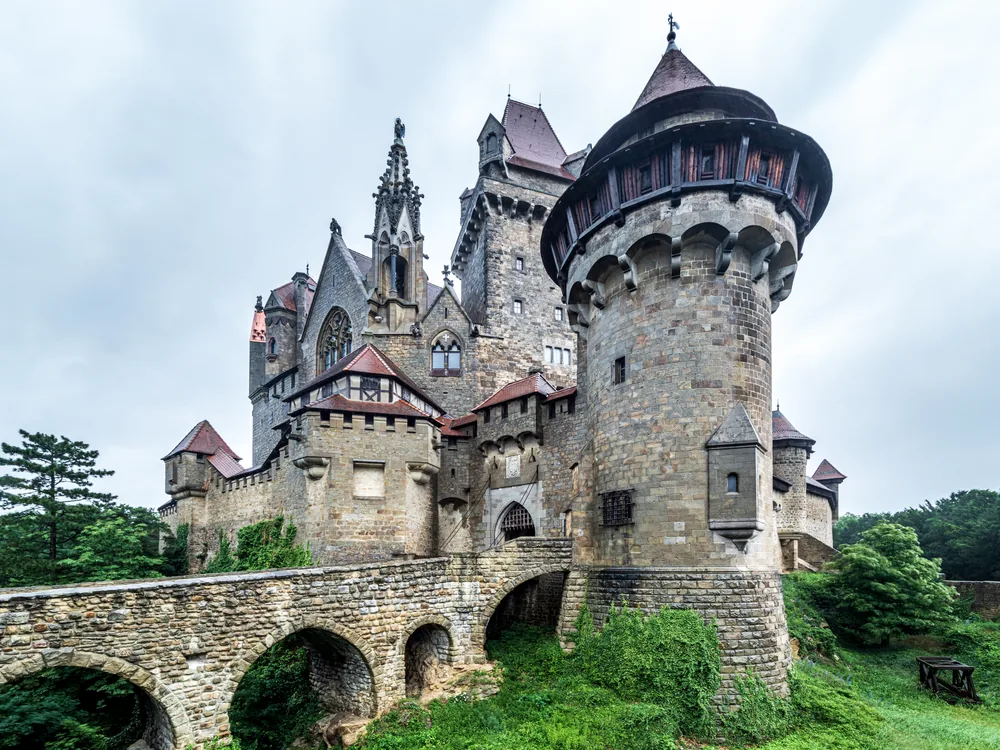
Kreuzenstein Castle stands on a limestone ridge above the village of Leobendorf, approximately 25 kilometres north of Vienna, at a height that gives it views across the Danube floodplain toward the Moravian hills to the northeast. What you see from the Vienna road — a convincingly medieval fortress with towers, a drawbridge, a keep, and a surrounding wall — was built between 1874 and 1906. The medieval castle that stood on this site before 1645 was destroyed by Swedish forces during the Thirty Years' War. Count Johann Nepomuk Wilczek, who began the reconstruction in 1874, was not trying to restore the original — he was building a new castle, using genuine medieval building fragments collected from across Central Europe, designed to feel medieval without claiming to be the original. The distinction is one that visitors to Kreuzenstein should hold in mind: this is not a restored ruin, not a replica, and not a theme-park fake. It is a purpose-built collection displayed in an architecturally unified shell, designed by a man who understood medieval material culture deeply enough to assemble it coherently.
Count Johann Nepomuk Wilczek (1838–1909) is not primarily remembered as a castle-builder. He is remembered as the man who financed the Austro-Hungarian Arctic expedition of 1872–1874 — the 'Tegetthoff' expedition that discovered Franz Josef Land and spent two winters locked in the Arctic ice before abandoning ship and sledging to safety. Wilczek's financial backing made the expedition possible; his personal engagement with polar exploration — he had taken part in a British Arctic search expedition in 1871 as a young man — was genuine rather than merely patronal. He spent the years after the Tegetthoff expedition directing the reconstruction of Kreuzenstein, using coal income from his Silesian estates to fund an architectural project of considerable ambition. The two activities — polar exploration and medieval castle reconstruction — are not as disconnected as they appear: both reflect the same 19th-century enthusiasm for combining scientific rigour with romantic adventure.
The medieval castle on this site was a possession of the Questenberg family, acquired by the Wilczeks in 1633, and destroyed twelve years later by Swedish forces under General Lennart Torstenson during the final campaign of the Thirty Years' War in 1645. The destruction was total enough that Wilczek was not restoring a ruin but building on cleared ground with only the documentary record and foundation archaeology to guide him. His approach was to collect genuine medieval fragments — architectural stonework, windows, doorways, staircases, capitals, corbels, and sculptures — from demolition sales, antique dealers, and estate auctions across Austria, Bavaria, the Tyrol, and Belgium, and to incorporate them into the new construction. The castle is therefore a genuine medieval materials collection housed in a 19th-century structural frame: the ironwork is real, the carved stone is real, the timber is real; only the assembly is of Wilczek's time.
The Wilczek collection of medieval decorative arts — weaponry, armour, tapestries, furniture, manuscripts, and ecclesiastical objects spanning roughly the 11th to the 16th centuries — was assembled in parallel with the construction, giving the completed building the character of a coherent private museum rather than an architectural exercise with empty rooms. Kaiser Wilhelm II and Emperor Franz Joseph I were among the guests at the ceremonial opening in 1906, giving the project an official recognition that acknowledged its cultural seriousness. The Wilczek family have owned and managed the castle continuously since.
The architectural style Wilczek and his architects employed draws from multiple medieval periods rather than committing to a single era: the gatehouse reflects one regional tradition, the great hall another, the chapel a third. This eclecticism is deliberate — it mirrors the way genuine medieval castles were built over generations, with each period leaving its own architectural signature — and it distinguishes Kreuzenstein from more stylistically consistent Gothic Revival reconstructions of the same period (such as Neuschwanstein in Bavaria, which commits entirely to Romanesque Revival under single 19th-century authorship). Kreuzenstein's eclecticism is a statement about how medieval buildings actually accumulated their character.
The castle has been used as a film location since the 1920s. The interior — maintained by the Wilczek family — is accessible via guided tour: the rooms contain the original collection in situ, with armour, a chapel with genuine medieval altarpieces, the great hall, and the kitchen all included in the standard visit. The courtyard is photogenic at any season; the towers offer views of the Vienna basin and the surrounding Lower Austrian countryside.
The private family ownership means the castle operates differently from state-managed heritage sites: opening hours are seasonal and can vary, and the guided tour format reflects the decision of successive Wilczeks about how the collection should be presented. The current count, Franz-Josef Wilczek, continues the family's involvement. Visiting without a guide is not possible — interpretation is embedded in the tour, which typically takes 45–60 minutes through the principal rooms and courtyard. Checking current season hours at burg-kreuzenstein.at before visiting is advisable.
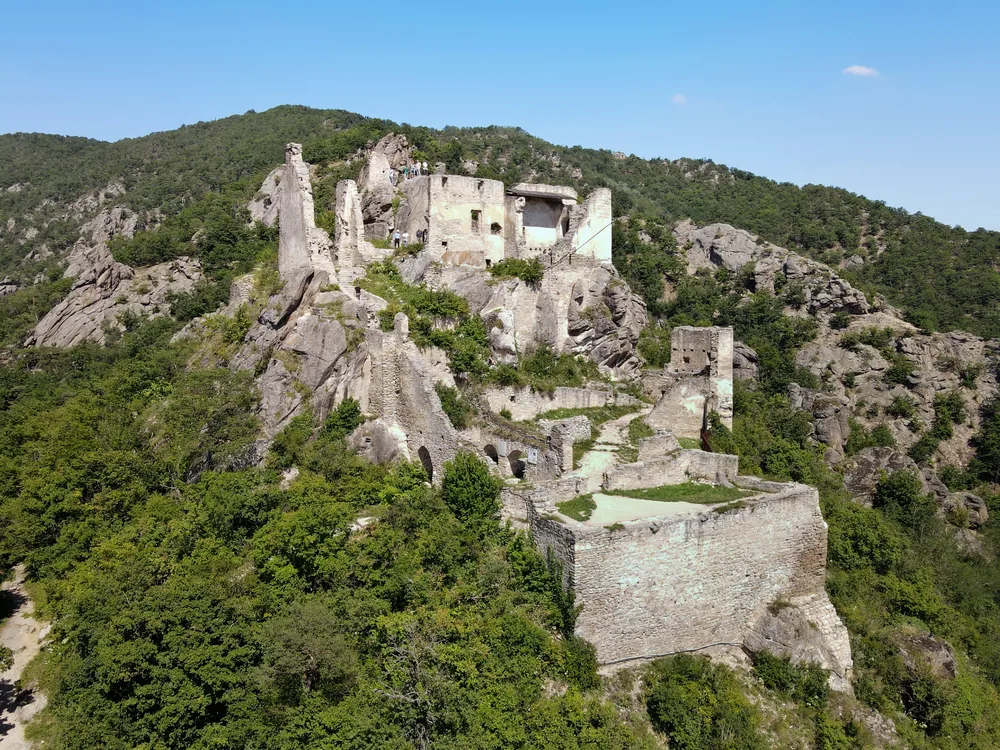
[Dürnstein Castle](/castles/austria/durnstein-castle), perched above the Danube in the Wachau valley about 70 kilometres west, is the legitimate medieval counterpart — the 12th-century ruin above the wine town where Richard the Lionheart was held prisoner after the Third Crusade. The Wachau valley's medieval ruins, Baroque architecture, and vineyard terraces are a different landscape register from the Vienna fringe at Leobendorf, but the two sites together illustrate the range of what 'Austrian castle' means across the different registers of genuine medieval ruin and Victorian reconstruction. The Vienna day trip that covers Kreuzenstein also includes Liechtenstein Castle (another Victorian reconstruction of medieval origins, south of Vienna) and the Seegrotte underground lake at Hinterbrühl — a day oriented around 19th-century noble investment in Austria's medieval and geological heritage.
History
The ridge above Leobendorf has held a castle since the early medieval period, when the Questenberg family maintained a fortress above the Danube floodplain. The Wilczek family acquired the property in 1633, but the castle they inherited was destroyed twelve years later — Swedish forces under General Torstenson razed it during the final campaigns of the Thirty Years' War, leaving only foundations on the limestone ridge.
The ruins sat untouched for two centuries until Count Johann Nepomuk Wilczek returned from financing the Austro-Hungarian Arctic expedition of 1872 with a project that would occupy the rest of his life. Beginning in 1874, he undertook the reconstruction of Kreuzenstein not from architectural plans but from a collection of authentic medieval fragments purchased from demolition sales across Austria, Bavaria, Tyrol, and Belgium. Doorways, carved stonework, stained glass, and structural timbers salvaged from medieval buildings being swept away by modernisation were incorporated into the new castle fabric — making Kreuzenstein a form of architectural rescue as much as construction. Over three decades, the Wilczek medieval art collection was assembled in parallel with the building itself.
The castle was completed in 1906 and inaugurated in the presence of Kaiser Wilhelm II and Emperor Franz Joseph I. Count Wilczek died in 1909; his family retained the property, and it has been used periodically as a film location through the 20th century. Guided tours run seasonally under the management of the current Count Wilczek.
How to Visit
Getting there: Leobendorf is approximately 25 km north of Vienna by car via the B3 or A22 Nordautobahn (exit Stockerau). By public transport, take the S1 or S2 regional train from Vienna Praterstern to Leobendorf station; the castle is a 30-minute walk or short taxi from the station.
Tickets: Walk-up entry is approximately €12 adults, €8 children; the castle is open approximately April to October — verify current season dates and guided tour times at burg-kreuzenstein.at before travelling, as the privately-managed schedule varies by season. The GetYourGuide full-day Vienna castles tour covers Kreuzenstein together with Liechtenstein Castle and the Seegrotte underground lake; castle admission is an optional extra fee within the itinerary.
Practical tips: The visit is by guided tour only (approximately 45–60 minutes) — independent exploration of the interior is not possible. The collection of medieval arms, armour, tapestries, and ecclesiastical objects displayed in situ throughout the rooms is the core content of the visit, not the architectural shell; the tour makes this accessible in a way that self-guided wandering would not.
Combine with: Dürnstein Castle — the genuine 12th-century ruin in the Wachau valley where Richard I of England was imprisoned, approximately 70 km west, offering a telling contrast between Victorian antiquarian reconstruction and authentic medieval ruin.
Frequently Asked Questions
It is a 19th-century construction built using genuine medieval materials. The medieval castle on the site was completely destroyed in 1645; Count Wilczek rebuilt from cleared ground starting in 1874, incorporating genuine medieval stonework, windows, staircases, and decorative elements collected from across Central Europe. The structural frame is 19th-century; the materials that give the castle its visual and tactile character are medieval originals — a coherent collection in a purpose-built setting, rather than a replica or a theme-park fake.
Location
Burg Kreuzenstein, 2100 Leobendorf, Austria
Nearby Castles
Tours & Tickets
Powered by GetYourGuide
From
€189/ person