
Diocletian's Palace
Dioklecijanova palača
Croatia · Dalmatia, Split · Near Split
Built 295 · Late Roman imperial palace-fortress built 295–305 CE, modelled on a Roman legionary fort — a rectangular plan approximately 215 by 180 metres with walls reaching 25 metres in height, four gates, and an internal division between the northern garrison half and the southern imperial residential half; the Peristyle (colonnaded courtyard), Vestibule (domed anteroom), and underground halls (Podrumi) survive substantially intact; Diocletian's Mausoleum (octagonal, on a podium) was converted to the Cathedral of Saint Domnius in the 7th century and remains in use; Jupiter's Temple became the Baptistry; the medieval and post-medieval city of Split grew up inside the palace walls, incorporating them as the walls of the urban fabric; UNESCO inscription 1979
This page is part of an independent travel guide and is not affiliated with, endorsed by, or operated by Diocletian's Palace.
© Castles & Palaces
Quick Facts
- Hours
- Daily 00:00–24:00
- Guided tour from
- €15
- Duration
- 2–4 hours
- Best time
- May to June and September to October for smaller crowds
- Nearest city
- Split
Featured Tour
Split: Diocletian's Palace Old Town Small-Group Walking Tour
Cancellation available · Instant confirmation
Highlights
- ✦Diocletian's Palace is the largest and best-preserved Roman palatial complex in the world — and its most unusual quality is not its preservation but its continuous occupation: after Salona was sacked in 614 CE, refugees moved inside the walls, subdivided the imperial apartments, and built the city that became modern Split, so the palace has been inhabited without interruption for 1,400 years
- ✦Diocletian's own Mausoleum — where he intended to be buried — became, in one of history's deepest ironies, the Cathedral of Saint Domnius: a Christian saint whom Diocletian had executed in 304 CE during the Great Persecution. The octagonal Roman mausoleum is now Split's Roman Catholic cathedral, with the original Roman stone reliefs and capitals still visible inside the Christian liturgical setting
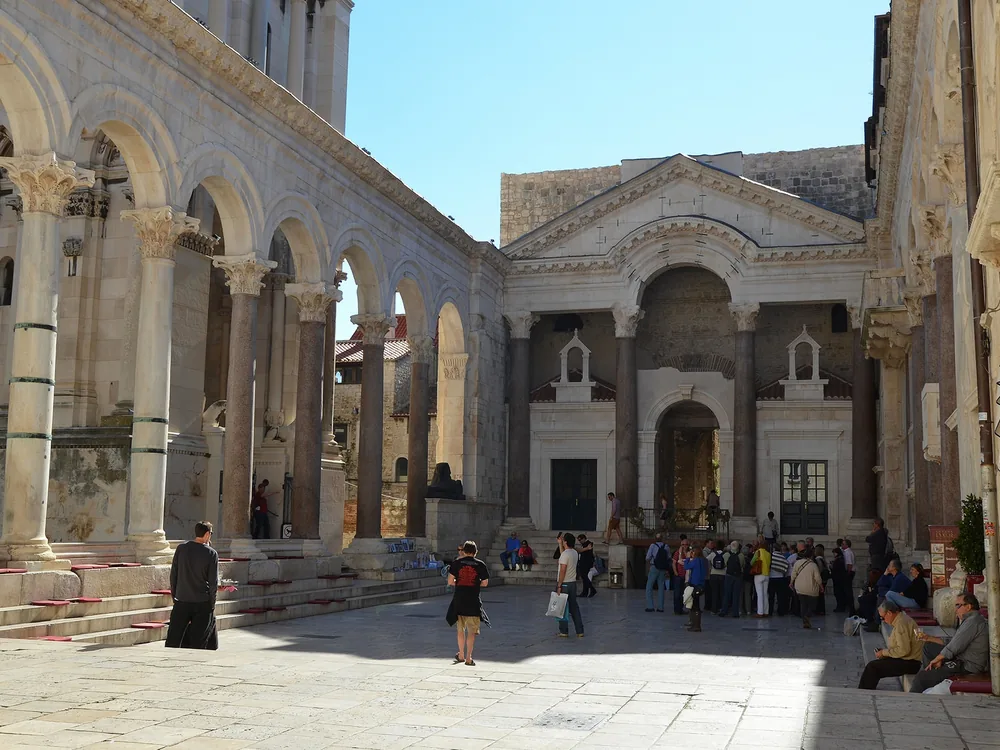
- ✦The Peristyle — the colonnaded courtyard at the heart of the imperial residential quarter — is now a café terrace, with medieval stonework between the original Roman columns, the cathedral entry off one side, and the entrance to the Vestibule (the domed anteroom to the imperial apartments) at the far end; it is possible to sit at a café table between Diocletian's original columns
- ✦The Underground Halls (Podrumi) beneath the imperial apartments are the most completely preserved section of the original Roman construction — a full-scale vaulted undercroft mirroring the room layout of the apartments above, used as a market in the medieval period (and featured in Game of Thrones as the dragon pits of Meereen)
- ✦The UNESCO inscription of 1979 — 'Historical Complex of Split with the Palace of Diocletian' — recognised the living city that grew up within the Roman walls as a single heritage entity, not just the palace fabric: the medieval towers, Venetian palazzi, and Baroque churches that crowd the Roman structure are all part of the inscription's scope
Skip the queue with a guided tour
Skip-the-line tickets & expert guides
The city of Split grew up inside a Roman emperor's retirement home. This is not a metaphor or an architectural analogy — it is a literal description of what happened. When Diocletian, Emperor of Rome, abdicated in 305 CE and retired to the Dalmatian coast of his homeland, he moved into a rectangular palace-fortress he had spent a decade building near the provincial capital of Salona. After the fall of the Western Roman Empire and the destruction of Salona by Avars and Slavs in 614 CE, the palace's remaining walls offered the best available shelter, and several thousand refugees moved in. They built houses against the walls, subdivided the imperial apartments, converted the mausoleum into a church, and turned the garrison barracks into living quarters. The Roman palace became a city. Today, Split's entire old town — the restaurants, shops, apartments, and hotels where roughly three thousand people live and several million visit each year — occupies the footprint of Diocletian's original retirement residence. The palace is not a ruin. It is still a building, still inhabited, still in daily use. What makes it unique in the world of Roman archaeology is not the quality of its preservation but the continuity of its occupation.
Diocletian was born around 244 CE near Salona — the son of a freedman from Dalmatia, who rose through the Roman military ranks to become Emperor. His reign (284–305 CE) involved one of the most significant administrative reorganisations in Roman history: the establishment of the Tetrarchy, the division of the empire into eastern and western administrative units, the reform of the tax system and the military, and the Great Persecution of Christians (303–311 CE) — the most systematic Roman attempt to suppress Christianity before Constantine's conversion. He is also the only Roman emperor to voluntarily abdicate and live out his days in retirement. When colleagues begged him to return to power during a crisis, he reportedly said that if they could see the cabbages he was growing in his Dalmatian garden, they would understand why he preferred retirement.
The palace he retired to was built between 295 and 305 CE, following the basic design of a Roman legionary fortress — a rectangle approximately 215 by 180 metres, with walls reaching 25 metres in height, four named gates (Porta Aurea to the north, Porta Argentea to the east, Porta Ferrea to the west, Porta Aenea to the south opening to the sea), and an internal division between the northern garrison half and the southern imperial residential half. The distinction between palace and fortress is, by design, blurred: Diocletian understood that retirement in a period of political instability required defensible architecture.
The southern half contained the imperial apartments, the Peristyle (colonnaded courtyard serving as the formal entrance to the imperial quarters), the domed Vestibule (the anteroom to the private apartments), a ceremonial dining hall, and Diocletian's Mausoleum — an octagonal structure on a rectangular podium where he intended to be buried. The mausoleum became, with the deepest possible historical irony, the Cathedral of Saint Domnius: a Christian saint whom Diocletian had executed in 304 CE during the Great Persecution. The cathedral consecration happened in the 7th century, roughly when the refugee occupation of the palace began. Diocletian's personal burial monument became a Christian church dedicated to one of his victims, and the building still functions as Split's Roman Catholic cathedral. The original octagonal interior, Roman capitals, and stone relief portraits of Diocletian survive in the walls alongside 13th-century frescoes and the cathedral's medieval modifications.
Jupiter's Temple — a small hexastyle Corinthian temple in the northern corridor — became the cathedral's baptistry, retaining its coffered barrel vault and an Egyptian crocodile sculpture at its entrance. The Porta Aurea (Golden Gate) to the north remains the most complete of the four gates, with blind arcading and decorative niches. The Podrumi (underground halls) beneath the southern imperial apartments mirror the room layout of the apartments above and represent the most completely preserved section of Roman construction in the complex — accessible via a separate ticket and extensively used as a filming location, including for Game of Thrones.
Walking into the Peristyle — the central colonnaded court where café tables now stand between Diocletian's original columns — makes the continuous occupation of the palace physically immediate. The columns have medieval stonework patched between them. A Romanesque tower rises from the corner of the mausoleum. Medieval house facades cover Roman walls. At the northern end, the Vestibule is now open to the sky, its dome long since gone, ringed by the original blind arcading and used as a performance space in summer.
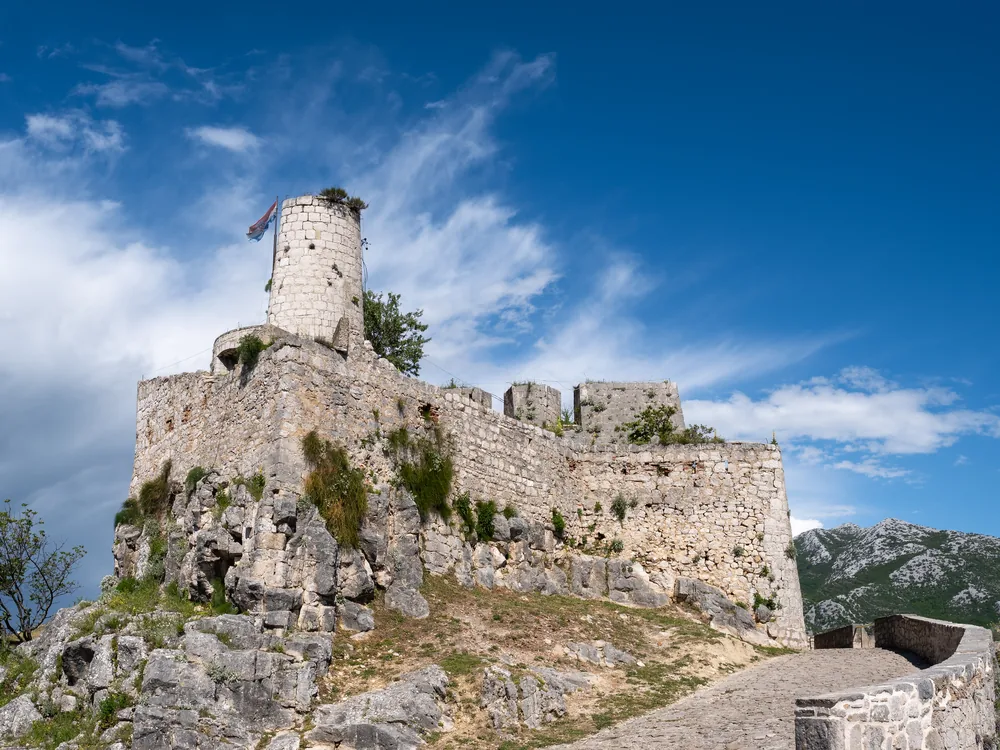
The Podrumi entry (approximately €12–15 adults) and individual monument tickets are the primary paid elements. The palace-city itself is free to enter at all hours. The guided walking tour is the highest-reviewed dedicated castle/palace tour product on this entire site — not a shared link with any other page — and provides the historical context that the physical experience of the palace-city benefits from significantly on a first visit. [Klis Fortress](/castles/croatia/klis-fortress), on the ridge above Split approximately eight kilometres inland, is the medieval counterpart — the Croatian royal fortress from which the region that Diocletian's palace made possible was controlled for centuries.
History
295–305 CE: Emperor Diocletian constructs the palace near Salona on the Dalmatian coast as his retirement residence. 305 CE: Diocletian formally abdicates as emperor and retires to the palace. 316 CE: Diocletian dies, presumably in the palace. 7th century: Western Roman Empire has collapsed; Avars and Slavs sack Salona (the regional capital, 5 km north); refugees from Salona and the surrounding territory move inside the palace walls and begin constructing permanent dwellings. The mausoleum is converted to the Cathedral of Saint Domnius; Jupiter's Temple becomes the Baptistry. Medieval period: The city of Split grows up inside the palace walls; Venetian control (1420–1797) adds further urban layers. 1979: UNESCO World Heritage inscription — 'Historical Complex of Split with the Palace of Diocletian.' Present day: Approximately 3,000 people live inside the palace walls as part of the functioning old town of Split.
How to Visit
Getting there: Split is accessible by ferry from Ancona, Italy (11 hours overnight), by bus from Dubrovnik (4 hours) and Zagreb (5 hours), and by air to Split Airport (24 km, with bus connections to the city centre). The palace complex is the old town itself — a 10-minute walk from the ferry terminal and bus station.
Tickets: The palace-city is free and open 24 hours as a public urban space. Individual monuments have separate fees: the Podrumi underground halls (approximately €12–15 adults), the Cathedral of Saint Domnius and bell tower (€3–5), and the Baptistry (small fee); buy on-site or via the official Diocletian's Palace website. The GetYourGuide small-group walking tour is the recommended way to experience the palace on a first visit — the Roman, medieval, and Venetian historical layers are significantly clearer with a guide than from self-guided signage alone.
Practical tips: Enter via Porta Aurea (Golden Gate) to the north for the most historically correct approach into the original imperial quarter, or Porta Aenea (Bronze Gate) to the south opening onto the Riva promenade for the most dramatic seaside arrival. May–June and September–October offer considerably smaller crowds than the July–August peak, while keeping all monuments open at full hours.
Combine with: Klis Fortress, the medieval Croatian royal stronghold 8 km inland above Split, is the historical counterpart to the palace and features in several multi-site tours departing from the city.
Frequently Asked Questions
No — the palace complex, which is the old town of Split, is free and open at all hours as a public urban space. Individual monuments within the palace have separate entry fees: the Underground Halls (Podrumi) cost approximately €12–15, the Cathedral of Saint Domnius and bell tower €3–5, and the Baptistry (Jupiter's Temple) a small additional fee. The Peristyle, the Vestibule, the palace gates, and the general old town streets are all free.
Location
Peristil, 21000 Split, Croatia
Nearby Castles
Tours & Tickets
Powered by GetYourGuide
From
€15/ person