
Frankopan Castle
Frankopanski kaštel
Croatia · Kvarner Bay, Island of Krk, Krk Town · Near Rijeka
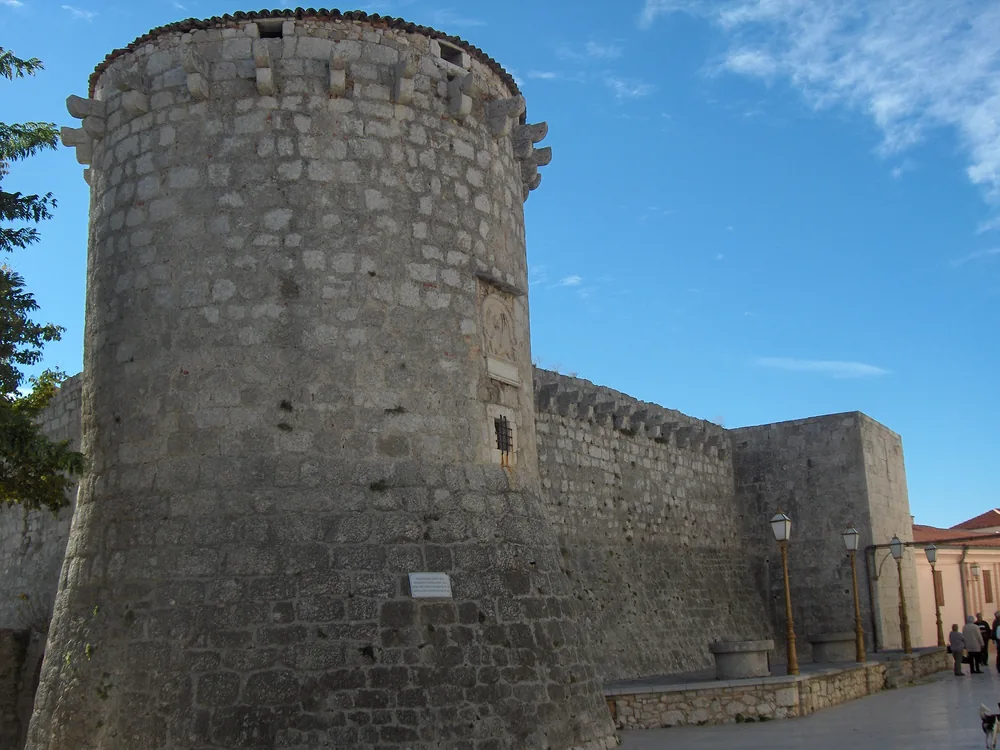
12th century · Medieval noble family fortification on the Adriatic coast — the castle in Krk Town occupies a commanding position above the harbour, developed and expanded across the Frankopan dynasty's tenure on the island from the 12th century through the late 15th century; the surviving structure includes a substantial round tower (the most prominent element of the harbour skyline and the dynasty's most characteristic surviving architectural mark on Krk), a rectangular tower, and connecting curtain walls; the complex is in the Romanesque-Gothic tradition typical of Adriatic coastal fortification, using local limestone in the manner characteristic of construction across the Kvarner Bay islands; the castle sits immediately adjacent to Krk Cathedral, itself a layered structure incorporating a pre-Romanesque basilica, Romanesque nave, and Gothic additions, creating a historic core of exceptional density for a small Adriatic island town; the round tower is the architectural element most associated with Frankopan construction across their various fortress sites in Croatia and the Littoral
This page is part of an independent travel guide and is not affiliated with, endorsed by, or operated by Frankopan Castle.
© Castles & Palaces
Quick Facts
- Hours
- Daily 09:00–19:00
- Guided tour from
- €140
- Duration
- 45 minutes–1 hour (castle); 2–3 hours (castle, cathedral, and Krk Town historic core combined); 10 hours (GetYourGuide full Krk island circuit)
- Best time
- May to October
- Nearest city
- Rijeka
Featured Tour
Rijeka: Krk Island Tour
Cancellation available · Instant confirmation
Highlights
- ✦The Frankopan dynasty and the last voluntary surrender — in 1480, Ivan VII Frankopan, the last Count of Krk, surrendered the island to Venice rather than allow it to fall to Ottoman forces pressing up from the Balkans; Krk was the last Adriatic island to come under Venetian control; the voluntary surrender, negotiated on terms that preserved the population's privileges, was one of the final acts of independent Frankopan power on the Kvarner, and the castle that had been the dynasty's seat became Venetian property; the decision has been interpreted both as pragmatic realism and as a betrayal, depending on the Croatian or Venetian perspective
- ✦The Frankopan round tower — the castle's most visible element is its substantial round tower, rising above Krk Town's harbor; round towers are the characteristic architectural mark of Frankopan construction across their various fortress sites in Croatia and the Littoral, appearing at Dubovac, at Modruš, and at other dynastic strongholds; the Krk tower's position overlooking the harbour and the sea approaches made it the effective symbol of Frankopan control over the island's principal port
- ✦350 years of dynastic rule over the island of Krk — the Frankopan family (known in Latin sources as Frangipani, a Roman noble family from which they claimed descent) first documented their control of Krk from around 1118 under Dujam I of Krk; across the following three and a half centuries they held the island continuously while expanding their mainland holdings into the Croatian Littoral, the Kupa river valley, and Lika; at their peak the Frankopans were the most powerful secular dynasty in Croatia-Slavonia after the Zrinski family
- ✦The 1671 Zrinski-Frankopan conspiracy — the later mainland Frankopan line ended dramatically on April 30, 1671 in Vienna, when Fran Krsto Frankopan was executed alongside his brother-in-law Petar Zrinski for leading a conspiracy against Habsburg rule; the two men had sought French and Ottoman support for Croatian autonomy within the Habsburg system; their failure and execution marked the extinction of the Croatian Frankopan line and removed the last great medieval Croatian noble family from the political map of Central Europe
- ✦Krk Town historic core and the adjacent cathedral — the castle sits immediately next to Krk Cathedral, itself a palimpsest of the island's history: a pre-Romanesque basilica incorporated into a Romanesque nave with Gothic additions from successive centuries; the cathedral's floor incorporates a section of Roman mosaic pavement; the harbour, the city walls, and the tight medieval street pattern of Krk Town compose one of the best-preserved small Adriatic historic cores, most accessible in early morning or evening when the day-tripper crowds from Rijeka and the mainland have dispersed
- ✦GetYourGuide Rijeka: Krk Island Tour — 10-hour island circuit explicitly including Frankopan Castle and Cathedral visit, Vrbnik wine tasting, Baška or Punat, and optional Košljun monastery boat trip
Skip the queue with a guided tour
Skip-the-line tickets & expert guides
Krk is the largest island in the Adriatic and one of the most continuously inhabited — Roman inscriptions, Glagolitic manuscripts (the oldest Croatian-language script, preserved on Krk in greater quantity than anywhere else in Croatia), and Frankopan fortress walls appear in the same small town on the same harbour. The castle that the Frankopan dynasty built and expanded over three and a half centuries of rule overlooks Krk Town's harbour from the promontory that has been the town's fortified high point since the Roman and possibly earlier periods. The round tower — the Frankopans' characteristic architectural signature, appearing at their other strongholds across the Croatian Littoral — rises above the town's limestone rooftops and the sea beyond.
The Frankopan family's connection to Krk begins in the historical record around 1118, when Dujam I of Krk is first documented as the island's ruling count. They were a family of the northern Adriatic nobility who later adopted (or were assigned) the Latin name Frangipani — an ancient Roman family name that gave their Croatian identity a Roman-aristocratic legitimacy useful in dealings with the papacy and with Venice. The adoption of the name Frankopan (the Croatian version) anchored the dynasty in the Croatian noble tradition; across the 12th through 15th centuries they became, through military prowess, strategic marriage, and the accumulation of mainland fiefdoms, the most powerful secular family in medieval Croatia after the Zrinski.
From their base on Krk they extended their holdings into the Croatian Littoral — the coastal strip between the Kvarner Bay and the Dinaric Alps — and into the interior, controlling the Kupa valley, Lika, and significant portions of Slavonia at various points in the family's history. Different branches of the family held different mainland territories simultaneously, a dispersal of power that made the Frankopans a constant factor in Croatian politics across two centuries but also left the family vulnerable to succession crises and the loss of individual branches without heirs.
The castle in Krk Town was the dynasty's seat and symbol throughout this period. Expanded and modified across successive Frankopan generations, it developed from a defensive tower above the harbour into a complex with multiple towers, curtain walls, and residential buildings — the centre of administration for an island that was among the more productive agricultural and fishing territories in the northern Adriatic. Adjacent to the castle, Krk Cathedral was developing in its own layered fashion: a pre-Romanesque basilica incorporated first into a Romanesque nave and then extended with Gothic additions, its floor incorporating a section of Roman mosaic pavement that the medieval builders found and preserved.
The end came in 1480. The Ottoman advance through the Balkans, which had reached the Dalmatian and Croatian mainland, was pressing toward the coast and the islands. Ivan VII Frankopan, the last Count of Krk, faced a choice without a good option: resist the Ottomans with insufficient force, or surrender. He chose to surrender to Venice — at the time the other major maritime power in the Adriatic — on terms that preserved the population's traditional privileges. The negotiated surrender was pragmatic but it ended the Frankopan line on Krk: the castle, the harbour, and the island passed to Venetian control, and the family's remaining power was concentrated on their mainland holdings in the Littoral and Lika.
The mainland Frankopan line continued for another two centuries before ending in the most dramatic possible way. On April 30, 1671, Fran Krsto Frankopan was executed in Vienna alongside his brother-in-law Petar Zrinski. The two men had led a conspiracy of Croatian and Hungarian nobles against Habsburg rule, seeking French and Ottoman support for a degree of Croatian autonomy that the Habsburgs were unwilling to concede. The conspiracy failed, the conspirators were arrested, tried, and beheaded in Vienna. Their executions marked the end of the last independent Croatian noble families of medieval origin and fundamentally altered the political structure of Habsburg Croatia.
[Dubovac Castle](/castles/croatia/dubovac-castle), near Karlovac on the mainland, was also held by the Frankopan family during their continental expansion — a fortress of the same dynasty built on a completely different topographic logic, an inland hilltop position controlling river crossings rather than an Adriatic harbour.
The GetYourGuide Krk island tour is a 10-hour circuit from Rijeka/Punat that explicitly includes Frankopan Castle and Cathedral as named stops, plus Vrbnik wine tasting, Baška or Punat, and an optional boat to Košljun island monastery.
History
c.1118: Dujam I of Krk first documented as Count of Krk — earliest record of Frankopan control of the island. 12th–15th century: Frankopan dynasty expands from Krk to control significant portions of the Croatian Littoral, Kupa valley, and Lika on the mainland; adoption of the Latin name Frangipani (Frankopan) as dynastic identity. 1480: Ivan VII Frankopan, last Count of Krk, voluntarily surrenders the island to Venice to prevent Ottoman conquest; Krk is the last Adriatic island to fall under Venetian control; castle passes to Venetian administration. 1480–18th century: Castle remains under Venetian and subsequently Austrian administration; Krk Town preserved as a going community within Venetian governance. 1671, April 30: Fran Krsto Frankopan and Petar Zrinski executed in Vienna following the failure of the Zrinski-Frankopan conspiracy against Habsburg rule; end of the mainland Croatian Frankopan line. Present day: Frankopan Castle open to visitors in Krk Town; managed as a Croatian cultural heritage monument.
How to Visit
Getting there: Krk island is connected to the Croatian mainland by the Krk Bridge (toll-free for cars) — Rijeka is approximately 35 minutes away. From Rijeka, buses also run across the bridge to Krk Town. Frankopan Castle is on foot from Krk Town harbour, within the compact historic core alongside the cathedral.
Tickets: Entry fee applies; confirm the current price locally in Krk Town or at the tourist office. The GetYourGuide Krk Island Tour is a 10-hour circuit from Rijeka/Punat that explicitly includes a visit to Frankopan Castle and Cathedral as named stops, plus Vrbnik wine tasting, Baška or Punat, and an optional boat trip to Košljun island monastery.
Practical tips: The castle, cathedral, and city walls are within a few minutes' walk of each other — combine them in a single visit. Come in the early morning or evening: day-tripper crowds from Rijeka and the mainland peak in the middle of the day, and the narrow harbour streets are most pleasant before or after the rush.
Combine with: Dubovac Castle near Karlovac on the mainland, the Frankopan dynasty's inland frontier fortress above the four-river confluence, tells the other half of the dynasty's story — the continental Military Frontier that complemented their island seat.
Frequently Asked Questions
The Frankopan family (Latin: Frangipani) were one of medieval Croatia's most powerful noble dynasties, ruling the island of Krk from around 1118 and at their peak controlling significant portions of the Croatian Littoral, Lika, and Slavonia on the mainland. Their importance in Croatian history rests on several foundations: they were the most enduring and geographically extensive Croatian noble family between the 12th and 17th centuries, maintaining power across the fragmented medieval Croatian political landscape; they were major patrons of the Glagolitic script (the oldest Croatian writing system, preserved in greater quantities on Krk than anywhere else in Croatia); and their end was dramatic — the 1671 execution of Fran Krsto Frankopan and Petar Zrinski in Vienna for conspiring against Habsburg rule is remembered in Croatia as a defining moment of national tragedy, the destruction of the last independent medieval Croatian noble families. The conspiracy and the executions are commemorated in Croatian historical literature and are among the more resonant episodes in the national historical narrative.
Location
Frankopanski kaštel, Krk Town, 51500, Primorje-Gorski Kotar County, Croatia
Nearby Castles
Tours & Tickets
Powered by GetYourGuide
From
€140/ person