
Valtice Chateau
Zámek Valtice
Czech republic · South Moravian Region (Jihomoravský kraj) · Near Mikulov
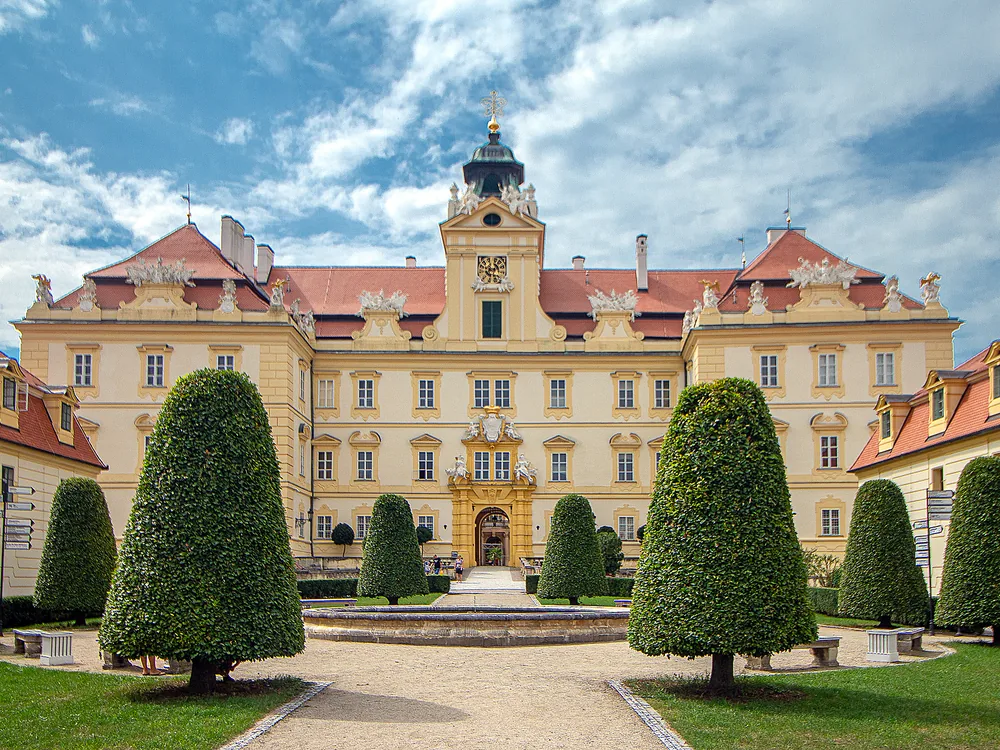
Built 1260 · Baroque residence of the Liechtenstein family at the centre of the UNESCO Lednice-Valtice Cultural Landscape (inscribed 1996); the original medieval fortress was progressively transformed through the 16th–18th centuries, with the decisive Baroque remodelling completed under Karl Eusebius von Liechtenstein between 1629 and 1678 to designs by the court architect Johann Bernhard Fischer von Erlach — who later designed the Karlskirche in Vienna; the result is one of the most important High Baroque residential complexes in Central Europe, with a 200-room interior, a state chapel, a riding school, and gardens formally laid out in the Baroque manner; Valtice was the primary seat of the Liechtenstein family before they relocated their court to Vienna; the UNESCO inscription covers the entire Lednice-Valtice area — approximately 280 km² of designed landscape including Valtice Chateau, Lednice Castle, and a system of Neo-Gothic follies, colonnades, minarets, and hunting lodges distributed through the connecting parkland in what is the largest formally designed landscape in Europe
This page is part of an independent travel guide and is not affiliated with, endorsed by, or operated by Valtice Chateau.
© Castles & Palaces
Quick Facts
- Hours
- Tue–Sun 09:00–17:00. Closed Mon
- Day trip from
- €169
- Duration
- 2–3 hours
- Best time
- April to October
- Nearest city
- Mikulov
Featured Tour
From Bratislava: Moravia: Lednice Castle and park
Cancellation available · Instant confirmation
Highlights
- ✦Valtice Chateau is a UNESCO World Heritage Site as part of the Lednice-Valtice Cultural Landscape (inscribed 1996) — 280 km² of designed parkland linking Valtice and Lednice Castle through a 19th-century Romantic landscape dotted with follies, a minaret, colonnades, a hunting lodge, and a temple; it is the largest formally designed landscape in Europe, and Valtice is its Baroque cornerstone
- ✦The chateau's Baroque remodelling was carried out to designs by Johann Bernhard Fischer von Erlach — the same architect who later designed the Karlskirche in Vienna and the Hofbibliothek; the Valtice commission preceded both and is one of his earliest major works; standing in front of the chateau's south facade is to see Fischer von Erlach's Baroque vocabulary in its formative phase
- ✦The National Wine Salon of the Czech Republic (Národní vinný salon) occupies the chateau's historic cellars and presents the 100 best Czech wines selected annually from approximately 6,000 entries — a tasting room and wine library that is open year-round (Thursday–Sunday) and accessible independently of the historic state rooms; this makes Valtice one of the few European heritage sites where the strongest visitor recommendation is to visit the cellar
- ✦The Liechtenstein family, who built Valtice as their primary seat from the 17th century and whose name now applies to a microstate between Austria and Switzerland, accumulated one of the largest private landholdings in Central Europe from this base; the scale of the Lednice-Valtice landscape — 280 km² of designed grounds — reflects the financial resources of a family wealthy enough to treat an entire river valley as a private garden
- ✦The proximity of [Lednice Castle](/castles/czech-republic/lednice-castle) — 12 kilometres north, the Liechtenstein family's Neo-Gothic summer castle with a minaret on the grounds and artificial lake — gives the Valtice visit its essential counterpart; the two buildings are the anchors of the UNESCO landscape and represent the same family's architectural ambitions across two centuries (17th-century Baroque at Valtice, 19th-century Neo-Gothic at Lednice)
Tickets & tours
Book through GetYourGuide
Valtice Chateau stands at the southern end of the Lednice-Valtice Cultural Landscape, in the South Moravian wine region close to the Austrian border, approximately 60 kilometres south of Brno. The town of Valtice is itself a compact Baroque settlement — the chateau's architecture extends into the town square and the surrounding streets, creating a coherent urban fabric that reflects the Liechtenstein family's control of the entire territory, not just the palace grounds. The chateau, the riding school, the state chapel, the gardens, and the wine cellars form an ensemble that occupies a substantial fraction of the town's total area.
The UNESCO inscription covers something considerably larger than the chateau itself. The Lednice-Valtice Cultural Landscape is a 280-square-kilometre area of designed parkland, formal garden, vineyard, and woodland linking Valtice Chateau with [Lednice Castle](/castles/czech-republic/lednice-castle) 12 kilometres to the north. Between the two major buildings, the Liechtenstein family distributed a series of landscape follies across the parkland during the late 18th and early 19th centuries: a Moorish minaret (the tallest in Central Europe outside of Istanbul), a temple of Diana, a colonnade, a triumphal arch, a hunting lodge, an aqueduct, and several other designed features that turned the connecting landscape into an outdoor gallery of architectural ornament. The designation of this entire landscape as a UNESCO World Heritage Site in 1996 recognised that the Lednice-Valtice area is not a castle with surrounding parkland but a designed landscape of continental scale — the largest of its kind in Europe.
The original medieval fortress at Valtice dates to the mid-13th century, when the strategic position on the Moravian-Austrian border made it a useful defensive point. The Liechtenstein family acquired Valtice in the early 14th century and made it their primary Moravian seat through the medieval period. The decisive architectural transformation came between 1629 and 1678, when Karl Eusebius von Liechtenstein commissioned a comprehensive Baroque remodelling from Johann Bernhard Fischer von Erlach. The Valtice commission was an early work in Fischer von Erlach's career — he would later design the Karlskirche and the Imperial Library (Hofbibliothek) in Vienna — and the chateau represents his Baroque vocabulary in a transitional phase, more restrained than his later Viennese work but already displaying the characteristic synthesis of Italian and Nordic Baroque influences that would define his mature style.
The chateau's interior reflects the ambitions of a family that was simultaneously a major European dynastic power and a Southern Moravian landowner. The 200 rooms include state reception halls, ducal apartments, a state chapel with ceiling frescoes, and the functional rooms of a large household that was actively used as a primary residence rather than an occasional showpiece. The scale of the Baroque programme — not just the building but the formal gardens, the riding school, the service buildings, the wine cellars — reflects the Liechtenstein family's wealth at the height of their influence, when they were one of the largest landowners in the Habsburg Empire.
The wine cellar is an unusual asset. The National Wine Salon of the Czech Republic (Národní vinný salon) occupies the chateau's historic cellar system and presents the 100 best Czech wines selected annually through a blind tasting competition from approximately 6,000 national entries. The tasting room is open Thursday–Sunday year-round, independently of the historic state rooms, and the wine library allows visitors to taste the selected wines by the glass. The recommendation to visit the cellar is not facetious: the Czech wine industry produces wines of genuine quality, particularly from the South Moravian wine region that surrounds Valtice, and the annual Wine Salon selection represents a curated introduction to that quality in the most appropriate possible setting.
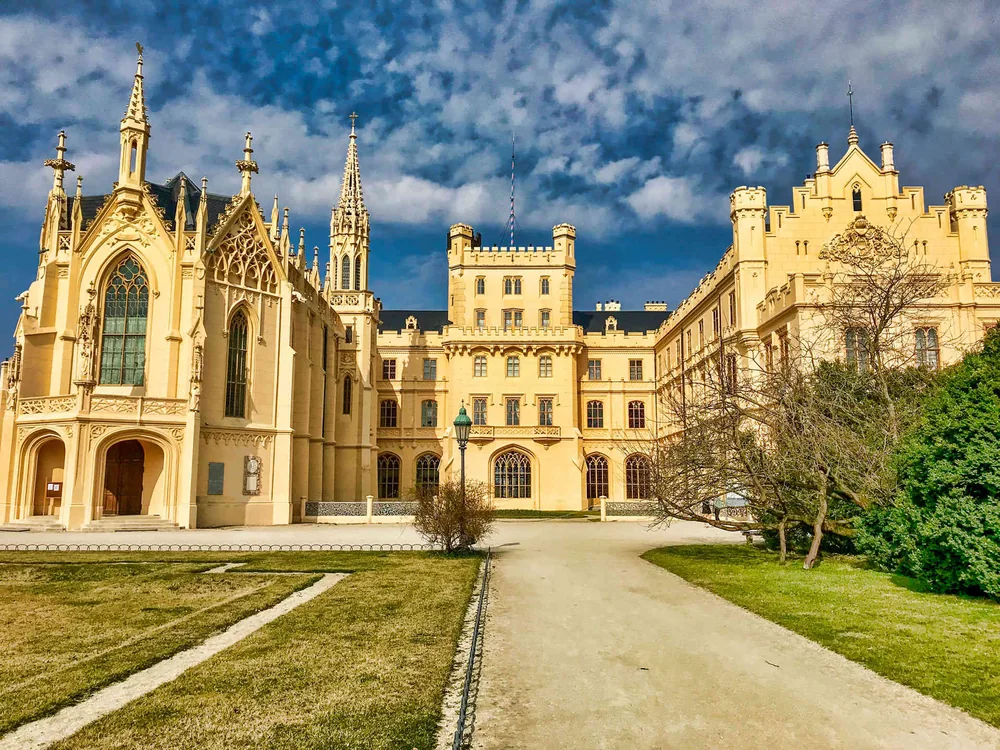
[Lednice Castle](/castles/czech-republic/lednice-castle) is the essential companion to Valtice. The Neo-Gothic castle, built by the Liechtenstein family in the early 19th century as a Romantic summer residence, represents the same family's architectural patronage a century and a half after Valtice — the shift from High Baroque to Romantic Neo-Gothic mirrors the broader European shift in aristocratic taste. Between the two castles, the UNESCO landscape with its follies and designed parkland fills in the 18th-century chapter that connects Baroque formality to 19th-century Romanticism.
The GetYourGuide day tour from Vienna or Brno covers the Lednice-Valtice area and Mikulov in a single day — the most efficient circuit for visitors without their own transport, combining the two UNESCO castles with the historic wine town of Mikulov on the Austrian border.
History
The Liechtenstein family acquired Valtice in the early 14th century and made it their primary Moravian seat, establishing at a strategic border position between Moravia and Austria a dynastic presence that would persist for six centuries. The medieval fortress that they inherited gradually gave way to a Baroque transformation: the major remodelling commissioned by Karl Eusebius von Liechtenstein between 1629 and 1678, with designs attributed to Johann Bernhard Fischer von Erlach, gave the chateau the architectural character it presents today — a Baroque palace of the first order on the Moravian-Austrian border.
Through the 17th and 18th centuries, the Liechtenstein court used Valtice as its primary seat while systematically redesigning the surrounding landscape as parkland. The project of giving the entire territory between Valtice and Lednice Castle an architectural presence — through follies, temples, mausoleums, and hunting lodges distributed across some 200 square kilometres of managed landscape — was among the most ambitious private landscape projects in European history. The result is the Lednice-Valtice Cultural Landscape, inscribed as a UNESCO World Heritage Site in 1996.
The Liechtenstein family was expelled from Czechoslovakia in 1945 under postwar decrees, and the chateau was nationalised. It is now open as a museum from April to October. The cellars, which the Lichtenstein estate used for wine production across the centuries, house the National Wine Salon of the Czech Republic — an institution that makes Valtice the symbolic capital of Moravian viticulture and keeps the cellars in operation year-round.
How to Visit
Getting there: Valtice is 60 km south of Brno and 60 km north of Vienna. By car, 50 minutes from Brno or 1 hour from Vienna. By train, from Brno to Valtice takes 90 minutes; from Vienna, travel via Bernhardsthal (~1.5 hours). The chateau is a 5-minute walk from Valtice train station.
Tickets: Walk-up entry to the state rooms is 250 CZK adult, 150 CZK child; the National Wine Salon in the cellars is separately ticketed and open Thursday–Sunday year-round. The GetYourGuide day trip from Bratislava covers Lednice Castle and park over 12 hours, with Valtice included as an optional extra.
Practical tips: The National Wine Salon in the cellars presents the 100 best Czech wines selected annually from 6,000 entries — worth visiting independently of the state rooms on Thursday–Sunday. Visit in September or October to coincide with the South Moravian wine harvest in the surrounding vineyards.
Combine with: Lednice Castle — 12 km north, the Romantic Neo-Gothic counterpart in the same UNESCO landscape, connected by cycle paths through the designed parkland.
Frequently Asked Questions
The Lednice-Valtice Cultural Landscape is a 280-square-kilometre designed landscape in South Moravia linking Valtice Chateau with Lednice Castle through formal parkland, vineyards, and woodland. The Liechtenstein family, who owned the entire area from the 14th century to 1945, systematically designed the connecting landscape with follies, a Moorish minaret, colonnades, temples, and a hunting lodge. UNESCO inscribed it in 1996 as the largest formally designed landscape in Europe — not just a castle with grounds, but a designed cultural landscape at the scale of a small principality.
Location
Zámecké náměstí 1, 691 42 Valtice, Czech Republic
Nearby Castles
Tours & Tickets
Powered by GetYourGuide
From
€169/ person