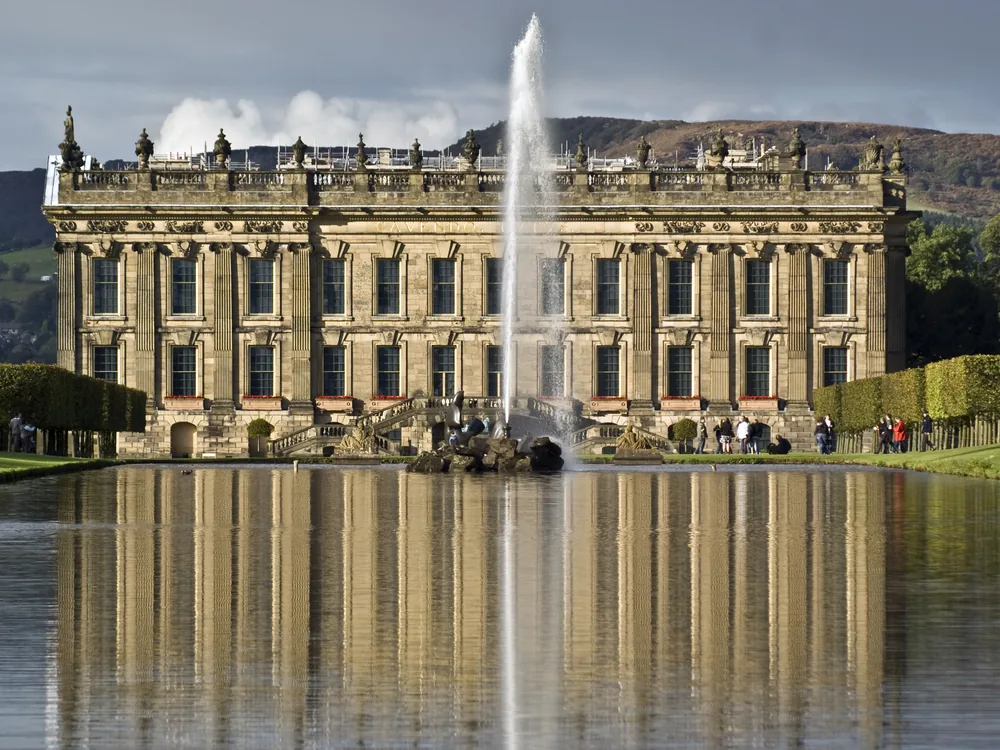
Chatsworth House
Chatsworth House
England · Derbyshire / Peak District · Near Bakewell
Built 1686 · English Baroque / Neoclassical country house — the current building was rebuilt in Baroque style by William Talman under the 1st Duke of Devonshire between 1686 and 1707, then extended and remodelled in Neoclassical style by Jeffry Wyatville in the 1820s for the 6th Duke; the Capability Brown landscape (1760s) replaced the formal Baroque garden with the naturalistic English parkland style; the house is set in a 25-mile estate in the Peak District above the River Derwent
This page is part of an independent travel guide and is not affiliated with, endorsed by, or operated by Chatsworth House.
© Castles & Palaces
Quick Facts
- Hours
- Daily 10:30–17:00
- Day trip from
- €127
- Duration
- 3–4 hours (house + garden); a full day if combining house, garden, farmyard, and estate walks
- Best time
- May to September
- Nearest city
- Bakewell
Featured Tour
From Manchester: Chatsworth House & Buxton Day Trip (Entry Included)
Cancellation available · Instant confirmation
Highlights
- ✦The art collection — assembled over 500 years by the Cavendish family; includes Old Master paintings (Rembrandt's 'An Old Man', Reynolds' portraits, Veronese, Van Dyck, Tintoretto), drawings (Raphael, Rubens), sculpture (Canova, Thorvaldsen), and a significant neoclassical collection assembled by the 6th Duke — one of the finest private art collections in Britain still held in its original setting
- ✦The Painted Hall and State Rooms — the Baroque entrance hall painted by Louis Laguerre (1694); the State Dining Room; the Sketch Galleries with drawings by Raphael and Dürer; and the 6th Duke's Sculpture Gallery with Canova's 'Sleeping Endymion' — a circuit of interconnected rooms that function as a private museum of European art
- ✦The Emperor Fountain — in the Chatsworth garden, the Emperor Fountain (built 1843 to impress Tsar Nicholas I on a planned visit that never happened) reaches heights of 90 metres, making it one of the highest gravity-fed fountains in the world; water is stored in the Emperor Lake on the moor above the house and fed by gravity alone
- ✦The Capability Brown landscape — the 1st Duke's formal Baroque garden (with its cascade, still flowing) was overlaid in the 1760s by Lancelot 'Capability' Brown's naturalistic English parkland design; the result is a landscape of great diversity: formal water features, kitchen garden, rock garden, cascade, arboretum, and the open parkland with its herd of fallow deer
- ✦The GetYourGuide day trip from Manchester — the guided tour (8 hours) includes coach transport from Manchester, a stop in the spa town of Buxton, and admission to Chatsworth, covering the house interior and grounds; the only practical way to visit without a car from Manchester
- ✦The Devonshire family connection — the 1st Duke obtained the title in 1694 for supporting the Glorious Revolution (1688); the family's political influence during the 18th century was such that they were often described as a parallel government; the 11th Duke Peregrine Cavendish (died 2004) opened the house to paid visitors in 1949 to meet the inheritance tax bill
Skip the queue with a guided tour
Skip-the-line tickets & expert guides
Chatsworth House is the benchmark English country house — the building by which all others are measured, not because it is the oldest or the largest, but because the combination of setting, art collection, landscape, and accumulated family history is the most complete expression of what the English aristocratic tradition produced over five centuries. It sits on the eastern bank of the River Derwent in a natural amphitheatre of Peak District moorland, and has been the seat of the Cavendish family, Dukes of Devonshire, since the 1550s — though the current building dates from a wholesale Baroque reconstruction begun in 1686.
The first Chatsworth was built by Bess of Hardwick and her husband Sir William Cavendish from 1549, a Tudor courtyard house on the same site. The 1st Duke of Devonshire, William Cavendish, obtained his dukedom in 1694 for his role in supporting the Glorious Revolution of 1688 (he was among the seven nobles who signed the letter inviting William of Orange to take the English throne), and to mark the elevation he commissioned the demolition and rebuilding of Chatsworth in the Baroque style then fashionable in Continental Europe. The architect William Talman designed the south and east fronts; the 1st Duke himself contributed to the design of the north and west. The cascade in the garden, still flowing, dates from this Baroque phase.
The house's art collection developed most intensively in the 18th century, when the 3rd and 4th Dukes made collecting a central activity, acquiring paintings, drawings, and sculpture on the Grand Tour circuit. The collection that visitors see today — in rooms designed partly to display it — includes Rembrandt's portrait 'An Old Man,' Reynolds' portraits of English nobility, works by Veronese, Van Dyck, and Tintoretto, and a significant drawing collection (Raphael, Rubens, Dürer) housed in the Sketch Galleries. The 6th Duke, the 'Bachelor Duke' (1790–1858), made the most extravagant additions: he commissioned Joseph Paxton as his head gardener, authorised the Emperor Fountain (built in 1843 to impress a visit by Tsar Nicholas I that never materialised), and assembled the Sculpture Gallery with Canova's 'Sleeping Endymion' at its centrepiece.
The Capability Brown landscape of the 1760s — replacing the 1st Duke's formal Baroque parterre garden — is the exterior complement to the art collection. Brown's approach was to make the estate appear as if nature had arranged it perfectly: open parkland falling to the river, clumps of trees on ridges, the house positioned as a natural object in a designed-to-look-natural countryside. The kitchen garden, the rock garden (Joseph Paxton's Swiss-influenced design, 1840s), the Cascade House waterfall, and the Emperor Fountain all survive within this naturalistic framework.
The GetYourGuide-listed day trip (8 hours) departs from Manchester and includes a stop in Buxton (the nearby Georgian spa town, with the Crescent baths and the opera house) before arriving at Chatsworth. The tour price **includes admission to the house and gardens** — the guided commentary covers both the interior rooms and the estate. This is the practical option for visitors without a car, since Chatsworth has no direct rail connection; the estate is accessible by bus from Bakewell in summer (seasonal Transpeak bus), but the day-trip coach is significantly more comfortable.
History
First Chatsworth built by Bess of Hardwick from 1549. Demolished and rebuilt in Baroque style by the 1st Duke of Devonshire (1686–1707). Title obtained in 1694 for supporting the Glorious Revolution. Art collection expanded by 3rd and 4th Dukes in the 18th century. Capability Brown redesigned the landscape in the 1760s. The Bachelor Duke (6th, 1790–1858) commissioned Paxton, the Emperor Fountain (1843), and the Sculpture Gallery. The 11th Duke opened the house to paid visitors in 1949 to fund inheritance tax. Now managed by the Chatsworth House Trust; house and estate remain the home of the 12th Duke and Duchess of Devonshire.
How to Visit
Getting there: By car, Chatsworth is around 1h30 from Manchester via the A6 through Buxton and the B6012, and about 45 minutes from Sheffield via the A621 Baslow Road; the estate has large car parks charged separately. There is no direct rail connection. From Bakewell (5 km), a seasonal Transpeak bus (Route 214/218) serves the estate in summer. The GetYourGuide day trip coach from Manchester is the most practical option for visitors without a car.
Tickets: Walk-up admission is £30 for adults and £15 for children, covering the house and garden (the farmyard is priced separately). The GetYourGuide day trip from Manchester includes full entry to the house and gardens plus a stop in Buxton — book at least a week ahead in peak season.
Practical tips: Allow a full day if combining the house, garden, farmyard, and an estate walk. The Emperor Fountain operates at scheduled times — check the board on arrival. The Sketch Galleries (Raphael and Dürer drawings) and the 6th Duke's Sculpture Gallery (Canova's Sleeping Endymion) are consistently less crowded than the grand State Rooms and are worth prioritising.
Combine with: The Georgian spa town of Buxton (13 km northwest) and Haddon Hall (9 km south, a remarkably complete medieval manor house) pair naturally with Chatsworth for a full Peak District heritage day.
Frequently Asked Questions
Yes — Chatsworth is not on any rail line, and the bus connections from Bakewell are seasonal and infrequent. The GetYourGuide coach tour from Manchester is the most practical option for visitors without a car: it includes admission, a Buxton stop, and a full day at the house and grounds. Self-drivers from Manchester or Sheffield have a reasonably straightforward drive of 1–1.5 hours.
Location
Chatsworth, Bakewell, Derbyshire DE45 1PP, England
Nearby Castles
Tours & Tickets
Powered by GetYourGuide
From
€127/ person