
Viljandi Castle Ruins
Viljandi ordulinnuse varemed
Estonia · Viljandi County, Southern Estonia · Near Tartu
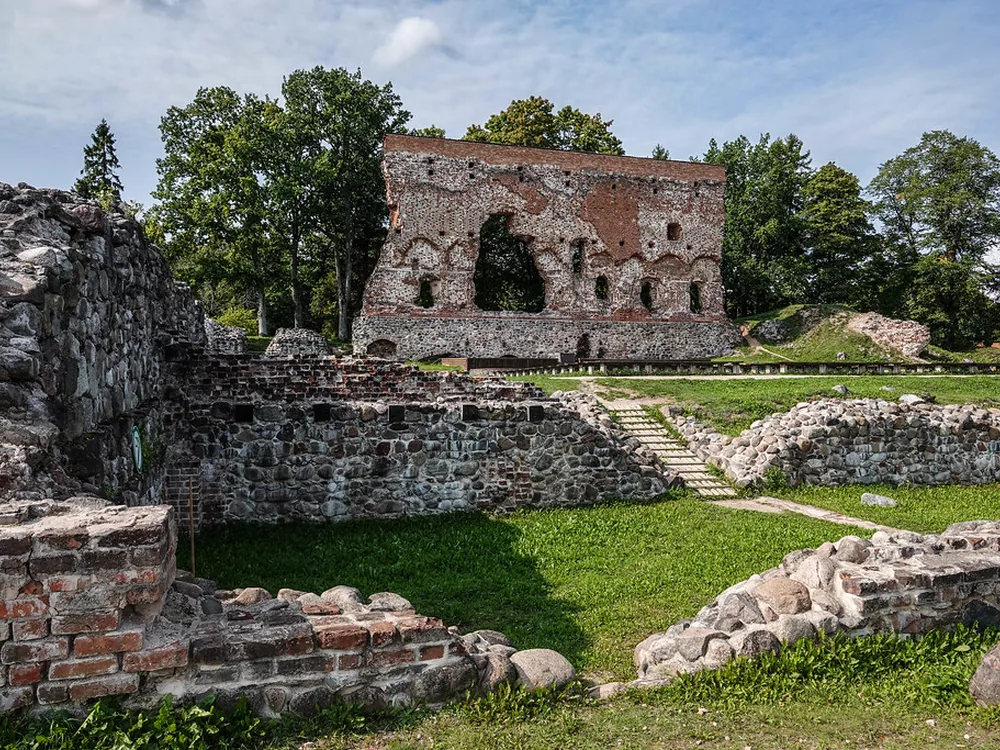
Built 1224 · Livonian Order castle ruins in a scenic lakeside hill park — originally built from 1224 by the Order of the Sword Brothers (Livonian Brothers of the Sword), which was absorbed into the Teutonic Order in 1237 to become the Livonian Order; the castle became the third largest Livonian Order castle in the region, after Riga and Cesis, with a complex multi-phase construction across the 13th to 15th centuries developing a main castle, two foreworks (outer defensive enclosures), and a lower bailey; the castle was damaged during the Livonian War (1558–1583) and finally destroyed during the Great Northern War (1700–1721) — the fortification was demolished by Russian forces to prevent its use by Swedish military; the ruins are now located within the Viljandi Castle Hill Park (Lossipark), a 19th-century romantic landscape garden laid out around the medieval ruins on a ridge above Lake Viljandi; a distinctive feature of the site is a suspension footbridge crossing a moat depression on the castle hill — one of the most photographed pieces of infrastructure in southern Estonia; Viljandi is associated with one of the largest folk music festivals in the world, the Viljandi Folk Music Festival, held annually in late July in and around the castle park since 1994
This page is part of an independent travel guide and is not affiliated with, endorsed by, or operated by Viljandi Castle Ruins.
© Castles & Palaces
Quick Facts
- Hours
- Mon–Sun Park open year-round, 24 hours
- Guided tour from
- €75
- Duration
- 1–1.5 hours (ruins + park walk + lake view)
- Best time
- May to September
- Nearest city
- Tartu
Featured Tour
Viljandi: Castle Ruins and City Private Guided Tour
Cancellation available · Instant confirmation
Highlights
- ✦The Livonian Order castle at Viljandi was one of the most significant fortifications in medieval Estonia — third in size and importance among Livonian Order strongholds after Riga and Cesis, with a main castle, two outer defensive enclosures (foreworks), and a lower bailey developing across multiple construction phases from the 13th to the 15th centuries; the Order of the Sword Brothers captured the site from local Estonian tribes in 1224 and built an initial fortification that was subsequently expanded as the Livonian Order (into which the Sword Brothers were absorbed in 1237 after a catastrophic military defeat at the Battle of Saule) consolidated its administrative hold over Estonia and Latvia; the castle served as the regional administrative centre for the Livonian Order's southern Estonian territory for more than 300 years
- ✦The Viljandi Folk Music Festival (Viljandi pärimusmuusika festival) is held annually in late July in and around the castle park since 1994, and has grown into one of the largest traditional and world music events in Northern Europe — attracting approximately 25,000 visitors to a town of 17,000 permanent residents, with stages in the castle ruins, the surrounding park, and venues across the town; the festival's programming emphasises traditional Estonian, Northern European, and world music alongside contemporary folk-influenced artists; the juxtaposition of medieval ruin acoustics and 21st-century folk music programming in a park around a 13th-century Livonian castle is one of the more distinctive festival settings in the Baltic region
- ✦The suspension bridge crossing the old moat depression at the Viljandi castle hill is one of the most photographed pieces of infrastructure in southern Estonia — a modern pedestrian footbridge suspended across what was once the water-filled moat between the castle's outer forework and the main castle; the moat is now a dry grassy depression in the landscape park, and the bridge crossing it provides the most dramatic approach to the ruin from below; the view back from the bridge toward the ruin walls above is the defining image of Viljandi castle in visitor photography
- ✦The destruction of Viljandi Castle came in two phases that reflect the larger geopolitical history of the Baltic. The Livonian War (1558–1583) — during which Ivan the Terrible's Russia invaded and contested the Livonian Confederation with Denmark, Poland-Lithuania, and Sweden — inflicted the first serious damage on the castle; the war ended with the Livonian Order's dissolution and Estonia coming under Swedish rule. The Great Northern War (1700–1721) — Peter the Great's war against Sweden for control of the Baltic — completed the destruction: Russian forces demolished the fortification to prevent its military use by Sweden. Viljandi castle was not simply abandoned to decay; it was deliberately demolished during one of the most consequential geopolitical shifts in Baltic history
- ✦Lake Viljandi, visible from the castle hill, is part of the landscape context that makes the Lossipark setting distinctive — the view from the ruin walls down to the lake, with the forested lakeside below and the town of Viljandi visible, is one of the most scenic vistas in southern Estonia; the combination of medieval ruins, 19th-century romantic landscape park, lake view, and summer folk festival creates a layered experience that makes Viljandi more interesting as a town visit than many single-site castle destinations; Viljandi has been named one of the most liveable small towns in Estonia and has a cultural infrastructure (museums, theatres, the music school of traditional music that organises the folk festival) disproportionate to its size
Skip the queue with a guided tour
Skip-the-line tickets & expert guides
Viljandi Castle ruins stand on a ridge above Lake Viljandi in the Lossipark (Castle Hill Park) in southern Estonia, approximately 160 kilometres south of Tallinn and 60 kilometres southwest of Tartu. The castle was one of the most significant Livonian Order fortifications in medieval Estonia — third in size after Riga and Cesis — and its history follows the larger arc of Baltic medieval and early modern geopolitics from the 13th-century Crusader conquest to the Great Northern War destruction in the 18th century.
The Order of the Sword Brothers (Livonian Brothers of the Sword) captured the site from local Estonian populations in 1224 and built the initial fortification. After the catastrophic defeat of the Sword Brothers at the Battle of Saule (1236), the order was absorbed into the Teutonic Order and reconstituted as the Livonian Order in 1237. Under Livonian Order administration, the Viljandi castle complex expanded substantially across the 13th to 15th centuries into a major fortification comprising a main castle, two outer foreworks (defensive enclosures), and a lower bailey — the administrative centre for the Order's southern Estonian territory for more than three centuries.
The castle's end came in two phases of Baltic geopolitical disruption. The Livonian War (1558–1583), in which Ivan the Terrible's Russia invaded and contested the Livonian Confederation with Denmark, Poland-Lithuania, and Sweden, inflicted the first serious damage. The war ended with the Livonian Order's dissolution and Estonia coming under Swedish rule. Then the Great Northern War (1700–1721) — Peter the Great's systematic campaign against Swedish Baltic dominance — brought the final destruction: Russian forces demolished Viljandi Castle specifically to deny it to Swedish military use. The ruin was therefore not simply abandoned; it was deliberately wrecked during one of the defining geopolitical shifts in Baltic history.
The ruins now sit within the Lossipark, a romantic landscape park laid out in the 19th century around the medieval walls. The park descends from the castle ridge to Lake Viljandi, with views across the water from the ruin walls. A suspension footbridge crossing the old moat depression is the most photographed feature of the site — a modern pedestrian structure suspended over what was once the water-filled moat between the outer forework and the main castle.
The Viljandi Folk Music Festival (Viljandi pärimusmuusika festival), held annually in late July in the castle park and surrounding venues since 1994, is one of the largest traditional and world music events in Northern Europe — drawing approximately 25,000 visitors to a town of 17,000 permanent residents, with stages set among the castle ruins and in the park. The festival's programming emphasises Estonian and Northern European traditional music alongside world music and contemporary folk-influenced artists.
Access to the ruins and Lossipark is free year-round. The GetYourGuide product is a private guided tour of Viljandi and the castle ruins for groups of up to 15 — €75 per group, not per person. Independent visitors can reach Viljandi from Tartu (1.5 hours by bus) or Tallinn (2.5 hours). [Toompea Castle](/castles/estonia/toompea-castle) in Tallinn is the natural companion piece — the other major Estonian castle heritage site, and the seat of the Estonian Parliament.
History
The Order of the Sword Brothers captured the Viljandi hilltop in 1224 and immediately began construction of a fortification that would become one of the most significant in medieval Estonia. The catastrophic defeat at the Battle of Saule in 1236 — where Lithuanian and Semigallian forces destroyed the Sword Brothers as a fighting force — interrupted the project but did not end it: the surviving Sword Brothers were absorbed into the Teutonic Order as the Livonian Order, and construction continued. Over the 13th to 15th centuries, the complex expanded to include the main castle, two foreworks, and a lower bailey, growing into the third largest Livonian Order castle in Estonia.
The Livonian War of 1558–83, which ended with the dissolution of the Livonian Order and the transfer of Estonia to Swedish rule, damaged the castle significantly. The final destruction came during the Great Northern War of 1700–21, when Russian forces systematically demolished Viljandi Castle as part of their campaign to secure Baltic dominance. What they left behind became, through a characteristic shift of sensibility, a Romantic landscape asset: the 19th century saw the Lossipark laid out around the ruins as an atmospheric landscape garden, preserving the medieval fabric as a picturesque feature rather than rebuilding it.
The ruins are freely accessible year-round, and since 1994 the castle park has hosted the Viljandi Folk Music Festival each July — an event that draws around 25,000 visitors annually to the medieval remains.
How to Visit
Getting there: By bus from Tartu: ~1.5 hours (frequent service). By bus from Tallinn: ~2.5 hours. The Viljandi bus station is a short walk from the Lossipark entrance. By car from Tartu: 60 km, ~1 hour.
Tickets: Entry is free. The GetYourGuide guided tour (from €75 per group of up to 15) covers Viljandi city and the castle ruins with a private guide — good value for groups visiting together.
Practical tips: Cross the suspension footbridge from below for the best view up to the ruin walls — it is the defining image of the site. If visiting in late July, the Viljandi pärimusmuusika festival fills the castle park with stages and up to 25,000 visitors; check viljandifolk.ee for dates and tickets in advance.
Combine with: Toompea Castle in Tallinn for Estonia's other major castle site, paired with Tartu (university city, 60 km east) for a full southern Estonia itinerary.
Frequently Asked Questions
Viljandi Castle was destroyed in two phases. The Livonian War (1558–1583), during which Russia, Denmark, Poland-Lithuania, and Sweden contested the Livonian Confederation, inflicted the first serious damage. The Livonian Order was dissolved and Estonia came under Swedish rule. Then, during the Great Northern War (1700–1721), Russian forces demolished the castle specifically to prevent its military use by Sweden. The ruin was not simply abandoned — it was deliberately dismantled during one of the most consequential shifts in Baltic political history.
Location
Lossipark, Viljandi 71001, Estonia
Nearby Castles
Tours & Tickets
Powered by GetYourGuide
From
€75/ person