
Castle of Lichtenberg
Château de Lichtenberg
France · Alsace / Bas-Rhin · Near Strasbourg
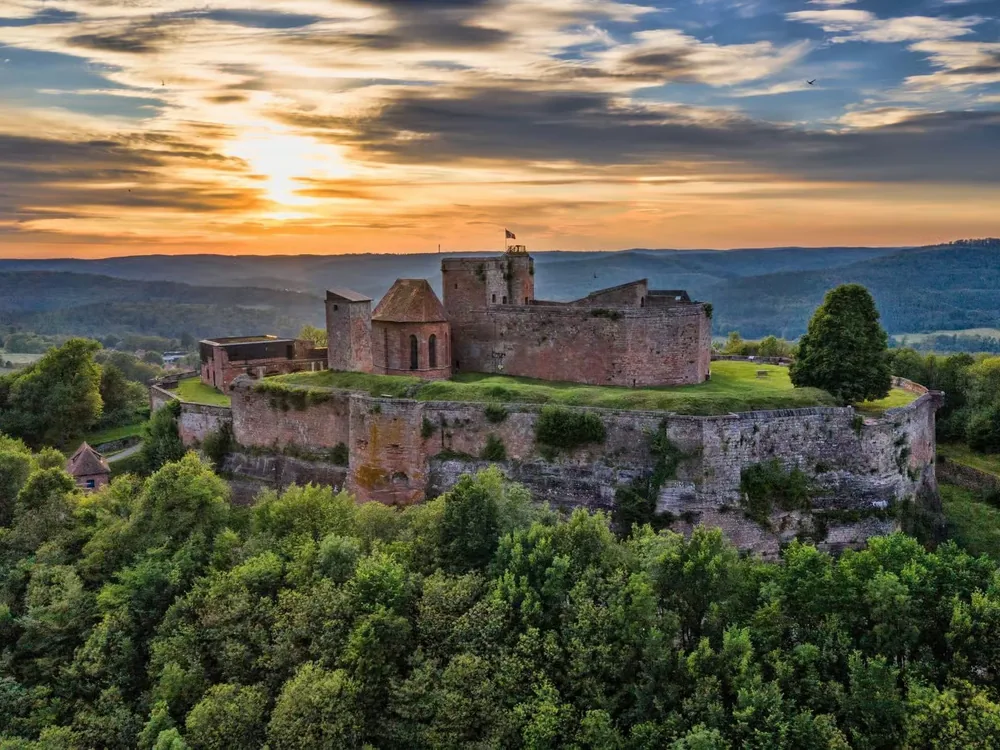
13th century · Medieval castle substantially redesigned for the gunpowder era — the original 13th-century castle on the Vosges du Nord sandstone spur was comprehensively rebuilt around 1580 by the Counts of Hanau-Lichtenberg to incorporate artillery bastions, gun embrasures, and a residential palace block within the medieval perimeter; the result is a late-Renaissance military engineering conversion that anticipates the Vauban fortification school of the 17th century; the red sandstone construction gives the castle a distinctive warm colour characteristic of the Vosges du Nord
This page is part of an independent travel guide and is not affiliated with, endorsed by, or operated by Castle of Lichtenberg.
© Castles & Palaces
Quick Facts
- Hours
- Tue–Sun 10:00–17:00. Closed Mon
- Entry via GetYourGuide
- €9
- Duration
- 1.5–2 hours (self-guided; indoor exhibitions + panoramic outdoor areas + castle circuit)
- Best time
- May to October
- Nearest city
- Strasbourg
Featured Tour
Castle of Lichtenberg: Self-Guided Admission Ticket (Alsace)
Cancellation available · Instant confirmation
Highlights
- ✦The 1580 artillery redesign — the most architecturally significant aspect of Lichtenberg is the comprehensive 16th-century transformation from a medieval tower castle to an artillery fortress; the Counts of Hanau-Lichtenberg hired military engineers who replaced the medieval perimeter with angled bastions, gun embrasures, and a residential palace block — creating a hybrid that is neither purely medieval castle nor purely Renaissance fortification, but a transitional moment in military architecture preserved in unusually complete form
- ✦The Vosges du Nord Regional Natural Park setting — the castle is on a sandstone spur in the Vosges du Nord, a UNESCO Biosphere Reserve and Regional Natural Park covering 130,000 hectares of mixed forest, sandstone outcrops, and traditional Alsatian villages; the castle is one of the three principal heritage monuments within the park alongside Fleckenstein Castle and the Wasenbourg ruins
- ✦The indoor exhibitions — the castle houses permanent exhibitions on the history of Lichtenberg from the medieval period through the Thirty Years' War (when the castle was significantly damaged), the Reformation (Lichtenberg and the Hanau-Lichtenberg county were among the earliest territories in the Holy Roman Empire to adopt Protestantism, in the 1520s), and the 19th-century romantic rediscovery of Alsatian medieval heritage
- ✦Panoramic views — from the castle's highest points, the views extend across the Alsatian plain to the Black Forest in Germany and, on clear days, to the Vosges mountains southward; the sandstone spur gives the castle commanding sight lines across the northern Alsace approaches
- ✦The red sandstone construction — the Vosges du Nord is characterised by its Buntsandstein (red sandstone), and Lichtenberg's walls glow with a warm amber-red colour unlike the grey limestone of most French medieval fortresses; the material is visible in the detailed masonry of the 16th-century rebuilding
- ✦Near Haut-Kœnigsbourg (~45km south) — both are major surviving Alsatian fortresses; Haut-Kœnigsbourg (on this site) is the better-known, more comprehensively restored counterpart; Lichtenberg is significantly less visited and retains more authentic ruin character
Skip the queue with a guided tour
Skip-the-line tickets & expert guides
The Castle of Lichtenberg occupies a sandstone spur in the Vosges du Nord Regional Natural Park, in northern Alsace approximately 60 kilometres north of Strasbourg and 45 kilometres north of the more famous Haut-Kœnigsbourg. It is a castle of two histories: a medieval history of the Counts of Lichtenberg and their successors the Counts of Hanau-Lichtenberg, which produced the original 13th-century structure; and a Renaissance history of military adaptation, which produced the comprehensive 1580 redesign that gave the castle the character it still has today.
The original castle was built on the sandstone spur in the 13th century by the Counts of Lichtenberg, one of the dominant noble families of northern Alsace. The Lichtenberg county expanded through the 13th and 14th centuries until it was among the most significant territories in the Upper Rhine region. On the death of the last Count of Lichtenberg in 1480, the territory passed to the Counts of Hanau, who merged it into the County of Hanau-Lichtenberg — a composite territory straddling the Rhine between Alsace and what is now Rhineland-Palatinate. The Hanau-Lichtenberg counts were among the earliest adopters of Protestantism in the Holy Roman Empire: Philip I of Hanau-Lichtenberg introduced Lutheran reforms in the 1520s, making his territories a Protestant island surrounded by largely Catholic Alsatian neighbours.
The 1580 redesign was the decisive moment in the castle's architectural history. By the mid-16th century, the development of gunpowder artillery had rendered the tall, thin walls of medieval castles militarily obsolete: cannon fire could breach them in hours, and high walls gave defenders no ability to return fire. The Italian school of military engineering had developed the trace italienne solution — low, thick, angled bastions that could absorb cannon shot, eliminate dead ground, and provide platforms for defensive artillery — and this system was being adopted across the Holy Roman Empire's fortifications. The Hanau-Lichtenberg architects applied a version of it to Lichtenberg comprehensively: the medieval perimeter was modified with artillery bastions and gun embrasures, a new residential palace block was constructed within the courtyard, and the overall defensive profile was lowered and thickened. The result anticipated the Vauban fortification principles that would become dominant in France a century later.
The Thirty Years' War (1618–1648) was catastrophic for Lichtenberg and for Alsace generally. The castle was besieged and captured multiple times, sustaining damage that left parts of the structure as ruins that were never fully rebuilt. When Alsace was absorbed into France by the 1648 Peace of Westphalia, the strategic rationale for maintaining Lichtenberg diminished — Strasbourg's fortifications to the south were the priority. The castle passed through the post-war period as a gradually declining structure, its role as a residential seat ended, its military utility overtaken by more modern fortifications.
The 19th-century Romantic movement rediscovered Alsatian medieval heritage, and Lichtenberg became an object of archaeological and historical interest. The French state undertook consolidation works in the 20th century to stabilise the surviving fabric, and the current permanent exhibitions were installed in the castle's habitable sections. Today visitors move self-guided through the site, covering the 16th-century residential palace block (partially roofed, with exhibitions on the Counts of Lichtenberg and the 1580 reconstruction), the artillery bastions and ramparts, the medieval keep remnants, and the panoramic terraces with views across the Alsatian plain.
The GetYourGuide-listed self-guided admission (approximately 2 hours) provides entry to the full castle circuit. **The castle is not wheelchair accessible** — GetYourGuide's own listing and the castle's site note explicitly that the 15-minute uphill walk from the parking area on uneven paths, combined with the stepped castle interior, makes the site unsuitable for visitors with mobility limitations.
History
Castle established in the 13th century by the Counts of Lichtenberg. Territory inherited by the Counts of Hanau-Lichtenberg (1480) after the last Count of Lichtenberg died without direct heirs. Protestantism adopted under Philip I of Hanau-Lichtenberg in the 1520s. Comprehensive 1580 redesign for gunpowder artillery under the Hanau-Lichtenberg counts. Damaged and partially ruined during the Thirty Years' War (1618–1648). Absorbed into France under the 1648 Peace of Westphalia. 19th–20th century consolidation and archaeological study. Now managed by the Château de Lichtenberg association within the Vosges du Nord Regional Natural Park.
How to Visit
Getting there: From Strasbourg by car: ~55 minutes north on the D919/D6 to Lichtenberg village (~60 km). No practical public transport exists. Free parking in the village below; 15-minute uphill walk on uneven paths to the entrance — the castle is not accessible for visitors with mobility limitations.
Tickets: Adults €8, children €4; no advance booking required. The GetYourGuide self-guided admission ticket covers entry to the full castle circuit — exhibitions, ramparts, artillery bastions, and panoramic terraces.
Practical tips: Allow 1.5–2 hours for a thorough visit. The castle is closed November–March; in July–August, Mondays open at 14:00 only. The panoramic terraces give views across the Alsatian plain to the Black Forest — reach them via the 16th-century artillery ramparts circuit for the full experience.
Combine with: Haut-Kœnigsbourg (~45 km south near Sélestat) for a full Alsace castle day — the contrast between Lichtenberg's authentic partial ruin and Haut-Kœnigsbourg's comprehensive Kaiser Wilhelm II restoration is instructive.
Frequently Asked Questions
By 1580, gunpowder artillery had already been transforming European military architecture for over a century — the Italian trace italienne system had been developed and codified by the 1530s. The Hanau-Lichtenberg redesign of 1580 reflects the relatively late adoption of artillery fortification in the upper Rhine region compared to Italy or France, but it also reflects the peace of the period: the Thirty Years' War that would devastate the castle was still 38 years in the future, and the 1580 redesign represents precautionary investment in a time of relative regional stability.
Location
Rue du Château, 67340 Lichtenberg, France
Nearby Castles
Tours & Tickets
Powered by GetYourGuide
From
€9/ person