Château de Corabœuf
Château de Corabœuf (Val-Mont)
France · Bourgogne — Côte-d'Or, near Cussy-la-Colonne and Nolay, south of Beaune · Near Beaune
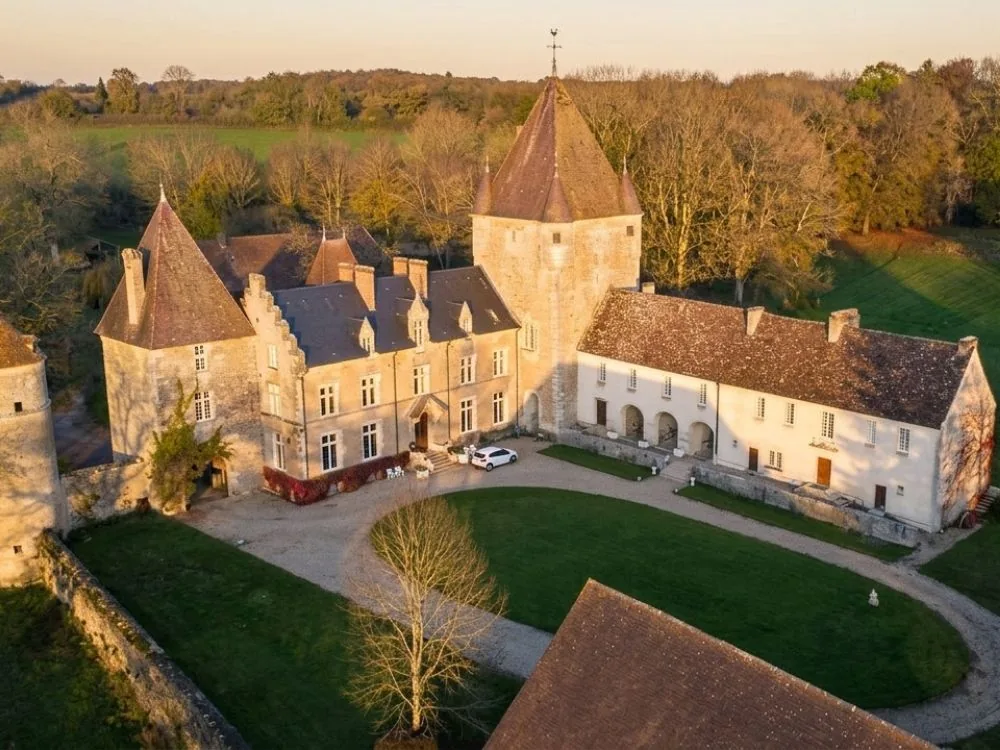
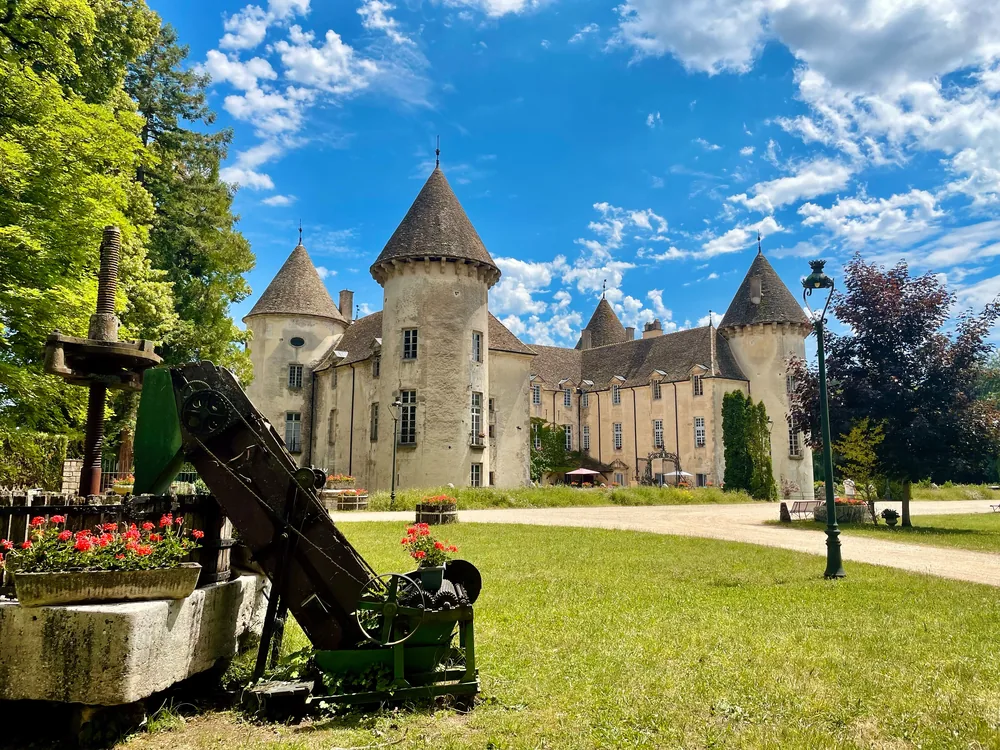
Built 1250 · Feudal donjon (keep) with cylindrical corner turrets — 13th–14th-century Burgundian construction in local limestone; associated structures include a fortified barn, a Hunter's Tower, formal gardens, and an arboretum; the estate fabric has never undergone comprehensive 19th-century restoration, preserving original medieval masonry in the donjon interior
This page is part of an independent travel guide and is not affiliated with, endorsed by, or operated by Château de Corabœuf.
© Castles & Palaces
Quick Facts
- Hours
- Tue–Fri 14:00–18:00. Sat & Sun 10:00–18:00. Closed Mon
- Entry via GetYourGuide
- €2
- Duration
- 1–1.5 hours (self-guided; estate + donjon)
- Best time
- April to October
- Nearest city
- Beaune
Featured Tour
Val-Mont: Visit to Château de Corabœuf — Admission Ticket
Cancellation available · Instant confirmation
Highlights
- ✦The 13th–14th-century donjon with original medieval masonry — the keep at Corabœuf has never undergone the comprehensive 19th-century restoration that reshaped many of France's most famous medieval monuments; the stonework and interior structure are substantially as the medieval builders left them, giving a quality of architectural authenticity that is genuinely rare at this price point
- ✦Unbroken private family ownership since the 18th century — the estate has remained with the same family through the Revolution, the 19th-century château market, and the present; the current owners are frequently present on-site and share the castle's history with visitors in person, a quality of direct encounter that organised heritage tourism rarely provides
- ✦The estate grounds — a fortified barn, a Hunter's Tower, maintained formal gardens, and a well-stocked arboretum extend across the estate beyond the donjon; the arboretum rewards a slow walk in spring, when the Côte-d'Or light is at its most luminous and the mature tree species are coming into full leaf
- ✦Complete absence from the standard Burgundy tourist circuit — the wine estates of the Beaune corridor, the Hôtel-Dieu, and the Côte de Nuits villages draw nearly all visitors to the Côte-d'Or; Corabœuf sits entirely outside that circuit, offering a sense of quiet discovery and uncrowded grounds that is genuinely difficult to find in this part of Burgundy
- ✦Multilingual access at one of France's lowest admission prices — the €2 entry includes a multilingual information flyer in English, German, Spanish, Dutch, and Italian, making the estate's history accessible to the European visitors it draws beyond the French-speaking world
Skip the queue with a guided tour
Skip-the-line tickets & expert guides
In the rolling hills of the Côte-d'Or, south of Beaune and well away from the wine estates that draw visitors to Burgundy's most celebrated villages, the Château de Corabœuf sits within an estate that the wider world has largely passed by. That is precisely its appeal. At a moment when most châteaux in the Beaune corridor have become luxury hotels, corporate tasting rooms, or state-managed heritage attractions, Corabœuf remains a working medieval estate in private family hands — the kind of place where the gate admits you for €2 and the owner may meet you in the courtyard.
The castle's architectural centrepiece is a 13th-to-14th-century donjon — a feudal keep of the type that defines the Burgundian countryside — with cylindrical corner turrets and original medieval masonry preserved in the interior walls. The keep's stonework has not been cleaned up or reconstructed in the 19th-century manner of Viollet-le-Duc that transformed many of France's most famous medieval monuments into something slightly theatrical; what you see at Corabœuf is what has survived across seven hundred years, which gives the visit a quality of quiet archaeological authenticity that polished heritage sites cannot replicate. The corner turrets catch the Burgundian afternoon light in limestone tones — quieter than Alsatian sandstone, more weathered than Norman granite — and the overall impression is of a building that has been maintained rather than improved.
The estate itself extends well beyond the donjon. A fortified barn — a common feature of Burgundian aristocratic properties, where agricultural and defensive functions were historically intertwined — stands nearby, alongside a Hunter's Tower and formal gardens maintained with visible care. The arboretum is the quietest surprise of the visit: a well-stocked collection of mature tree species that makes the estate genuinely pleasurable to walk in spring and early summer, when the Côte-d'Or landscape is at its most luminous. The grounds as a whole reward the visitor who takes time to walk them rather than heading straight for the keep and leaving.
The current owners, who have held the estate since the 18th century, are frequently present on-site. This is not merely a logistical curiosity: the family at Corabœuf has maintained the practice — increasingly rare among private châteaux that open to the public — of engaging directly with visitors and explaining the castle's history in person rather than delegating the task to an audio guide or a signage programme. For travellers genuinely interested in medieval Burgundy rather than in the wine-tourism experience, this quality of direct encounter with the people who actually live with and care for the history makes Corabœuf exceptional at any price.
A multilingual information flyer covers English, German, Spanish, Dutch, and Italian — a practical acknowledgement that the estate attracts a European visitor base drawn to authentic heritage rather than the standard Beaune circuit. Corabœuf is a castle for travellers who have already visited the famous sites and are looking for what the mainstream Burgundy circuit systematically omits: the small, the privately owned, the historically specific, and the beautifully unrestored.
History
The feudal landscape of medieval Burgundy was dense with fortified residences — every significant landowner maintained a defended seat, and the Côte-d'Or preserves dozens of them in varying states of survival. Corabœuf's donjon belongs to the wave of 13th-to-14th-century construction that followed the consolidation of Burgundian ducal authority under the Capetian line: as political order was established and estates formalised across the duchy, the lords of the territory around Cussy-la-Colonne raised the corner-turreted keep that still stands at Val-Mont.
Through the medieval and early modern periods the castle passed through the hands of Burgundian noble families who added the associated structures — the fortified barn, the Hunter's Tower, the formal gardens — that give the estate its present character. The duchy of Burgundy itself passed to the French Crown in 1477 after the death of Charles the Bold at Nancy, absorbing the Côte-d'Or into a France that was rapidly centralising, and the smaller feudal estates of the southern Côte-d'Or declined in political significance even as they retained their agricultural and social function.
By the 18th century the estate had come to the family that holds it still, making Corabœuf one of the rare surviving examples of unbroken private ownership in a region where the Revolution, the 19th-century property market, and the 20th-century tax burden successively transferred most château estates to institutional owners, wine domaines, or hotel operators. That continuity accounts for the estate's distinctive character: the castle has been maintained rather than restored, preserved rather than transformed, and the family's long familiarity with its history has made them among the most knowledgeable and willing guides to it.
How to Visit
Getting there: Cussy-la-Colonne lies approximately 25 km south-southwest of Beaune. By car from Beaune, take the D970 south toward Nolay, then follow minor roads to Cussy-la-Colonne and the Val-Mont estate — approximately 30–35 minutes. No public transport serves the estate; a car is essential. From Dijon (55 km north), allow 50–55 minutes via the A31 south and then the departmental roads. Use coordinates (46.9653, 4.6281) or 'Val-Mont, Cussy-la-Colonne' for navigation — the castle is not prominently signposted from main roads.
Tickets: Walk-up entry €2 adult, €1 child — one of the most affordable château visits in France. The GetYourGuide admission ticket covers the same entry price with a multilingual information flyer; book online or pay at the gate. Note that visits are self-guided — no formal tour programme runs, but the owners are frequently present on-site and willing to share the castle's history directly with visitors who ask.
Practical tips: The estate is most rewarding in spring and early summer (April–June), when the arboretum is in full leaf and the formal gardens are well maintained; visiting outside this window means the grounds are less attractive even if the donjon interior is accessible. The estate is a private residence as well as a heritage site — behave accordingly and follow any instructions from the owners on access. Check val-mont.fr before travelling to confirm current opening hours, which can shift at short notice for a site of this scale.
Combine with: The Cistercian Abbaye de Fontenay (30 km north — Burgundy's UNESCO-listed 12th-century abbey, one of the oldest and best-preserved Cistercian monasteries in Europe) pairs naturally with Corabœuf for a day of Burgundian medieval heritage well off the main tourist circuit.
Frequently Asked Questions
It depends on your interests. The castle is not on the wine estate circuit and has no tasting room; it is a medieval architectural site on a private estate. From Beaune, the drive south to Cussy-la-Colonne takes about 30 minutes into countryside away from the Côte de Nuits and Côte de Beaune appellations. For travellers with a genuine interest in medieval history or privately maintained heritage, it is an exceptional and very affordable detour — particularly as a contrast to the polished, commercially oriented sites of the main Beaune circuit.
Location
Val-Mont, 21360 Cussy-la-Colonne, Côte-d'Or, France
Nearby Castles
Tours & Tickets
Powered by GetYourGuide
From
€2/ person