
Château des ducs de Bretagne
Château des ducs de Bretagne
France · Pays de la Loire, Loire-Atlantique, Nantes · Near Nantes
Built 1466 · Late Gothic ducal fortress with early Italian Renaissance decorative elements — the 13th-century ducal castle that originally occupied the site was demolished in the late 15th century to make way for the current building; François II, last independent Duke of Brittany, began construction around 1466 with a deliberately dual intention: a military fortress capable of resisting the King of France, and a residence grand enough for the ducal court; his daughter Anne of Brittany (twice Queen of France) continued the building after 1488 and added the sculptural decoration — dormers, loggias, carved coats of arms — that introduces the first traces of Italian Renaissance style into Brittany; the complex has a large polygonal enceinte with towers and a dry moat, enclosing a courtyard with the logis (residential range), the Tour de la Couronne d'Or (Golden Crown Tower, Anne's signature addition), and the Grand Gouvernement building; significant modifications were made during the long period of French military use (17th–19th centuries)
This page is part of an independent travel guide and is not affiliated with, endorsed by, or operated by Château des ducs de Bretagne.
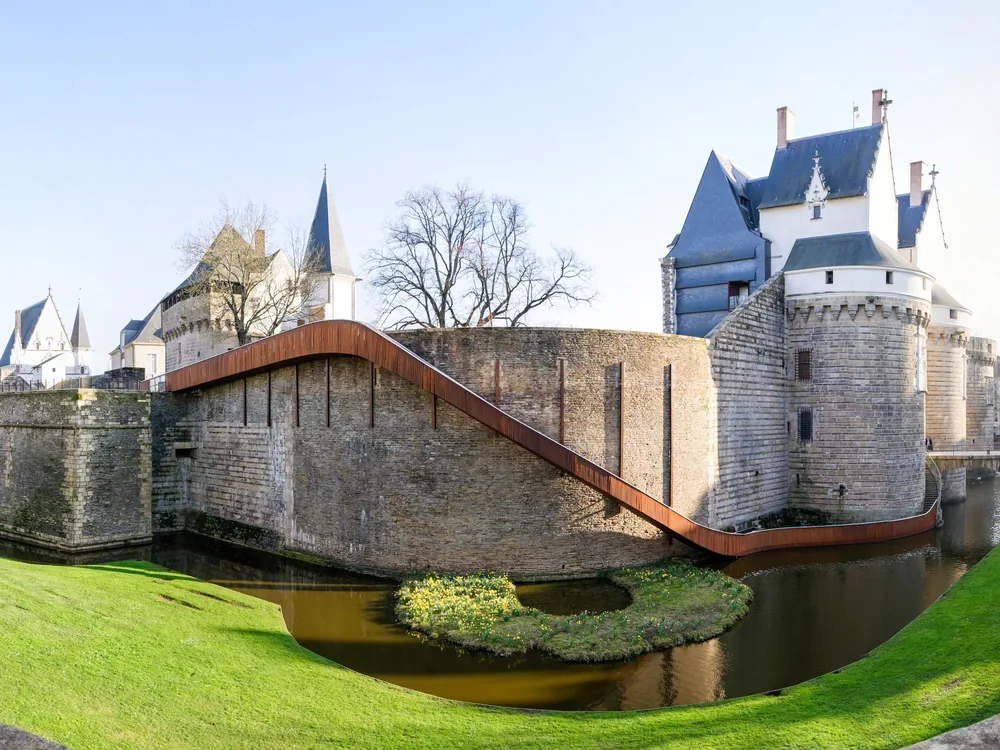
© Castles & Palaces
Quick Facts
- Hours
- Daily 10:00–18:00
- Guided tour from
- €30
- Duration
- 1.5–3 hours (exterior walk + museum); 1.5 hours (GetYourGuide ramparts tour)
- Best time
- April to October
- Nearest city
- Nantes
Featured Tour
Nantes Monumental Sightseeing Tour with Tour Guide
Cancellation available · Instant confirmation
Highlights
- ✦Anne of Brittany's legacy — daughter of the last independent Duke, twice Queen of France (married Charles VIII in 1491, then his successor Louis XII in 1499), Anne continued the castle's construction after her father's death and added the Tour de la Couronne d'Or (Golden Crown Tower) with its early Renaissance decorative programme — the first significant penetration of Italian Renaissance style into Brittany
- ✦The last independent ducal seat — the castle was built by François II (1458–1488) specifically to resist French royal power; within a year of his death, his daughter's marriage to Charles VIII brought Brittany into personal union with France, and the 1532 union treaty completed the formal absorption; the building that was meant to anchor Breton independence became a French royal residence within decades
- ✦Free exterior access — the castle's courtyard, ramparts walk, and the moat gardens are freely accessible; the Musée d'Histoire de Nantes (separately ticketed, ~€8 adult) occupies the interior with a comprehensive collection on the city's history from the Gaulish oppidum to the contemporary city
- ✦Musée d'Histoire de Nantes — reopened after the 15-year restoration in 2007, the museum is notable for its honest engagement with Nantes's role in the French Atlantic slave trade; the city was France's most active slave-trade port in the 18th century, and the museum's permanent collection addresses this history directly and without evasion
- ✦The site's first Pays de la Loire and Brittany-border castle — the Loire Valley château cluster already covered (Chambord, Chenonceau, Amboise, etc.) belongs to the Val de Loire UNESCO zone well to the east; Nantes and the Dukes of Brittany represent a distinct Atlantic political and cultural tradition; this is the first site page dedicated to that tradition
- ✦GetYourGuide Nantes Monumental Sightseeing Tour — a 2.5-hour licensed-guide walking tour of the city that includes a 30-minute skip-the-line stop inside the castle, plus the cathedral, the Psalette, and other Nantes landmarks
Skip the queue with a guided tour
Skip-the-line tickets & expert guides
The Château des ducs de Bretagne stands in the city centre of Nantes, a massive pentagonal enceinte with round towers and a dry moat that looks, from the outside, like a serious military fortification built to resist a determined attacker. From the inside — a courtyard of elegant late Gothic and early Renaissance architecture, with the Tour de la Couronne d'Or's carved loggias and dormer windows — it looks like the residence of a court with cultural ambitions to match its military anxieties. Both readings are correct. The castle was built by the last independent Dukes of Brittany with exactly this dual purpose: resist the King of France with the outer walls, compete with the French royal court in the inner courtyard.
The political context of the castle's construction is the central fact of its history. In the 15th century, Brittany was the last major French duchy to maintain genuine independence — not merely administrative autonomy but full sovereign independence, with its own estates, its own laws, and its own foreign policy. The Dukes of Brittany had managed to preserve this status through decades of careful diplomacy and selective military resistance, playing France against England and Spain in the manner of a small power that knows its independence depends on its larger neighbours remaining divided. By the mid-15th century, this independence was under increasing pressure from a French monarchy that was consolidating the kingdom after the Hundred Years War.
François II, who became Duke of Brittany in 1458, began the current castle around 1466 on a site that had previously held a 13th-century ducal building, which was demolished to make way for the new construction. The brief was explicit: the outer fortifications should be capable of resisting French royal forces, and the inner residence should be grand enough to receive and impress foreign ambassadors, visiting sovereigns, and the Breton nobility. The two goals were architecturally in tension — military efficiency and courtly elegance pulled the design in different directions — and the result is a building that reads differently from outside and inside.
François II died in 1488, the year after a defeat by French forces at the Battle of Saint-Aubin-du-Cormier that critically weakened Breton independence. He left a daughter, Anne — thirteen years old and the heiress to the Breton duchy. Anne of Brittany's story is one of the most extraordinary in late medieval French political history: orphaned, her duchy's independence fatally compromised, she was nonetheless able to negotiate her own marriage (twice) to the King of France, doing so on terms that preserved Breton autonomy within the French crown rather than surrendering it outright. She married Charles VIII in 1491; when he died without a surviving heir in 1498, she married his successor Louis XII in 1499. Through both marriages she insisted on terms that kept Brittany's legal and administrative distinctiveness.
At the castle in Nantes, Anne continued her father's building programme. The inner courtyard's most celebrated element is her contribution: the Tour de la Couronne d'Or (Golden Crown Tower), decorated with carved Gothic and early Renaissance motifs — loggias, dormer windows with sculptural programmes, the complex heraldic devices of the dual crowns (Queen of France and Duchess of Brittany). These carvings are the first significant appearance of Italian Renaissance decorative vocabulary in Brittany, arriving here through Anne's connections to the French royal court that was itself beginning to absorb Italian influence from the Italian Wars. The transition from late Gothic to early Renaissance is visible in the same building, in the work of the same commission.
After Brittany's formal absorption into France in 1532 — the union treaty that François I forced through the Breton estates — the castle's role changed entirely. It became a French royal stopover on visits to the region, then gradually a military installation: barracks, an arsenal, and at various points a prison (the Edict of Nantes, granting limited religious freedoms to Protestants, was signed here by Henri IV in 1598). A major gunpowder explosion in 1800 destroyed the Jacobin Tower and damaged the northern enceinte. By the 20th century the castle had been significantly altered from its original form and was in considerable disrepair.
The city of Nantes undertook a comprehensive 15-year restoration beginning in the early 1990s, fully closing the site at several points. The castle reopened in 2007 with the courtyard, ramparts, and moat gardens freely accessible and the Musée d'Histoire de Nantes — a new historical museum conceived for the restored interior — installed in the main residential range. The museum is notable within French civic museums for its treatment of Nantes's role in the Atlantic slave trade: the city was France's most active slave-trade port through much of the 18th century, responsible for dispatching roughly 550,000 enslaved Africans to the French Caribbean colonies, and the museum addresses this history directly in its permanent collection, with a substantive and unsparing exhibition.
This is the site's first castle page dedicated to the Pays de la Loire and the Brittany political tradition. The Loire Valley château cluster — Chambord, Chenonceau, Amboise, Blois — belongs to the Val de Loire UNESCO zone east of Nantes, and culturally and architecturally to the French royal tradition rather than the Breton ducal one. Nantes and the Château des ducs de Bretagne represent a distinct Atlantic political world.
History
The Château des ducs de Bretagne owes its current form to François II, the last independent Duke of Brittany, who began rebuilding the ducal castle at Nantes around 1466 on the site of an earlier fortification that occupied the Gallo-Roman town wall. François commissioned the substantial military enceinte — the round towers and curtain wall that still present themselves as serious fortifications — while the courtyard inside was conceived as a ducal residence of the first quality. He did not live to complete it: defeated at the Battle of Saint-Aubin-du-Cormier in 1488, François died weeks later, leaving the duchy to his daughter Anne.
Anne of Brittany is the figure whose name the castle carries most naturally. She ruled as the last independent duchess, married first Charles VIII of France in 1491 and then Louis XII after Charles's death in 1498, and added the Tour de la Couronne d'Or — the courtyard's most elegant architectural feature — to the castle during her reign. Her death in 1514 accelerated Brittany's integration into France, formalised by the Union treaty of 1532, after which the castle became a French royal residence. The most historically significant act conducted within its walls came in 1598, when Henri IV signed the Edict of Nantes here, granting limited religious freedoms to Protestants.
Subsequent centuries brought military barracks, arsenal, and prison use, and a gunpowder explosion in 1800 destroyed the Jacobin Tower. A 15-year restoration programme completed in 2007 gave the castle its current form: free exterior access to the courtyard and enceinte, with the Musée d'Histoire de Nantes installed in the residential range.
How to Visit
Getting there: Nantes city centre — take tram line 1 to 'Duchesse Anne / Château des Ducs de Bretagne', or walk 10 minutes from Nantes Centrale station. Nantes is connected to Paris Montparnasse by TGV (2 hours 10 min).
Tickets: The castle courtyard, rampart walk, and moat gardens are free to enter with no booking required. The Musée d'Histoire de Nantes inside the residential range is separately ticketed at ~€8 for adults, with reduced rates available; buy at the museum entrance or at chateaunantes.fr. The GetYourGuide Nantes Monumental Sightseeing Tour is a 2.5-hour licensed-guide city walking tour that includes a 30-minute skip-the-line stop inside the castle, plus the cathedral and other Nantes landmarks — it is not a castle-only or museum ticket.
Practical tips: The Musée d'Histoire de Nantes is one of the most honest civic history museums in France — its permanent exhibition on Nantes's Atlantic slave trade (the city dispatched ~550,000 enslaved Africans to the French Caribbean) is substantive and unsparing. Allow a separate hour for the museum if history is your primary interest. The Tour de la Couronne d'Or's Renaissance carved loggias are Anne of Brittany's personal architectural contribution and worth examining closely.
Combine with: The Passage Pommeraye (a 19th-century covered shopping gallery, 10 minutes on foot) and the Jules Verne Museum in the city complete a full Nantes day. The Mémorial de l'Abolition de l'Esclavage (Memorial to the Abolition of Slavery) on the Loire quayside is a 15-minute walk and directly relates to the castle's museum history.
Frequently Asked Questions
Anne of Brittany (1477–1514) was the daughter of the last independent Duke of Brittany, François II. At his death in 1488, she became Duchess at age 11, with Brittany's independence severely compromised by French military pressure. Despite this position, she negotiated her own marriage (to Charles VIII of France in 1491) on terms that preserved Breton legal autonomy. When Charles VIII died, she married his successor Louis XII in 1499 — making her the only woman to have been twice Queen of France through successive marriages. She is remembered in Brittany as the last guarantor of the duchy's independence; her additions to the Château des ducs de Bretagne (the Tour de la Couronne d'Or and its Renaissance decoration) are the most tangible surviving monuments to her rule.
Location
4 Place Marc Elder, 44000 Nantes, France
Nearby Castles
Tours & Tickets
Powered by GetYourGuide
From
€30/ person