
Fleckenstein Castle
Château du Fleckenstein
France · Alsace — Bas-Rhin, Vosges du Nord Regional Natural Park, near Lembach · Near Wissembourg
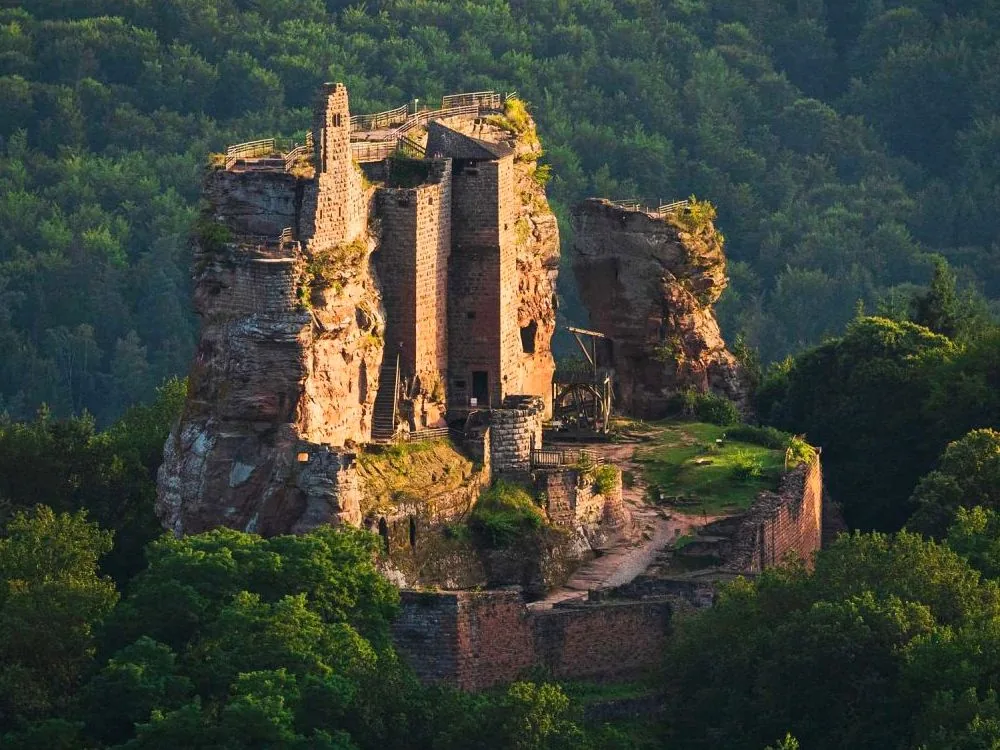
Built 1128 · 12th–13th century sandstone ridge castle built directly on a narrow sandstone outcrop sixty metres above the Vosges du Nord valley floor — the most distinctive feature is the castle's vertical organisation along the spur, with staircases and chambers carved directly into the living Buntsandstein (red sandstone) rather than built upon it in conventional masonry; the superstructure of rounded towers and curtain walls crowns the rock in the warm red sandstone characteristic of the Vosges du Nord; the plan is elongated and narrow, dictated by the spur's geometry; successive lords of Fleckenstein added structures from the 12th through 14th centuries, producing a layered sequence of Romanesque and early Gothic construction in warm sandstone; the castle anticipates the dramatic rock-architecture tradition of Alsatian and Palatinate ridge castles that developed through the 13th century
This page is part of an independent travel guide and is not affiliated with, endorsed by, or operated by Fleckenstein Castle.
© Castles & Palaces
Quick Facts
- Hours
- Daily 10:00–18:00
- Duration
- 1–1.5 hours
- Best time
- May to October
- Nearest city
- Wissembourg
Highlights
- ✦The rock-carved architecture — the most distinctive feature of Fleckenstein is the direct integration of carved sandstone with masonry construction: staircases, rooms, and passages cut into the living Buntsandstein spur are the structural foundation on which the castle was built, a technique that exploits the relatively soft red sandstone of the Vosges du Nord in a way unlike conventional medieval masonry construction
- ✦Panoramic views toward Germany — from the upper platform, views extend north across the Alsace–Palatinate frontier into Germany and across the Vosges du Nord forest canopy; the castle sits close to the modern French–German border, and its sight lines reflect the strategic geography of the mountain passes it was built to command
- ✦The forest approach from Lembach — the 30-minute walk through beech and oak forest is integral to the Fleckenstein experience; the sandstone spur emerges dramatically above the treeline on approach, giving the ruin the quality of discovery that makes it one of the more memorable arrivals among Alsace's many castle sites
- ✦The Vosges du Nord Regional Natural Park setting — Fleckenstein is one of three principal medieval monuments within the UNESCO Biosphere Reserve, alongside the Castle of Lichtenberg and the Wasenbourg ruins, in a park covering 130,000 hectares of mixed forest, sandstone outcrops, and traditional Alsatian villages
- ✦The 12th-century origins — the castle is first documented in 1128, giving it nearly nine centuries of recorded history on the same sandstone spur; the lords of Fleckenstein who built it were minor Alsatian nobility whose position above the Vosges passes gave them disproportionate economic and strategic significance as toll-collectors on the cross-mountain trade routes
- ✦The ruined silhouette — the state of preservation, with substantial walls and towers standing roofless above the forest, produces an atmospheric and photogenic ruin that extensive restoration tends to eliminate; Fleckenstein reads as an authentic medieval site in a way that comprehensively restored counterparts cannot fully replicate
Skip the queue with a guided tour
Skip-the-line tickets & expert guides
Fleckenstein Castle rises from a narrow sandstone outcrop sixty metres above the surrounding Vosges du Nord forest, one of the most dramatically positioned ruins in Alsace. The castle does not merely sit on the rock — it is, in the most literal sense, part of it: staircases and chambers are carved directly into the living Buntsandstein, and the masonry walls and towers spring from the spur as though continuous with the natural geology. This integration of carved rock and built structure is what makes Fleckenstein genuinely distinctive among Alsatian medieval sites.
The castle occupies a spur in the northern Vosges du Nord Regional Natural Park, approximately five kilometres west of the Castle of Lichtenberg and forty-five kilometres north of Haut-Kœnigsbourg. The Vosges du Nord is a UNESCO Biosphere Reserve and Regional Natural Park covering 130,000 hectares of mixed beech and oak forest, sandstone outcrops, and traditional Alsatian villages. Fleckenstein is one of the three principal medieval heritage monuments within the park, alongside Lichtenberg and the smaller Wasenbourg ruins. The site lies near the village of Lembach, in the Bas-Rhin department, close to the German border — the castle's name reflects the frontier territory in which it stands, straddling the linguistic and cultural divide between Alsace and the Rhineland-Palatinate.
The first documented mention of Fleckenstein dates to 1128, when it appears in records as a fortified stronghold of the lords of Fleckenstein, a minor noble family who would remain associated with the castle for three centuries. The position above the Vosges du Nord passes made the castle economically valuable well beyond its modest territorial base: the mountain passes linking Alsace to the German territories of the Palatinate were significant arteries for medieval trade, and a castle commanding the approach valleys collected tolls and guaranteed the lords of Fleckenstein a revenue stream that sustained successive expansions of the stronghold.
The castle grew through the 12th and 13th centuries as successive lords added structures to the spur, exploiting the living sandstone for carved staircases and chambers rather than relying entirely on dressed masonry. The upper castle, reached by staircases cut into the rock, commanded the widest view; the lower sections provided residential and storage functions. The Thirty Years' War (1618–1648) proved catastrophic: the conflict that devastated much of Alsace left Fleckenstein partially demolished and permanently abandoned. When the Peace of Westphalia in 1648 incorporated Alsace into France, the strategic rationale for maintaining a fortification at Fleckenstein vanished, and the gradual ruination that followed produced the romantic ruin visible today.
What remains is substantial and rewarding. The lower castle sections, the rock-carved staircases, the upper platform with its panoramic views across the Vosges forest toward Germany, and the distinctive Buntsandstein masonry all survive in a state that rewards careful exploration. The forest approach from Lembach — a thirty-minute walk through beech and oak — gives the ruin its essential context: the sandstone spur materialises above the treeline as walkers approach, the castle walls and the rock appearing almost indistinguishable in colour and texture. Fleckenstein is one of those European ruins where the setting and the arrival experience are inseparable from the monument itself — and it remains one of the least crowded of Alsace's major medieval sites.
History
Fleckenstein's origins lie with a minor Alsatian noble family whose name the castle still carries. The lords of Fleckenstein appear in documentary sources from the early 12th century as holders of a sandstone spur in the northern Vosges — modest territory, but positioned above the forest passes connecting Alsace to the Rhineland-Palatinate, which gave the family authority over significant trade and military routes. Toll revenues from this cross-mountain traffic sustained successive expansions of the stronghold through the 12th and 13th centuries, with the lords carving staircases and chambers directly into the living Buntsandstein rather than building entirely in dressed masonry — a technique that exploited the relatively soft local sandstone and produced the castle's distinctive layered, rock-integrated character. The Fleckenstein family line eventually extinguished in the early 15th century, and the castle changed hands several times in the turbulent politics of the late medieval upper Rhine. The Thirty Years' War was the decisive catastrophe: repeated campaigns through the Vosges du Nord between the 1620s and 1648 left the castle substantially demolished and permanently unviable as a residence or fortification. The Peace of Westphalia, which transferred Alsace to France in 1648, ended any remaining strategic rationale for maintaining the site, and the abandonment that followed was total. The French state's 19th-century classification of the ruins as a monument historique ensured that what survived would be consolidated rather than quarried, and the site was eventually opened to the walking public within the Vosges du Nord Regional Natural Park.
How to Visit
Getting there: From Wissembourg by car: approximately 25 minutes south on the D3 to Lembach (~20 km), then follow signs to the Château du Fleckenstein car park. From Strasbourg: roughly 1 hour north on the A4/D27 to Lembach (~75 km). No practical public transport serves the castle — a car is essential for most visitors. From the car park, a well-signed forest path leads to the castle entrance in approximately 30 minutes.
Tickets: Walk-up entry pricing is managed on-site — check chateau-fleckenstein.com before visiting. There is no standalone GetYourGuide ticket for Fleckenstein; if you plan to visit multiple Alsace sights in one trip, the Pass Alsace (~€30, valid 1–5 days, covers 60+ attractions across Alsace including this castle) may offer value — check passalsace.com for included sites.
Practical tips: Allow 1 to 1.5 hours on-site. The forest approach path is well-maintained from May to October but can be icy from November through March — sturdy footwear is advisable year-round. The sandstone walls photograph best in late afternoon summer light, when the Buntsandstein glows most intensely. There is no roofed shelter at the castle itself, so check the weather forecast before setting out.
Combine with: Castle of Lichtenberg (5 km east, complementary Vosges du Nord sandstone castle) and Haut-Kœnigsbourg (45 km south, the definitive Alsace castle experience).
Frequently Asked Questions
Public transport connections to Lembach are extremely limited and do not align with castle visiting hours in practice — for almost all visitors, a car is the only realistic option. Cyclists willing to navigate the Vosges du Nord forest roads can reach Lembach independently, and the 30-minute approach walk from the car park is on maintained forest paths. From November through March, the paths can be icy and the castle may have limited or no access — always verify at chateau-fleckenstein.com before travelling.
Location
Route du Fleckenstein, 67510 Lembach, France
Nearby Castles
Tours & Tickets
Powered by GetYourGuide
Plan Your Visit