
Altenburg Castle
Burg Altenburg
Germany · Upper Franconia, Bavaria — Bamberg, on the Altenburg hill, 390m above city level · Near Bamberg
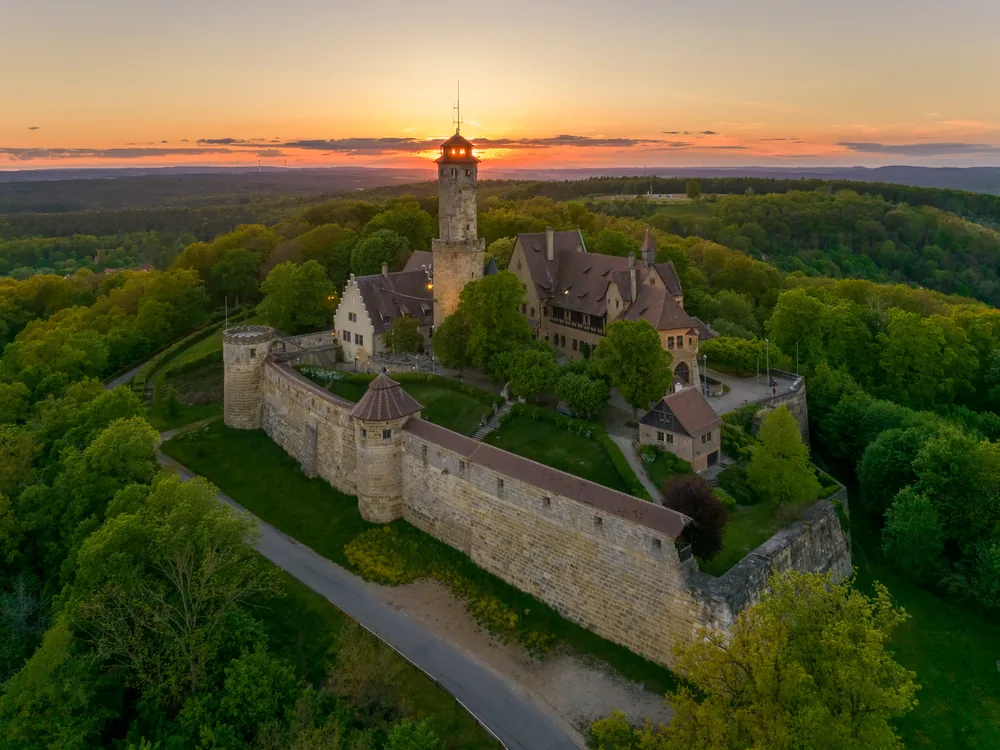
Built 1109 · Romanesque and Gothic fortification on the highest of Bamberg's seven hills — the castle's core structures date from the 12th century (the keep and earliest curtain walls), with significant rebuilding after the Thirty Years' War destruction and subsequent restoration by the Alter Burgverein (Old Castle Club) from the 19th century onward; the current complex includes the medieval keep (Bergfried), the Pallas residential building (partially reconstructed in the 19th century), a Romanesque chapel with medieval frescoes, a deep well, and a circuit of defensive walls; the castle is notable for combining genuine medieval fabric (particularly in the chapel and keep) with sensitive 19th-century restoration rather than wholesale reconstruction — the castle reads as a stratified historic monument rather than a theme-park recreation
This page is part of an independent travel guide and is not affiliated with, endorsed by, or operated by Altenburg Castle.
© Castles & Palaces
Quick Facts
- Hours
- Tue–Sun 09:00–17:00. Closed Mon
- Guided tour from
- €13
- Duration
- 1–1.5 hours (courtyard + keep + chapel + views; 1 hour guided tour via GetYourGuide)
- Best time
- May to September
- Nearest city
- Bamberg
Featured Tour
Bamberg: Altenburg Castle Guided Tour (1 hour, German only — 'Rare Find')
Cancellation available · Instant confirmation
Highlights
- ✦The highest of Bamberg's seven hills — Bamberg's famous comparison to Rome (both cities founded on seven hills) is most visceral from the Altenburg: at approximately 390 metres, the castle hill is the highest point of the city; the view from the keep and the courtyard encompasses the entire UNESCO old town — the Cathedral hill, the Old Town Hall (Altes Rathaus) on its bridge-supported island, the medieval Dominican church spires, the breweries, and the Regnitz River meanders below
- ✦Bamberg UNESCO old town (inscribed 1993) — the city below the Altenburg is one of the best-preserved medieval German urban landscapes, inscribed for its intact ensemble of medieval civic, religious, and domestic architecture; it escaped wartime bombing and retains its street plan and building fabric essentially unchanged since the 18th century; the UNESCO inscription specifically names Bamberg alongside Bruges and Prague as exemplars of intact European medieval urbanism
- ✦E.T.A. Hoffmann connection — Ernst Theodor Amadeus Hoffmann, the Romantic-era writer whose work was adapted into Offenbach's opera 'The Tales of Hoffmann' and who directly influenced Edgar Allan Poe, lived in Bamberg from 1808 to 1813; his Bamberg writings reference the Altenburg directly as an atmospheric setting that fed his Gothic imagination; the castle's 'Hoffmann-Snug' (Hoffmann-Stübchen) — a small room in the castle — is named in his memory and is covered in the GetYourGuide guided tour
- ✦The Romanesque chapel with medieval frescoes — the castle chapel, built in the 12th–13th centuries, retains fragmentary medieval frescoes; these are among the oldest surviving painted surfaces in the Bamberg area and give the chapel a historical weight disproportionate to its modest physical scale
- ✦Alter Burgverein (Old Castle Club) — the castle has been managed by the Alter Burgverein, a Bamberg citizens' association, since the 19th century; this unusual ownership model (a civic club rather than a state or commercial operator) gives the castle a quality of local civic pride and careful, non-commercial stewardship that distinguishes it from the professionally managed state-owned fortresses of Bavaria
- ✦'Rare Find' GetYourGuide guided tour — the German-language guided tour (1 hour) is marked as a 'Rare Find' on GetYourGuide due to low availability; tours are infrequent and slots fill quickly; advance booking of at least 7 days is recommended; the tour covers the castle's defensive systems, weaponry history, the Pallas, and the Hoffmann-Stübchen
Skip the queue with a guided tour
Skip-the-line tickets & expert guides
The Altenburg stands on the highest of Bamberg's seven hills — the comparison to Rome, which the city's promoters have made for centuries, is never more apposite than from the Altenburg's courtyard at approximately 390 metres above sea level, looking down through the Franconian beech forest to the city spread below. The Cathedral Hill with its four-towered Dom, the island-set Old Town Hall, the sandstone-and-timber gabled houses of the Sandstrasse, the hop gardens and brewery yards that have produced Bamberg's distinctive smoked beer (Rauchbier) for five centuries: all of it is legible from the castle's battlements in a single sweep.
The castle was first documented in 1109, which places its foundation in the period of the Babenberg and early Staufen administration of Franconia. The Bamberg bishops were its principal lords through the medieval period, using the Altenburg as a retreat and refuge when the city's politics required distance. It was destroyed during the Thirty Years' War (1618–1648) — the conflict that devastated most of central Germany's castle heritage — and partially rebuilt in the late 17th century. The more significant restoration came in the 19th century, when the newly formed Alter Burgverein (Old Castle Club) — a civic association of Bamberg citizens — took ownership and began the careful programme of restoration and maintenance that the castle has benefited from ever since.
The Alter Burgverein's ownership is one of the Altenburg's most distinctive features. Most German medieval castles of comparable size and historical significance are managed by state heritage organisations (the Bayerische Verwaltung der staatlichen Schlösser, Gärten und Seen, or equivalent), by commercial operators, or by heritage foundations. The Altenburg is managed by a citizens' association that has maintained the castle as an act of local civic stewardship for over 150 years. The result is a castle that operates more like a community institution than a heritage site: accessible, unpretentious, and run with the particular care that comes from genuine emotional investment rather than professional administration.
The castle's physical elements include the medieval keep (Bergfried), the Romanesque chapel with fragmentary medieval frescoes that are among the oldest painted surfaces in the Bamberg area, the Pallas residential building (partially reconstructed in the 19th century on medieval foundations), a deep well of medieval origin, and the circuit of defensive walls and towers that define the castle's hilltop perimeter. The chapel's frescoes — damaged but present — give the interior visit an archaeological dimension that a fully restored castle would not have.
The E.T.A. Hoffmann connection gives the castle a literary significance beyond its architectural history. Ernst Theodor Amadeus Hoffmann (1776–1822) — the Romantic-era writer whose supernatural tales were adapted into Offenbach's opera 'Les Contes d'Hoffmann' and who directly influenced Edgar Allan Poe, Charles Dickens, and Dostoevsky — lived in Bamberg from 1808 to 1813, working initially as a theatrical director at the Bamberg court theatre. His Bamberg period was among his most creatively productive; the city's atmospheric medieval landscape, and the Altenburg above it, fed directly into his Gothic imagination. The castle's 'Hoffmann-Stübchen' (Hoffmann-Snug) — a small commemorative room — is named in his memory and is included in the GetYourGuide guided tour.
The guided tour (1 hour) is conducted in German only. It covers the castle's defensive architecture, the weaponry and military history of the Franconian fortification tradition, the Pallas and its historical function, and the Hoffmann connection. The tour is marked as a 'Rare Find' on GetYourGuide due to low availability — tour slots are limited and infrequent, and advance booking of at least 7 days is recommended.
Bamberg is accessible from Munich by train in approximately 2 hours (ICE), from Nuremberg in 45 minutes, and from Frankfurt in 2 hours. It is the natural starting point for a Franconian cultural circuit that includes the Residenz palace at Würzburg (a UNESCO World Heritage Baroque palace, 60 kilometres west) and the medieval walled town of Rothenburg ob der Tauber. The Altenburg is the first Upper Franconia entry on this site — a gap in Bavaria coverage that until now was entirely concentrated in the south of the state (Neuschwanstein, Linderhof, Munich Residenz, Nymphenburg), all of which are more than 230 kilometres from Bamberg.
History
First documented 1109; castle established by the Bamberg bishops as a hilltop retreat on the highest of Bamberg's seven hills. Medieval period: keep and Romanesque chapel constructed; castle serves as an episcopal residence. 1553: captured and damaged during the Second Margrave War (Fürstenaufstand). Thirty Years' War (1618–1648): extensive damage; partial ruin. Late 17th century: partial rebuilding. 19th century: Alter Burgverein (Old Castle Club) formed by Bamberg citizens; restoration programme begins and continues to the present. Current period: castle managed by the Alter Burgverein; open to visitors May–October.
How to Visit
Getting there: From central Bamberg, three options reach the Altenburg: walk the forest path through the Altenburgwald — 45–60 minutes uphill, the traditional approach and part of the experience; take a taxi from the city centre (around 10 minutes); or cycle up the hill road. There is no direct bus service to the castle gate.
Tickets: Entry costs €5 for adults and €2 for children, paid at the castle gate (open May–October only; closed November–April — confirm dates at burg-altenburg-bamberg.de). The GetYourGuide guided tour runs one hour in German only and covers the castle's defensive systems, the Pallas, the Hoffmann-Stübchen, and the Romanesque chapel frescoes; it is marked as a "Rare Find" due to very limited slot availability.
Practical tips: Book the GetYourGuide tour at least 7 days in advance — slots are infrequent and fill quickly. Non-German speakers can visit independently; the views from the keep, the medieval chapel, and the courtyard atmosphere are fully rewarding without a guide.
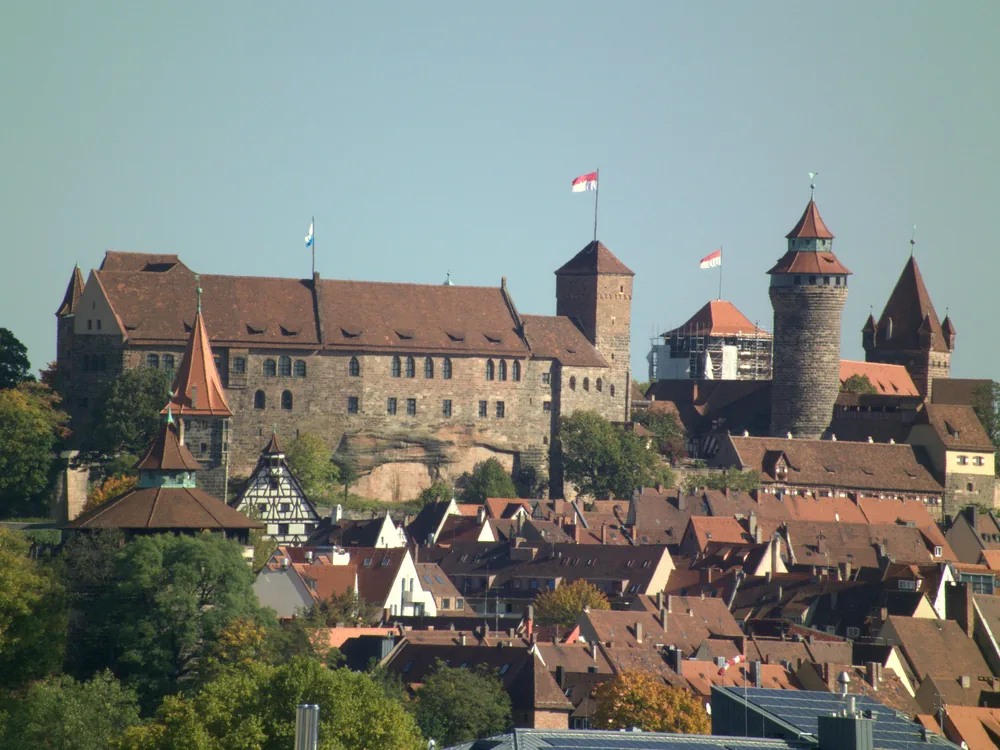
Combine with: Nuremberg Castle is 60 km south by direct train — pair both on a Franconian castle circuit.
Frequently Asked Questions
No — the GetYourGuide guided tour is German language only. There is no English-language tour product currently available via GetYourGuide. Non-German speakers can visit the castle independently with an entry ticket and use self-guided materials (confirm availability at burg-altenburg-bamberg.de); the architectural and landscape experience of the castle — the views, the medieval chapel, the keep — does not require a guide to appreciate.
Location
Altenburg 1, 96049 Bamberg, Bavaria, Germany
Nearby Castles
Tours & Tickets
Powered by GetYourGuide
From
€13/ person