
Dresden Castle
Residenzschloss Dresden
Germany · Dresden, Saxony · Near Dresden
Built 1547 · Renaissance electoral palace with Baroque additions — the Residenzschloss was substantially rebuilt in Renaissance style from 1547 under Elector Moritz of Saxony, with major Baroque extensions under Augustus the Strong (Elector Frederick Augustus I) in the early 18th century; the palace was gutted by Allied bombing on 13 February 1945 and extensively restored from 1985, with the final reconstruction phase completed in the 2010s; the Hausmannsturm (327-step watchtower) and Green Vault treasure chambers are the most architecturally significant surviving and restored components
This page is part of an independent travel guide and is not affiliated with, endorsed by, or operated by Dresden Castle.
© Castles & Palaces
Quick Facts
- Hours
- Tue–Sun 10:00–18:00. Closed Mon
- Entry via GetYourGuide
- €18
- Duration
- 2–3 hours (general admission circuit); 3–4 hours if climbing the Hausmannsturm
- Best time
- Year-round
- Nearest city
- Dresden
Featured Tour
Dresden Castle: General Admission Ticket (Official SKD Ticket)
Cancellation available · Instant confirmation
Highlights
- ✦Neues Grünes Gewölbe (New Green Vault) — Augustus the Strong's unrivalled treasury of European decorative arts: 3,000 objects in ten rooms including Renaissance goldsmith work, amber cabinets, ivory carvings, and the world-famous Court of Delhi on the Birthday of the Grand Mogul (5,223 individual figures set with 4,909 diamonds, 160 rubies, and 164 emeralds). All included in the general admission ticket
- ✦Turkish Chamber (Türckische Cammer) — the largest and most important collection of Ottoman objects outside Turkey, assembled by Augustus the Strong from diplomatic gifts, battlefield trophies, and direct purchases: 600 objects including ceremonial armour, horse trappings, a full Ottoman campaign tent, and the sword of Sultan Suleiman the Magnificent
- ✦Hausmannsturm — the castle's 100-metre-high watchtower, climbable via 327 steps, offers the definitive panorama of the Dresden skyline: Frauenkirche, Zwinger, Semperoper, and the Elbe valley in a single sweep. The view from the upper gallery rewards the climb absolutely
- ✦Historisches Grünes Gewölbe (Historic Green Vault) — a separate, separate-ticket experience: the original in-situ treasure chambers of Augustus the Strong, with objects displayed exactly as they were in 1733, in elaborately decorated baroque rooms. Requires advance booking and sells out weeks ahead; not included in the general admission ticket
- ✦The 2019 Dresden Castle heist — three showcase cabinets in the Historic Green Vault were broken into on 25 November 2019 by a two-man team who cut the power to the Altstadt, smashed display cases, and escaped with 21 pieces of Saxon court jewellery worth an estimated €113 million. Most pieces were recovered in a 2022 plea deal. The theft briefly made Dresden's treasury collection global news
- ✦Wettin dynasty collection — the Residenzschloss holds the electoral and royal regalia, armour collections, and art objects of the House of Wettin, the royal dynasty that ruled Saxony from 1089 to 1918 and whose electors included Augustus the Strong, who shaped modern Dresden with his building campaigns and collection patronage
Skip the queue with a guided tour
Skip-the-line tickets & expert guides
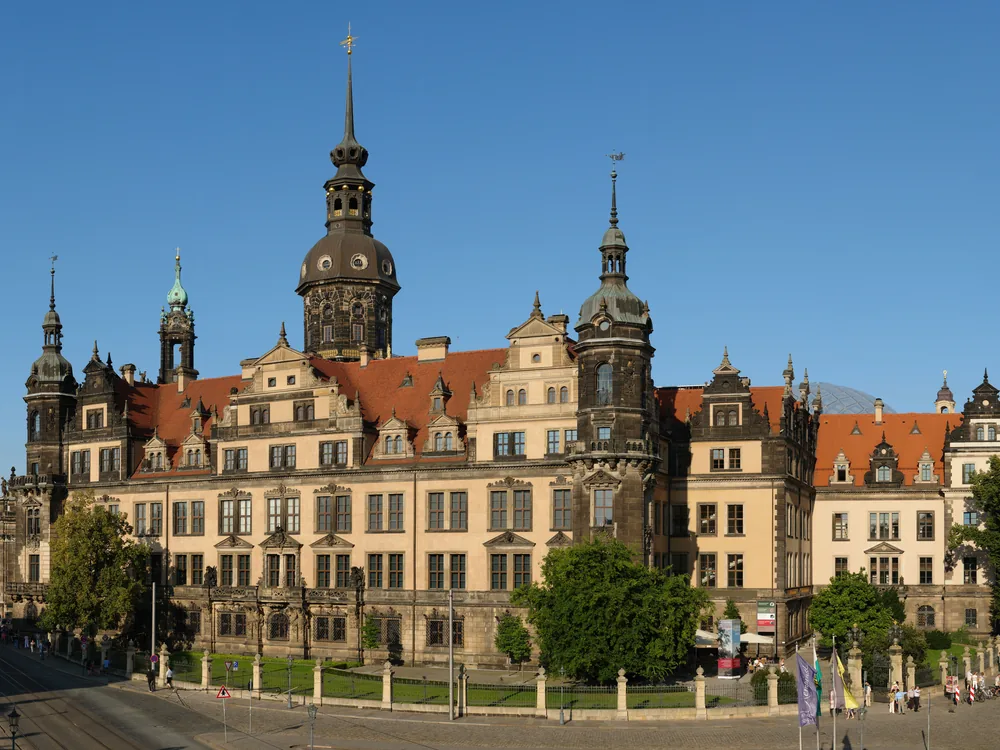
The Residenzschloss of Dresden — the Wettin dynasty's principal residence for four centuries — stands at the centre of Dresden's historic Altstadt, flanked by the Zwinger pleasure palace to the southwest and the Hofkirche (Catholic court church) to the north. It is one of the most important Renaissance and Baroque palace complexes in Germany, the home of one of the finest collections of European decorative arts assembled by any royal house, and a building whose post-war history of destruction and meticulous restoration is as significant as its original construction.
The palace began in its current form in 1547, when Elector Moritz of Saxony commissioned a substantial Renaissance reconstruction of an earlier medieval building on the same site. The Wettin electors had held Dresden as their capital since the late 14th century, and successive campaigns through the 16th and 17th centuries produced a palace of considerable architectural ambition — quadrangular in plan, with four wings arranged around a central courtyard, the Hausmannsturm rising above the northeastern wing as the defining vertical element of the Altstadt skyline. The Baroque expansion under Augustus the Strong (Elector Frederick Augustus I, King of Poland 1697–1733) added the building's most famous element: the Green Vault, a sequence of treasure chambers in the lower western wing created to house Augustus's extraordinary collection of jewellery, goldsmiths' work, ivory, amber, and decorative objects.
Augustus the Strong is one of the defining figures of European Baroque culture. An elector of immense aesthetic appetite and political ambition — he converted to Catholicism to secure the Polish crown, maintained a court of calculated magnificence designed to project Saxon power throughout the Holy Roman Empire, and assembled art collections that ranked among the finest in Europe — his patronage shaped Dresden's visual character entirely. The Zwinger, the Frauenkirche, the Semperoper, the Japanese Palace, the Porcelain Collection: every major Dresden landmark either dates from his reign or was given its definitive character by his collecting and building campaigns. The Green Vault was the centrepiece of his self-presentation: not a private treasury hidden from view but a sequence of public rooms designed to be shown to visiting dignitaries as evidence of Saxon wealth and culture.
The Green Vault exists today in two forms that are critically distinct. The Historisches Grünes Gewölbe (Historic Green Vault) is the original in-situ treasure chamber — eight rooms decorated in the style of Augustus's court, with objects displayed exactly as they were in 1733 in carved and gilded settings and illuminated to reproduce the candlelit drama of Baroque court display. Access to this is limited to small timed groups, requires advance booking weeks ahead, and carries a separate (higher) admission price. The Neues Grünes Gewölbe (New Green Vault), included in the general admission ticket, is the post-war reconstruction: 3,000 objects in glass cases across ten rooms on the upper floor, with exceptional individual pieces including the Court of Delhi on the Birthday of the Grand Mogul — a table centrepiece featuring 5,223 miniature figures, 4,909 diamonds, 160 rubies, and 164 emeralds, commissioned for Augustus the Strong's son in 1708 and considered the most elaborate example of European goldsmith work ever created. Visitors who confuse the two vaults and expect the New Green Vault to reproduce the atmospheric in-situ rooms of the Historic Vault will be disappointed; the New Green Vault is a world-class decorative arts museum in a conventional glass-case format. Both are extraordinary — they are simply different experiences.
On 13 February 1945, RAF and USAAF bombing raids destroyed approximately 1,600 acres of Dresden's city centre and killed between 22,000 and 25,000 people. The Residenzschloss was gutted — its roofs burned, floors collapsed, and interior destroyed — though the exterior walls survived. The debate over Dresden's bombing remains historically contested: the city had limited military value by February 1945, the German defeat was weeks away, and the scale of civilian casualties was enormous. The East German government left the palace ruin partly as anti-Western political symbolism. Restoration began in 1985, under communist rule, and continued through reunification and into the 21st century. The final wing was completed in 2019 — a reconstruction that spanned three German political systems.
On 25 November 2019, a group of thieves broke into the Historic Green Vault showcases, cut the electricity supply to the Altstadt to disable the alarm system, smashed three display cases, and escaped with 21 pieces of 18th-century Saxon jewellery: a Dresden White Diamond brooch, a set of brilliants and diamonds known as the Dresden Brillant-Garnitur, and a diamond hilt sword, among others, with a combined value estimated at €113 million. The thieves were arrested in 2020; a 2022 plea deal saw most pieces returned in exchange for reduced sentences. The heist is the most significant theft from a German museum in history and temporarily brought Dresden's collections to worldwide attention.
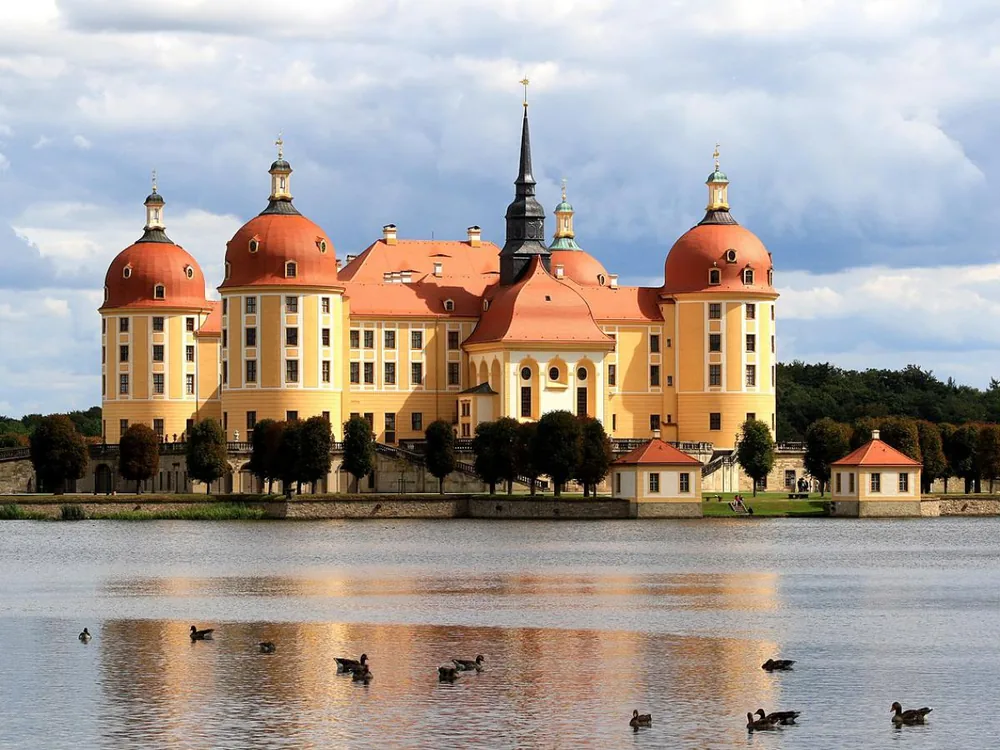
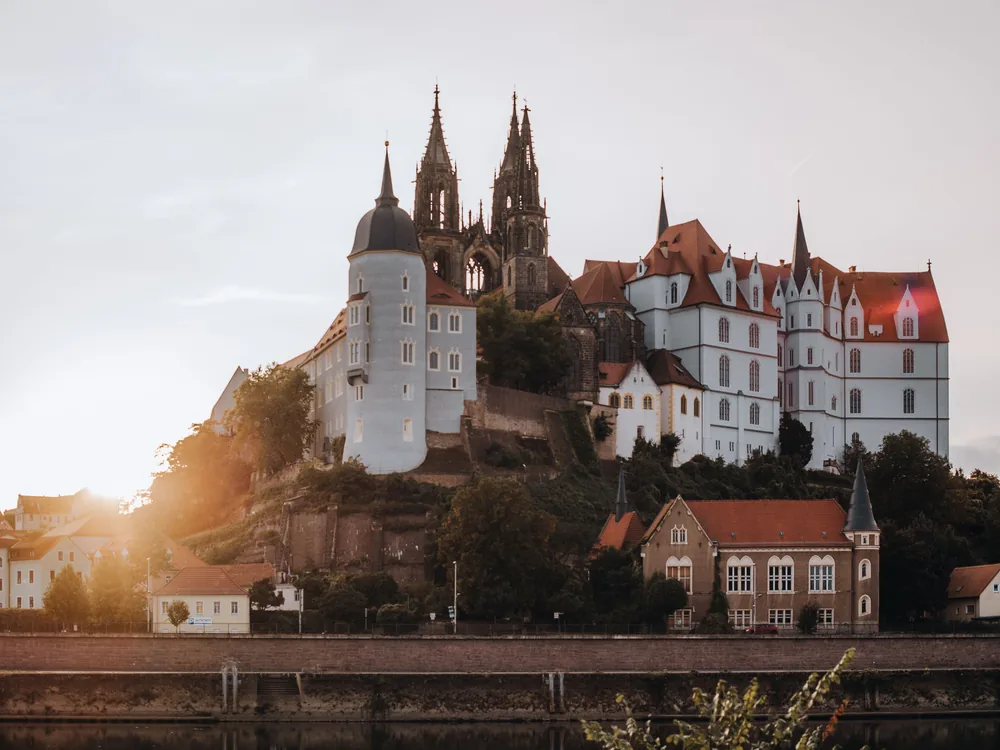
The Hausmannsturm — the 100-metre watchtower — can be climbed via 327 steps to an exterior gallery that provides the highest publicly accessible viewpoint in the Dresden Altstadt. The panorama from the top places the Frauenkirche dome, the Zwinger's pavilion roofline, the Elbe's curve, and the Saxon hills in the distance into a single composition. The climb is entirely worthwhile and is consistently cited by visitors as the most memorable element of the palace visit. Nearby, [Moritzburg Castle](/castles/germany/moritzburg-castle) is accessible by a historic steam railway from Dresden Neustadt station, and [Albrechtsburg Castle](/castles/germany/albrechtsburg-castle) in Meißen — where European porcelain was first produced in 1710 — rounds out a compelling day-trip triangle from the Saxon capital.
History
Medieval building on site from 13th century. Moritz of Saxony commissions Renaissance reconstruction 1547. Hausmannsturm built in its current form. Augustus the Strong (Elector Frederick Augustus I) creates the Green Vault treasure chambers, early 18th century. Augustus becomes King of Poland 1697; Dresden established as one of Europe's most splendid Baroque courts. Allied bombing 13 February 1945: palace gutted (exterior walls survive). East German restoration begins 1985. Reunification 1990; restoration continues. New Green Vault opens 2004; Historic Green Vault reopens 2006. Final wing completed 2019. November 2019: daring heist of Historic Green Vault; jewels partly recovered in 2022 plea deal.
How to Visit
Getting there: The Residenzschloss is in central Dresden's Altstadt, a 5-minute walk from Dresden Hauptbahnhof. ICE trains connect Dresden to Berlin (about 2 hours) and Leipzig (about 1 hour). Tram lines 1, 2, 4, and 8 stop at Postplatz, a short walk from the palace.
Tickets: General admission costs €18 for adults; children under 17 enter free. The GetYourGuide official SKD entry ticket covers the Neues Grünes Gewölbe, Turkish Chamber, Renaissance Wing, Armory, and Hausmannsturm. The Historisches Grünes Gewölbe (Historic Green Vault) requires a separate timed-entry ticket booked directly at skd.museum — groups are limited to 100 per hourly slot and availability is frequently sold out 2–4 weeks ahead.
Practical tips: Book the Historic Green Vault timed slot first if it is your priority — walk-up availability is rarely possible. The Hausmannsturm (327-step tower climb) is included in general admission and provides the best elevated view of the Dresden Altstadt; allow 15–20 minutes for the ascent.
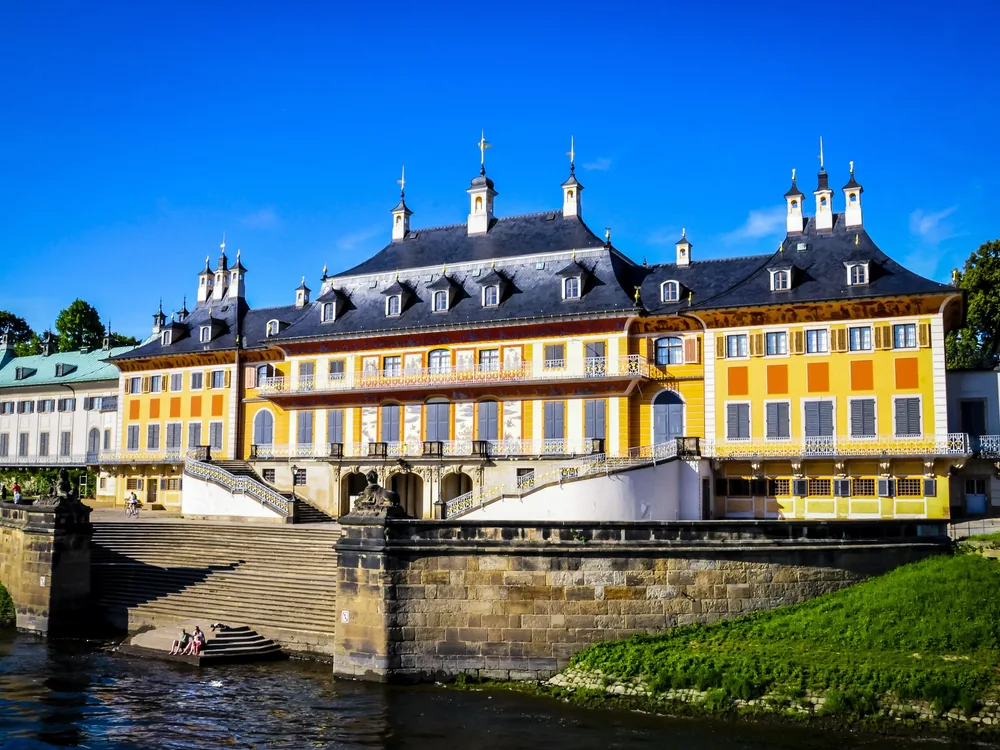
Combine with: Moritzburg Castle is accessible by historic steam railway from Dresden Neustadt. Albrechtsburg Castle in Meißen (25 km northwest) is the birthplace of European porcelain, and Pillnitz Castle is the Electoral summer palace a short drive downstream.
Frequently Asked Questions
The Historisches Grünes Gewölbe (Historic Green Vault) is the original in-situ treasure chamber, with objects displayed in their 1733 positions in elaborately decorated Baroque rooms — dark, atmospheric, with candlelight-scale illumination. Limited groups, timed entry, separate ticket (book weeks ahead at skd.museum). The Neues Grünes Gewölbe (New Green Vault) is included in general admission — 3,000 objects in glass cases in a conventional museum format, including the extraordinary Court of Delhi centrepiece. Both are exceptional; they are different experiences. Many visitors do both on the same day using separate tickets.
Location
Taschenberg 2, 01067 Dresden, Saxony, Germany
Nearby Castles
Tours & Tickets
Powered by GetYourGuide
From
€18/ person