
Ettersburg Palace
Schloss Ettersburg
Germany · Thuringia — Ettersburg, near Weimar · Near Weimar
Built 1706 · Three-winged building built 1706–1712 for Duke Wilhelm Ernst von Sachsen-Weimar, with a three-story "New Castle" added in 1722; part of the UNESCO "Classical Weimar" World Heritage ensemble
This page is part of an independent travel guide and is not affiliated with, endorsed by, or operated by Ettersburg Palace.
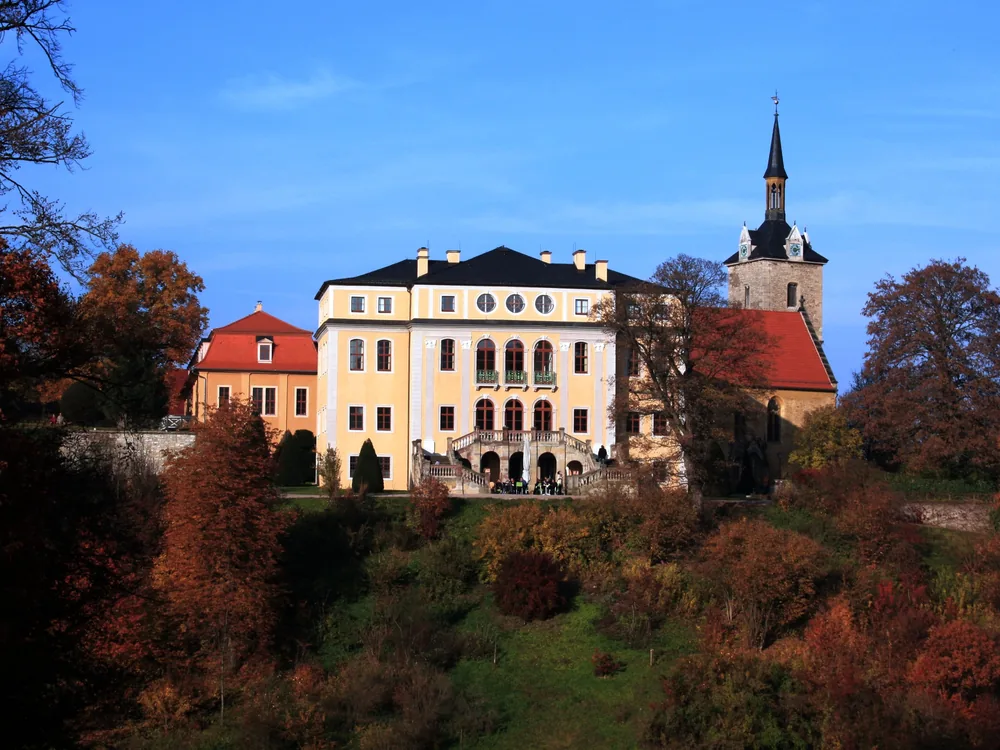
© Castles & Palaces
Quick Facts
- Rooms from
- €93 / night
- Duration
- Overnight stay; the surrounding park is freely open to the public year-round
- Best time
- Year-round
- Nearest city
- Weimar
Stay Here
Schloss Ettersburg
Rooms are within the historic castle building itself
Booked via Booking.com · Free cancellation on most rates
The castle park is freely accessible year-round, with exhibition boards on the site's history. The castle interior functions as a hotel/conference centre and is NOT open to the general public on a regular basis — accessible only during occasional cultural events (such as the Pentecost Festival since 2011). No independent museum-style entry ticket exists.
Highlights
- ✦Built 1706–1712 for Duke Wilhelm Ernst von Sachsen-Weimar; a three-story "New Castle" was added in 1722
- ✦Summer residence of Duchess Anna Amalia (1776–1780), becoming a cultural and intellectual center of the Weimar court
- ✦Meeting place of the celebrated Weimar literary circle: Goethe, Schiller, Wieland and Herder; Goethe arranged Schiller's 1799 retreat here to write "Maria Stuart"
- ✦Part of the UNESCO World Heritage "Classical Weimar" ensemble; the park is freely accessible year-round, though the castle interior is not open for general public tours
Stay in the castle itself
Book a room via Booking.com
Schloss Ettersburg, just north of Weimar in Thuringia, was built between 1706 and 1712 on the orders of Duke Wilhelm Ernst von Sachsen-Weimar as an unadorned three-winged building, with a three-story "New Castle" added in 1722. From 1776 to 1780 it served Duchess Anna Amalia as a summer residence, and during those years it became one of the intellectual and cultural centers of the Weimar court — a literary circle gathered here that included Christoph Martin Wieland, Johann Wolfgang von Goethe, Johann Gottfried von Herder, storyteller Johann Karl August Musäus, and actress Corona Schröter. Goethe himself arranged for Friedrich Schiller to retreat to Ettersburg starting in 1799 to work undisturbed, where he completed his play "Maria Stuart" in 1800.
Today, both the Old Castle and the 1722 New Castle house a combined 28 rooms and suites operated as a hotel, conference center and event venue, part of the UNESCO World Heritage "Classical Weimar" ensemble. The surrounding park is freely accessible to the public year-round, with exhibition boards recounting the site's literary and architectural history, though the castle interior itself is reserved for hotel guests and conference attendees — public access to the building is generally limited to cultural events, most notably the nearly two-week Pentecost Festival held at Ettersburg since 2011.
Anna Amalia's tenure at Ettersburg places the palace within one of the most significant chapters of German literary history: her court at Weimar, of which Ettersburg formed a genuine intellectual satellite, brought together the writers whose work would come to define German Classicism, making the palace grounds a direct physical setting for conversations and creative work behind some of the era's most enduring literary output.
Schiller's 1799 retreat to Ettersburg specifically to complete "Maria Stuart" gives the palace a concrete, documented connection to one of German drama's most performed historical tragedies, and the fact that Goethe personally arranged the visit underscores the close working relationship between the two writers during this period of their careers.
The "Classical Weimar" UNESCO designation recognizes a constellation of sites across Weimar and its surroundings connected to the city's late-18th and early-19th-century flowering as a center of German literature, philosophy and art, of which Ettersburg represents one of the more rural, park-set components alongside the more central sites within Weimar itself.
The Pentecost Festival's role as the primary occasion for public access to Ettersburg's interior reflects a broader pattern among historic buildings now operating as hotels, where cultural programming provides a periodic bridge between a property's commercial hospitality function and its status as a genuine public heritage site.
The freely accessible park surrounding the palace, with its exhibition boards on local history, gives even non-staying visitors a meaningful way to engage with Ettersburg's literary and architectural significance, softening the otherwise firm separation between the hotel's paying guests and the wider public's access to the site.
History
Schloss Ettersburg was built between 1706 and 1712 for Duke Wilhelm Ernst von Sachsen-Weimar, with a three-story New Castle added in 1722. It served Duchess Anna Amalia as a summer residence from 1776 to 1780, becoming a gathering place for the Weimar literary circle including Goethe, Schiller, Wieland and Herder — Goethe arranged for Schiller to retreat here in 1799 to complete "Maria Stuart." Today both the Old and New Castle house 28 rooms as a hotel and conference centre, part of the UNESCO "Classical Weimar" ensemble, with the surrounding park freely open to the public year-round.
How to Stay
Getting there: About 15 minutes by car from central Weimar; roughly 30 minutes from Erfurt and 1h from Jena.
Rooms & rates: 23 modern rooms plus 1 junior suite and 4 larger suites (28 total), spread across the historic Old Castle and the 1722 New Castle — no separate modern annex. From €93/night.
On-site: Restaurant, conference rooms, event spaces; free year-round access to the surrounding castle park.
Good to know: The castle park is free and open to everyone, but the building itself isn't open for general public tours — non-guests can experience the interior mainly through cultural events like the Pentecost Festival.
Combine with: Classical Weimar's UNESCO ensemble in the city center, and the Goethe/Schiller literary heritage sites nearby.
Frequently Asked Questions
The castle interior is generally reserved for hotel guests and conference attendees, with public access mainly limited to cultural events such as the Pentecost Festival held at Ettersburg since 2011. The surrounding park, however, is freely accessible year-round.
Location
Schloss Ettersburg 1, 99439 Ettersburg, Germany
Nearby Castles
Rooms from
€93/ night