
Giebichenstein Castle
Burg Giebichenstein
Germany · Saxony-Anhalt · Near Halle (Saale)
Built 961 · Twin castle complex on a porphyry cliff above the Saale River in Halle, divided into the ruined Oberburg (upper castle), dating from the 10th century and long a residence of the Archbishops of Magdeburg, and the Unterburg (lower castle), rebuilt in the Renaissance style and still standing intact; the Oberburg ruins are associated in German and Nordic legend with the imprisonment of the poet-hero motif found in medieval sagas; the site's romantic ruined silhouette above the river made it a favoured subject for German Romantic painters; the Unterburg now houses the Burg Giebichenstein University of Art and Design, one of Germany's leading art schools
This page is part of an independent travel guide and is not affiliated with, endorsed by, or operated by Giebichenstein Castle.
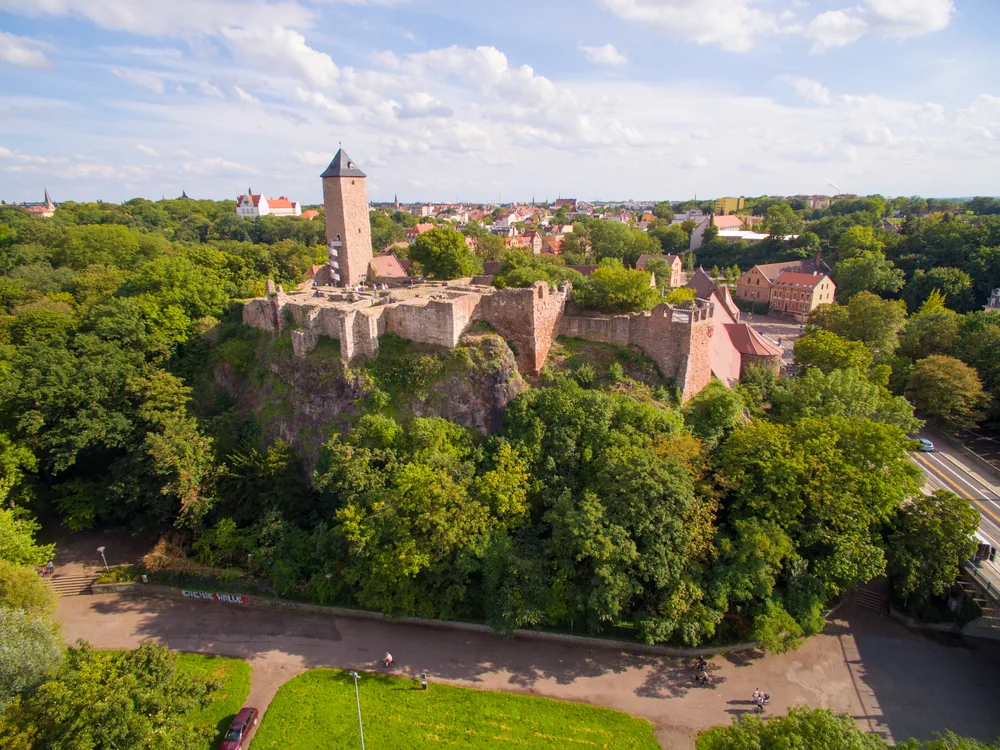
© Castles & Palaces
Quick Facts
- Hours
- Daily Open
- Guided tour from
- €19
- Duration
- 2 hours
- Best time
- Year-round
- Booking
- Required
- Nearest city
- Halle (Saale)
Featured Tour
Halle (Saale): The Castle Tour
Cancellation available · Instant confirmation
Highlights
- ✦A twin castle complex on a porphyry cliff above the Saale River: the Oberburg (upper castle) a romantic medieval ruin freely accessible to visitors, and the Unterburg (lower castle) a Renaissance rebuilding that now houses the Burg Giebichenstein University of Art and Design
- ✦First documented in 961 and associated with the Archbishops of Magdeburg, who used the upper castle as a residence for centuries — one of the oldest fortified sites in Saxony-Anhalt
- ✦The Burg Giebichenstein Kunsthochschule (University of Art and Design) occupies the Unterburg — a celebrated German art institution with roots in the early 20th century Bauhaus era, making the lower castle an active centre of contemporary art and design education
- ✦The ruined silhouette of the Oberburg above the Saale was a favoured subject of German Romantic painters, drawn to the combination of medieval ruin, river, and cliff that the castle's site provides
- ✦Free access to the Oberburg ruins and the cliff path above the Saale; the 2-hour guided tour provides access to the interior and historical commentary on both castle sections
Skip the queue with a guided tour
Skip-the-line tickets & expert guides
On a cliff of dark porphyry above a bend in the Saale River, where the water runs fast and the rock face rises directly from the bank, stand the two halves of a castle whose history begins in the 10th century and whose present is as much about art as it is about architecture. Burg Giebichenstein — the Giebichenstein Castle — divides clearly into two distinct experiences separated by a vertical cliff: the Oberburg (upper castle), a ruined medieval structure perched at the cliff's edge and freely accessible, and the Unterburg (lower castle), a Renaissance rebuilding on the river bank below, intact and currently housing one of Germany's most celebrated schools of art and design.
The site's first recorded fortification dates from 961, when documents mention a fortress at Giebichenstein. Through the medieval period, the upper castle was associated with the Archbishops of Magdeburg — the dominant ecclesiastical power in this part of the Holy Roman Empire — who used it as a residence and administrative centre. The cliff setting was, from a military perspective, essentially impregnable from the river side: the porphyry rock face that the Saale runs directly beneath made approach from below impossible, while the ridge approach from the town above was controllable through conventional fortification. The castle consequently survived without major siege damage through the medieval period, though the Oberburg eventually fell into ruin through neglect and partial demolition rather than military action.
The lower castle was rebuilt in the Renaissance period in a more residential mode, reflecting the broader 16th-century shift from purely defensive to mixed residential-defensive use that characterised noble and ecclesiastical architecture across the German territories. This rebuilding is what survives as the Unterburg today — a coherent Renaissance structure that, in the 20th century, found a remarkable second life as the campus of the Burg Giebichenstein Kunsthochschule Halle (now the Burg Giebichenstein University of Art and Design). Founded in 1915, the school became closely associated with the broader German Bauhaus movement in the early 20th century and has remained one of Germany's most highly regarded institutions for art, design, craft, and industrial design education. The presence of an active art school within the castle walls means the Unterburg is a working institutional campus rather than a heritage site in the conventional sense — visitors encounter students, studios, and exhibitions alongside the castle architecture.
The Oberburg ruins are the site's more immediately atmospheric element. The medieval walls, towers, and chapel fragments perched on the porphyry cliff above the Saale have been a subject for artists and writers since at least the 18th century, when the German Romantic movement found in ruined medieval castles above rivers the embodiment of its aesthetics of historical loss and natural sublimity. The Giebichenstein cliff view — ruins, rock, and river — was depicted by multiple painters in the Romantic period and generated a substantial literary association: the combination of medieval fortress, natural cliff, and the specific legend of imprisonment connected to the site (medieval sagas and later literary traditions placed a captive poet-hero figure at Giebichenstein, a narrative echoed in the historical imprisonment of various notable figures at this or similar Rhine-Saale fortresses) made it a resonant location in the German cultural geography of the 19th century.
The GetYourGuide guided tour runs approximately 2 hours and covers both sections of the castle — the Oberburg ruins and the Unterburg interior — with historical commentary on the full arc from the 10th-century episcopal fortress to the 20th-century art school. Note: the tour shows a 'provider rating' of 4.4 on GetYourGuide rather than a verified customer review count; treat this as an indication of the operator's general standing rather than a verified review average, and check current availability when booking.
Halle (Saale) itself is a city with a denser historical and cultural layer than its modest international profile suggests. It is the birthplace of Handel — George Frideric Handel was born here in 1685, and the Händel-Haus museum in the city centre occupies his family's house. The city's medieval market square is among the best-preserved in Saxony-Anhalt. The Moritzburg, a large late-medieval fortified residence now housing an important art collection, is a 15-minute walk from the city centre. And the Saale corridor south of Halle leads quickly to Merseburg (with its exceptional Romanesque cathedral and the unique Merseburg Incantations, the earliest surviving examples of Old High German verse), and onward to Naumburg Cathedral, a UNESCO World Heritage Site.
History
The fortified site at Giebichenstein is first documented in 961. Through the medieval period, the upper castle (Oberburg) was associated with the Archbishops of Magdeburg, who used it as a residence and administrative centre — the ecclesiastical power that dominated this part of the Holy Roman Empire. The Oberburg subsequently fell into ruin through neglect rather than military action, while the lower castle (Unterburg) was rebuilt in the Renaissance period in a more residential style.
The Unterburg's modern history began in 1915 when the Burg Giebichenstein Kunsthochschule Halle was founded there, an art school that became closely associated with the Bauhaus movement in the early 20th century and is now the Burg Giebichenstein University of Art and Design, one of Germany's leading institutions for art, craft, and design education. The Oberburg ruins above the Saale River, freely accessible and atmospherically positioned on a porphyry cliff, have been a subject for German Romantic painters and writers since the 18th century.
How to Visit
Getting there: Giebichenstein Castle is about 3 km north of Halle (Saale) city centre. From Halle Hauptbahnhof, take tram line 7 toward Kröllwitz; the castle is a short walk from the Burg Giebichenstein stop. By bicycle, the Saale riverbank path from the city centre reaches the castle in about 15 minutes.
Tickets: Entry is free. The Oberburg ruins and cliff path above the Saale are freely accessible daily with no booking required. The GetYourGuide guided castle tour runs 2 hours and covers the interiors of both castle sections with historical commentary — book in advance as slots are limited.
Practical tips: The view from the Oberburg over the Saale bend is the principal reward for independent visitors and the free ruins visit is worthwhile on its own. The Unterburg is an active university campus; during term time student exhibitions and studios are visible alongside the castle architecture.
Combine with: Leuchtenburg Castle is 60 km south on the Saale — a medieval hilltop fortress overlooking the river valley, easily paired on a Saale Valley day.
Frequently Asked Questions
The Burg Giebichenstein Kunsthochschule Halle (now formally the Burg Giebichenstein University of Art and Design) was founded in 1915 in the Unterburg (lower castle). It became closely associated with the Bauhaus movement in the early 20th century — sharing both teaching philosophy and several personnel with the Bauhaus in Dessau and Weimar — and has remained one of Germany's most respected institutions for art, design, craft, and industrial design education. The school's presence means the Unterburg is an active campus rather than a purely heritage space, and visitors may encounter student exhibitions and design work alongside the castle architecture.
Location
Schlossberg, 06114 Halle (Saale), Germany
Nearby Castles

Tours & Tickets
Powered by GetYourGuide
From
€19/ person