
Manderscheid Lower Castle
Niederburg Manderscheid
Germany · Rhineland-Palatinate (Eifel) · Near Manderscheid
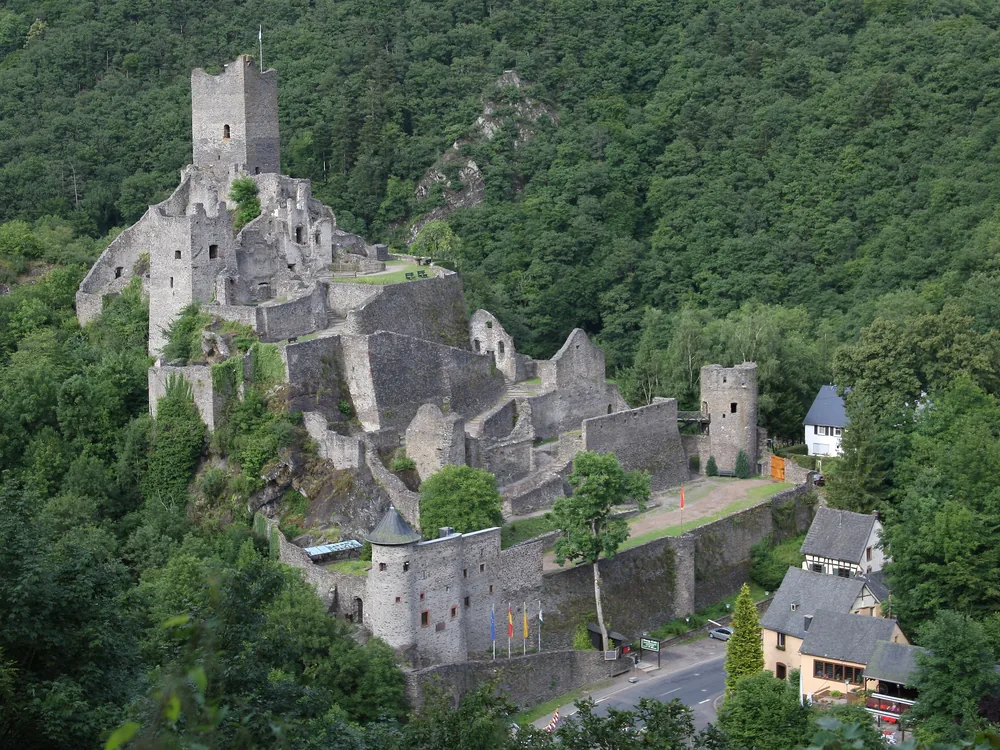
Built 1130 · 12th-century medieval ruins on a ridge above the Lieser river valley in the Eifel highlands, constituting the lower of two castle ruins — Niederburg (Lower Castle) and Oberburg (Upper Castle) — positioned on opposite ridges of the valley with the town of Manderscheid between them; the twin-castle configuration was characteristic of divided inheritances within medieval noble families, with the Lords of Manderscheid holding both castles and different branches controlling each at various periods; the Niederburg fell into ruin after a 17th-century fire and was never rebuilt; the ruins include the remains of the keep, curtain walls, and gate structures on a dramatic forested ridge above the valley floor; guided access only on Sundays at 14:00 in German
This page is part of an independent travel guide and is not affiliated with, endorsed by, or operated by Manderscheid Lower Castle.
© Castles & Palaces
Quick Facts
- Hours
- Sun 14:00–15:30 (guided tour only). Closed Mon–Sat
- Guided tour from
- €9
- Duration
- 1–1.5 hours
- Best time
- May to October
- Booking
- Required — book 2+ days ahead
- Nearest city
- Manderscheid
Featured Tour
Manderscheid: Lower Castle Guided Tour (Sundays 14:00, German only)
Cancellation available · Instant confirmation
Highlights
- ✦Manderscheid's twin-castle geography is the defining feature: the Niederburg (Lower Castle) and Oberburg (Upper Castle) stand on opposite ridges of the Lieser river valley, facing each other across the gorge with the small town between them — a configuration that arose from the division of the Manderscheid lordship between family branches, and that makes the combined ruin landscape one of the most visually distinctive in the Eifel
- ✦CRITICAL VISITING NOTE: The GetYourGuide guided tour runs on Sundays at 14:00 only and is conducted in German language only — there are no English-language guided tours, no weekday access, and no alternative tour times; visitors who want the guided interior experience must plan specifically around this Sunday afternoon schedule
- ✦The Eifel landscape around Manderscheid is characterised by volcanic maar lakes — the Schalkenmehrener Maar and Weinfelder Maar are within 5 km — which are among the clearest volcanic crater lakes in Central Europe, formed by eruptions in the basaltic Eifel volcanic field, and which give the regional landscape a distinctly unusual geology for Germany
- ✦The Lords of Manderscheid were a significant comital dynasty in the medieval Eifel, documented from the 12th century, with branches that controlled both the Niederburg and Oberburg at various periods and extended their influence across the Eifel through the 14th and 15th centuries before the line eventually divided into territorial inheritances that no longer required both castles to be maintained
- ✦The Niederburg ruin, on its forested ridge above the Lieser valley, has the atmospheric quality of a castle that was abandoned rather than excavated — the vegetation has reclaimed the walls in places, the forest floor comes up to the gate structures, and the absence of heavy restoration or formal staging gives the ruins a more authentic character than more heavily managed castle sites in the region
Skip the queue with a guided tour
Skip-the-line tickets & expert guides
The Lieser river cuts through the Eifel highlands in a narrow valley south of the Mosel, and at Manderscheid the valley floor is so confined between its ridges that the town sits directly between two castle ruins on opposite hillsides — the Niederburg on the ridge to the south and the Oberburg on the ridge to the north, each visible from the other across the gorge, and both within walking distance of the church at the valley centre. This twin-castle configuration is the defining geographical fact about Manderscheid and the thing that makes it worth understanding before the visit: you are not looking at two castles in the usual sense of neighbouring strongholds, but at a single lordship that was physically split between two sites as the result of inheritance divisions within the same family.
The Lords of Manderscheid are documented from the early 12th century, when the original castle — on what would become the Niederburg site — was established as the seat of a comital family with holdings across the Eifel highlands. The Eifel in the 12th century was a landscape of competitive noble families, ecclesiastical territories (Trier and Cologne both had interests here), and the kind of complex overlapping claims that medieval German noble genealogy makes uniquely difficult to summarise without losing the thread. The Manderscheid family expanded their influence through the 13th and 14th centuries, developing branches that controlled different parts of the family territory, and the twin-castle configuration at the town — with the Niederburg and Oberburg on their respective ridges — reflects this branching in physical form. Different branches of the family held different castles, and the valley between them was, in a literal spatial sense, the gap between the family's internal divisions.
The Niederburg — the lower castle, positioned on the southern ridge — is the castle this entry concerns. It was built and developed from the 12th century as the principal Manderscheid seat, with construction phases that added the keep, curtain walls, and gate structures that survive in ruined form today. The castle's decline came from a fire in the 17th century that gutted the building. Unlike many castle fires that prompted reconstruction, the Manderscheid blaze ended the castle's functional life permanently: the family and the Eifel political context had changed sufficiently by the 17th century that rebuilding was not pursued, and the ruins were left to the forest. The Oberburg — on the northern ridge across the valley — has a separate history of decay and ruin that is parallel but not identical; both castles are now publicly accessible as historical sites, but neither has been reconstructed.
The Sunday 14:00 guided tour is a specific constraint that requires emphasis before planning a visit. The GetYourGuide guided tour is conducted exclusively in German, exclusively on Sundays, and exclusively at 14:00 — there is no English-language option, no weekday access with a guide, and no alternative time slot. The tour is run by local heritage volunteers with detailed knowledge of the castle's history and the Manderscheid family's genealogy, which makes it excellent for German-speaking visitors with an interest in Eifel history and essentially inaccessible for visitors who need English. Visitors who want to walk on the ruins without the guided context can use the public footpaths that approach the castle outside tour hours, but the interior access and the narrative are the Sunday-afternoon-German package only.
The landscape that makes the Sunday-afternoon drive or walk worthwhile is the Eifel itself, which around Manderscheid is characterised by something unusual in Germany: volcanic crater lakes. The Schalkenmehrener Maar and the Weinfelder Maar are within 5 kilometres of Manderscheid — circular lakes sitting in the ancient craters of volcanic eruptions from the basaltic Eifel volcanic field, among the most recently geologically active volcanic areas in Central Europe (the last major eruption was approximately 11,000 years ago, recent in geological terms). The maar lakes are extraordinarily clear, surrounded by birch and oak forest, and have the quality of perfect circles set into the landscape that makes the volcanic origin immediately legible from the hillsides above them. The Laacher See, approximately 30 kilometres east, is the largest and most geologically active of the Eifel maars and is sometimes described as Europe's most dangerous dormant volcano.
Manderscheid town itself is small — a Eifel village of a few hundred inhabitants — and the visitor infrastructure is appropriately modest: a tourist office, some accommodation, and the weekend leisure infrastructure of a German nature-tourism destination. The Lieser valley around the town is popular with hikers and cyclists following the established Eifel trail network, and the twin-castle ruins feature on the regional hiking maps as a natural stopping point. For visitors driving through the Eifel on a Sunday, the 14:00 castle tour fits naturally into a day that might include the maar lakes in the morning and the Mosel valley in the afternoon. The Gerolsteiner Dolomiten — a row of Devonian limestone columns rising abruptly from the Eifel plateau about 25 kilometres northeast of Manderscheid — provide an additional geological landmark worth combining with the Sunday tour.
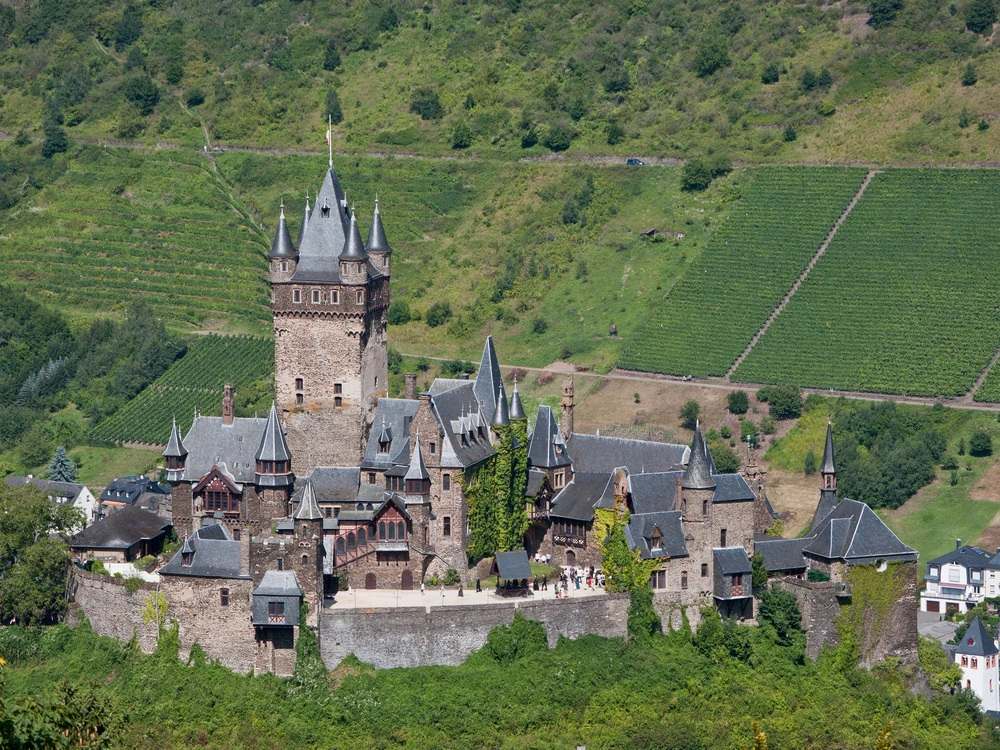
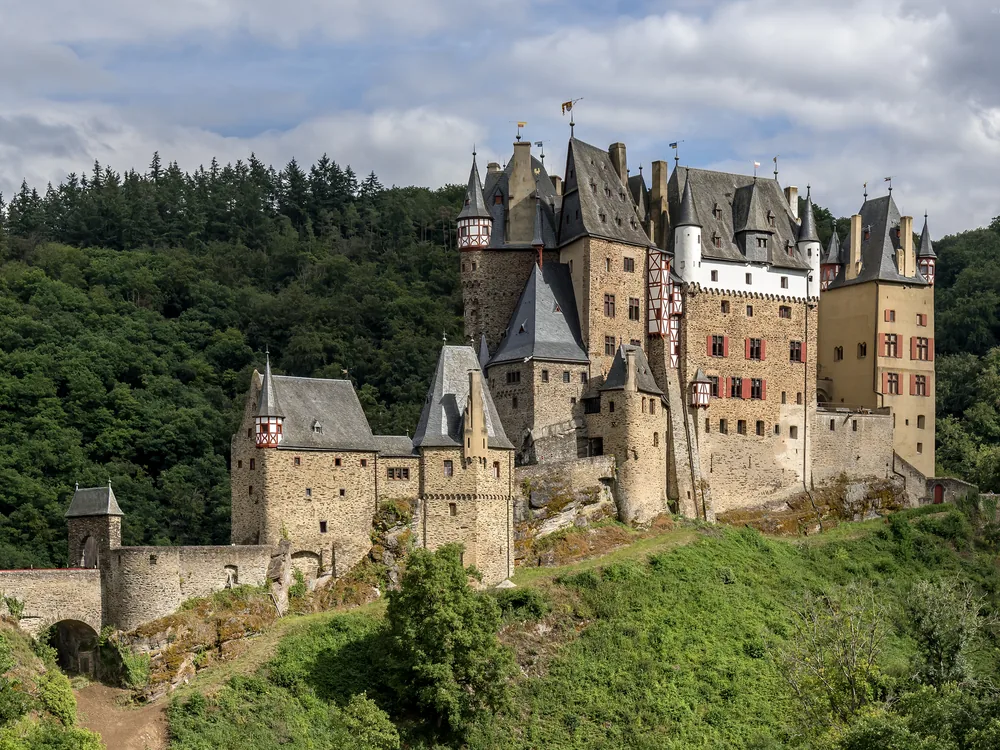
Reichsburg Cochem, approximately 35 kilometres northeast in the Mosel valley and already on this site, and Eltz Castle, approximately 40 kilometres northeast and among the most completely preserved medieval castles in Germany, are the most natural additions to a Manderscheid visit for visitors with their own transport. The three together cover a significant range of Rhineland castle experience: Manderscheid's authentic twin ruin in a volcanic landscape, Reichsburg Cochem's tourist-facing restored hilltop castle above the Mosel, and Eltz's exceptional medieval residential interiors in a deep valley setting.
History
The Niederburg at Manderscheid was established in the early 12th century by the Lords of Manderscheid, a comital family with holdings across the Eifel highlands. The twin-castle configuration with the Oberburg on the opposite ridge developed as the family divided into branches holding different parts of their territorial inheritance. The Niederburg was developed and extended across the medieval period before a fire in the 17th century destroyed the interior. The castle was not rebuilt and fell to ruin. The Manderscheid family's main line eventually died out, and the ruins passed to the municipality and heritage authorities. Both castle ruins are now accessible to visitors, with the Niederburg's Sunday-only guided tour providing the principal structured heritage access.
How to Visit
Getting there: By car: Manderscheid is on the B421 in the Eifel, about 35 km south of Cochem or 45 km northwest of Trier; from Cologne or Frankfurt allow 2–2.5 hours. There is no practical rail access — Manderscheid has no railway station and bus connections are infrequent; a car is required.
Tickets: Entry costs €6 for adults and €3 for children. The GetYourGuide guided tour runs Sundays at 14:00 only, in German only — there is no English-language alternative, no weekday guided access, and no other time slot. Visitors can approach the ruins on public footpaths on any day without a tour; the Sunday guided visit provides interior access and historical interpretation.
Practical tips: Plan specifically for a Sunday afternoon if you want the guided interior experience. The Schalkenmehrener Maar and Weinfelder Maar volcanic crater lakes (5 km away) make an ideal morning complement before the 14:00 tour — the circular crater lakes are among the most striking geological features in the Eifel.
Combine with: Reichsburg Cochem is 35 km northeast in the Moselle valley. Eltz Castle is 40 km northeast — one of Germany's best-preserved medieval castles in a deep forest valley setting.
Frequently Asked Questions
The Niederburg ruins can be approached on foot via public footpaths on any day, and the exterior of the ruins is visible from the paths without guided access. However, the structured guided tour that provides interior access and historical interpretation runs on Sundays at 14:00 only, in German only. There is no English-language alternative and no weekday guided access. Visitors who need the guided experience must plan specifically for a Sunday afternoon visit.
Location
Niederburg, 54531 Manderscheid, Germany
Nearby Castles
Tours & Tickets
Powered by GetYourGuide
From
€9/ person