
Münchhausen Castle
Schlosshotel Münchhausen
Germany · Lower Saxony — Aerzen (Schwöbber), near Hamelin · Near Hamelin (Hameln)
Built 1570 · Renaissance castle commissioned in 1570 by Hilmar von Münchhausen; damaged by fire in 1992, restored as a 5-star hotel in 2004
This page is part of an independent travel guide and is not affiliated with, endorsed by, or operated by Münchhausen Castle.
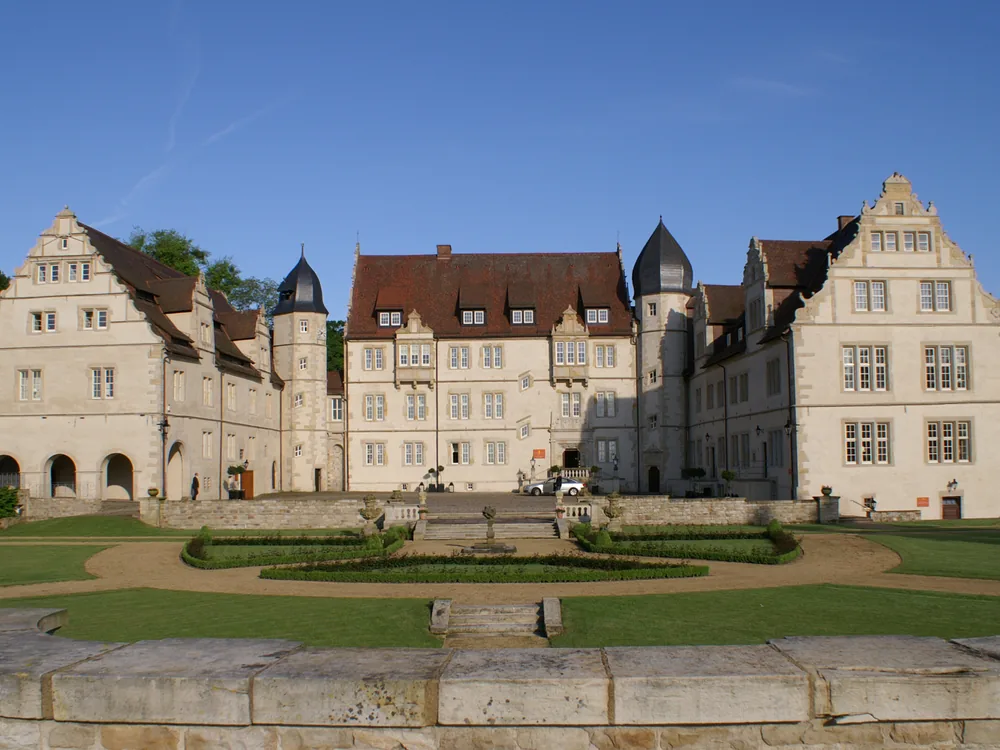
© Castles & Palaces
Quick Facts
- Rooms from
- €205 / night
- Duration
- Overnight stay only
- Best time
- Year-round
- Nearest city
- Hamelin (Hameln)
Stay Here
Schlosshotel Münchhausen
Rooms are split between the historic building and a newer wing
Booked via Booking.com · Free cancellation on most rates
Highlights
- ✦Commissioned in 1570 by Hilmar von Münchhausen, a noted mercenary leader, as a gathering place for aristocrats and collectors
- ✦Tsar Peter the Great visited in 1715, drawn by the estate's exotic plant collection and pineapple plantation
- ✦A 1992 fire devastated one wing; the castle reopened as a 5-star hotel in 2004
- ✦Half of the 67 rooms and suites are in the historic castle, the other half in a remodelled tithe barn connected by an underground passage
- ✦Two 18-hole golf courses on the estate
Stay in the castle itself
Book a room via Booking.com
Münchhausen Castle was commissioned in 1570 by Hilmar von Münchhausen, a mercenary leader of some renown, who built the estate as a gathering place for aristocrats, thinkers and collectors of his era. The castle takes its name from the Münchhausen family, but this is worth clarifying plainly: it is not the childhood home of the famous fabulist "Baron Münchhausen" (Karl Friedrich Hieronymus von Münchhausen), the tall-tale-telling figure of German literary legend. That Baron Münchhausen was born in nearby Bodenwerder, a separate town on the Weser river, and has no documented direct connection to this specific castle beyond the shared family surname — a connection easy to assume from the name alone, but not historically accurate.
Among the estate's more notable historical visitors was Tsar Peter the Great of Russia, who came in 1715 fascinated by the property's extensive plant collection and its pineapple plantation growing in the orangery — an exotic curiosity for the period, and a sign of the estate's cultivated, cosmopolitan character even in the early 18th century. The castle changed hands over the centuries that followed, its Renaissance architecture and grounds maintained through successive generations of ownership.
A fire in 1992 devastated one wing of the historic building, a serious setback that required a substantial restoration effort before the castle reopened as a five-star hotel in 2004. Today's 67 rooms and suites are split evenly between the historic castle building and a remodelled tithe barn (Zehntscheune) just across the grounds, connected to the main house by an underground passage — a practical solution that allowed the hotel to expand its room count without altering the historic castle's own footprint.
The estate's two 18-hole golf courses give Münchhausen a genuinely different amenity profile from castle-hotels built purely around historic architecture and spa facilities, positioning it as a golf-focused destination within the Weserbergland Schaumburg-Hameln Nature Park as much as a historic overnight stay. The surrounding parkland, with its lake and mature trees, reflects centuries of deliberate landscaping alongside the castle's own architectural development.
Aerzen and the wider Weser river region carry a strong association with German folklore beyond the Münchhausen name itself, most famously through nearby Hamelin's Pied Piper legend — giving visitors staying at the castle a natural, folklore-themed day trip within easy reach. The region's gently rolling hills and river valleys offer a quieter, more pastoral landscape than the dramatic gorge scenery associated with Germany's Rhine and Moselle castle country.
The distinction between this castle's Münchhausen family and the literary Baron is worth restating for anyone researching the property online: search results for "Münchhausen" frequently surface the fictional baron's fantastical tall tales — journeys to the moon, riding on cannonballs — well before information about this specific 16th-century estate, making the disambiguation a genuinely useful piece of context for visitors rather than a minor footnote.
The Weserbergland Schaumburg-Hameln Nature Park surrounding the castle takes its name from the Weser river, which winds through a landscape of low wooded hills and half-timbered towns distinct from the steeper, vine-covered valleys of the Rhine and Moselle further south and west. That gentler topography supports the estate's two 18-hole golf courses in a way that would be impractical on the steeper terrain found at many of Germany's river-gorge castle sites.
The underground passage connecting the historic castle to the remodelled tithe barn is a practical detail worth noting for guests choosing between the two accommodation wings: it allows movement between the buildings regardless of weather, a genuinely useful feature given the region's changeable central-European climate across the different seasons in which the hotel operates.
History
Münchhausen Castle was commissioned in 1570 by Hilmar von Münchhausen, a mercenary leader, as a gathering place for aristocrats and collectors. Tsar Peter the Great visited in 1715, drawn by the estate's plant collection and pineapple plantation. A 1992 fire devastated one wing before the castle reopened as a five-star hotel in 2004. Today's 67 rooms and suites are split between the historic castle and a remodelled tithe barn connected by an underground passage. The castle shares its name with the Münchhausen family but is not connected to the fabulist Baron Münchhausen, who was born in nearby Bodenwerder.
How to Stay
Getting there: Aerzen (Schwöbber), Lower Saxony, near Hamelin (Hameln).
Rooms & rates: Roughly half of the 67 rooms and suites are within the historic castle building; the other half are in a remodelled tithe barn (Zehntscheune) across the grounds, linked to the castle by an underground passage. From €205/night.
On-site: Restaurant, two 18-hole golf courses, gardens.
Good to know: The castle takes its name from the Münchhausen family (built by Hilmar von Münchhausen in 1570) — it is not the childhood home of the famous fabulist 'Baron Münchhausen' (Karl Friedrich Hieronymus von Münchhausen), who was born in nearby Bodenwerder and has no direct connection to this specific building beyond the shared family surname. Specify a castle-building room if sleeping inside the 1570 structure is the priority — the tithe barn rooms are comfortable and connected underground, but reflect a more modern conference-centre style.
Combine with: Hamelin (Hameln), the town of the Pied Piper legend, a short drive away.
Frequently Asked Questions
No. The castle takes its name from the Münchhausen family — it was commissioned in 1570 by Hilmar von Münchhausen — but the fabulist Baron Münchhausen, Karl Friedrich Hieronymus von Münchhausen, was born in nearby Bodenwerder and has no direct documented connection to this specific building beyond the shared family surname.
Location
Schwöbber 9, 31855 Aerzen, Germany
Nearby Castles
Rooms from
€205/ night