
Goslar Imperial Palace
Kaiserpfalz Goslar
Germany · Lower Saxony, Harz district — Goslar historic town, UNESCO World Heritage · Near Goslar
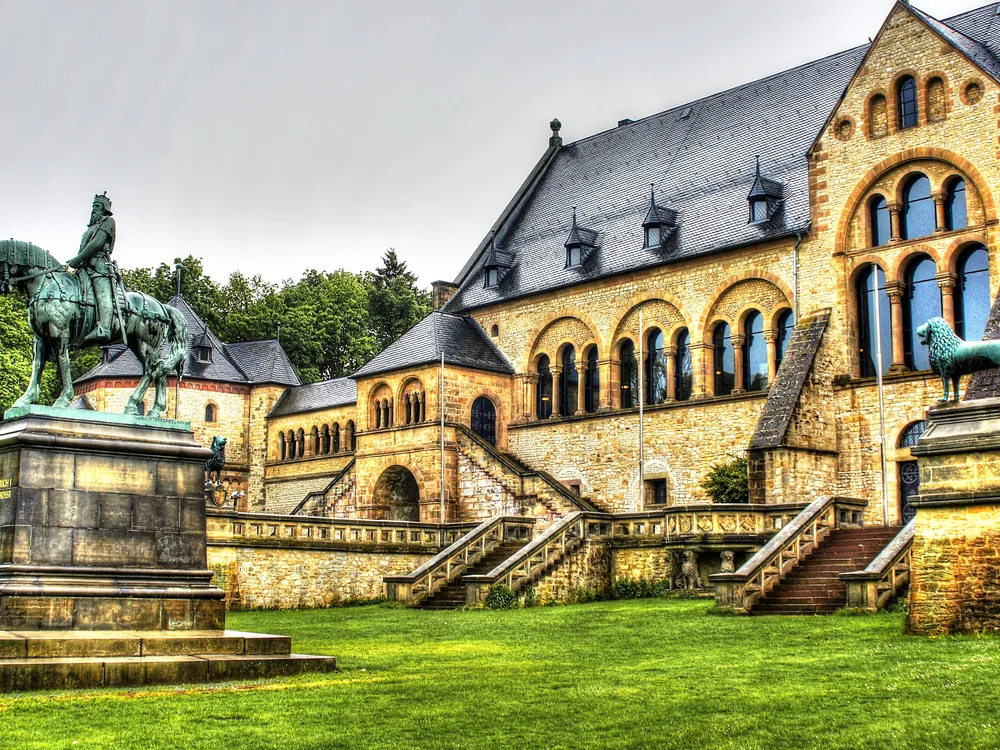
Built 1040 · Romanesque imperial palace (Pfalz) built for the Holy Roman Emperor Henry III in the 11th century — the main hall (Palas) is a large rectangular two-storey structure of remarkable proportions for its date: 47m long, 15m wide, with a round-arched arcade at the lower level and a series of twin-light windows at the upper level; the imperial chapel of Saint Ulrich, adjacent to the Palas, is a smaller centrally planned structure with an octagonal crossing; the Palas interior was extensively painted with historicist murals in the 1870s–1890s during restoration commissioned by Kaiser Wilhelm I, making the interior a significant document of 19th-century nationalist historical painting as well as of medieval architecture
This page is part of an independent travel guide and is not affiliated with, endorsed by, or operated by Goslar Imperial Palace.
© Castles & Palaces
Quick Facts
- Hours
- Daily 10:00–17:00
- Guided tour from
- €14
- Duration
- 1–1.5 hours
- Best time
- May to October
- Nearest city
- Goslar
Featured Tour
Goslar: Guided Tour of the Imperial Palace Kaiserpfalz (German language only)
Cancellation available · Instant confirmation
Highlights
- ✦Henry III's heart entombed here — the Emperor Henry III (reigned 1046–1056) considered Goslar his primary residence and used the Kaiserpfalz as the governmental heart of the Holy Roman Empire; his heart was buried in the palace chapel of Saint Ulrich after his death in 1056, where it remains today — one of the most tangible physical connections to an 11th-century emperor in existence
- ✦The Palas hall — the great hall of the palace, 47m long and 15m wide, is a major surviving example of Ottonian/Salian Romanesque architecture; most comparable halls from this period exist only as foundations; Goslar's is above ground, largely intact, and still the dominant building in the city's historic core
- ✦19th-century historical paintings — Kaiser Wilhelm I commissioned a comprehensive programme of monumental historicist paintings in the 1870s–1890s, depicting scenes from medieval German imperial history in the full-scale Palas interior; these paintings are significant documents of 19th-century nationalist historical culture — the German Empire's attempt to claim continuity with the medieval Holy Roman Empire
- ✦UNESCO World Heritage — the Historic Town of Goslar and the Rammelsberg Mines (1992) are jointly inscribed; the silver mines at Rammelsberg, which produced the wealth that funded the Imperial Palace, have been mined continuously for over a thousand years and remain one of the most significant surviving medieval industrial sites in Europe
- ✦Goslar's medieval town — over 1,500 half-timbered buildings survive in Goslar's old town, one of the densest concentrations of Fachwerkhaus (timber-frame) architecture in Germany; the Marktplatz, the Kaiserworth merchants' building, and the water channels running through the medieval street plan make Goslar a complete medieval city experience
- ✦GetYourGuide guided tour in German — the GetYourGuide product is listed as a 'rare find — usually unavailable'; confirmed as a German-language guided tour only; visitors who prefer an English-language experience should book an audio guide at the palace entrance instead
Skip the queue with a guided tour
Skip-the-line tickets & expert guides
The Goslar Imperial Palace — Kaiserpfalz Goslar — stands at the southern edge of Goslar's old town, at the base of the Rammelsberg hill whose silver mines paid for its construction. It is one of the oldest and most completely surviving royal residences in Germany: a Romanesque palace built for the Holy Roman Emperor Henry III in the 1040s, at a time when the Imperial court had no fixed capital but moved between a network of palace sites across the German-speaking territories of the Empire. Goslar was Henry III's preferred residence — he spent more time here than anywhere else in his domain — and he invested proportionally in making the site worthy of that preference.
The palace complex as it survives consists of two principal buildings: the Palas (the great hall, the ceremonial and governmental heart of the palace) and the chapel of Saint Ulrich. The Palas is the more remarkable structure for its scale: a two-storey rectangular building 47 metres long and approximately 15 metres wide, with a ground-level Romanesque arcade and a series of twin-light windows on the upper storey. Most comparable great halls from this period — the Carolingian Aula Regia at Ingelheim, the many other Pfalzen that Henry III and his predecessors used across the Empire — survive only as excavated foundations or in fragmentary form. Goslar's Palas is above ground, substantially intact, and still the largest and most dominant building in the historic town below it. This survival is partly due to luck and partly due to the comprehensive 19th-century restoration that gave the building its current condition.
Henry III died in 1056, aged 38. He had reigned for ten years as Emperor, reaching the peak of Salian dynasty power — he appointed three Popes in a single year in 1046 and held the Empire at its greatest territorial extent. His death at Goslar, where he had spent so much of his reign, was followed by a funerary arrangement that reflects the depth of his attachment to the place: his body was transported to the Cathedral at Speyer, the traditional burial church of the Salian emperors, but his heart was separately entombed in the chapel of Saint Ulrich at the Kaiserpfalz, where it remains nearly a thousand years later. The chapel itself — a centrally planned Romanesque structure with an octagonal crossing — is one of the few places in Europe where this kind of tangible physical connection to an 11th-century emperor is still in place.
The interior of the Palas was substantially transformed in the 1870s and 1890s, when Kaiser Wilhelm I — the first emperor of the newly unified German Empire — commissioned a comprehensive programme of monumental historical paintings by the painter Hermann Wislicenus. The paintings depicted scenes from medieval German imperial history: Otto the Great, Henry III and his successors, the conflicts between Empire and Papacy, the Investiture Controversy. The programme was explicitly nationalistic, using the medieval Holy Roman Empire as the historical ancestor and legitimating precedent for the new Wilhelmine German state. The paintings are in this sense as much a document of the 1870s as of the 1040s — they tell you as much about how late-19th-century Germany conceived of its historical identity as they tell you about the actual events depicted.
The UNESCO World Heritage designation (1992) covers both the historic town of Goslar and the Rammelsberg Mines, which are inseparably connected: the silver deposits at Rammelsberg, extracted continuously from approximately 968 AD to the mine's closure in 1988 — over a thousand years of production — created the wealth that funded the Imperial Palace, the merchants' guilds, and the half-timbered buildings of the old town. The Rammelsberg is a separate visitor site (a short drive south of the old town) with an extensive underground mine tour. Together, the Imperial Palace and the Rammelsberg represent the complete economic and political history of medieval Goslar.
The GetYourGuide guided tour (listed as 'Rare Find — usually unavailable') is a German-language guided tour. Visitors who prefer English should book an audio guide at the palace entrance instead — these are available in multiple languages and cover the same Palas and chapel circuit.
History
Goslar established as a royal residence from approximately 922 AD under Henry I, exploiting the nearby Rammelsberg silver mines. Henry II builds the first Pfalz on the site c.1005. Henry III constructs the current Palas c.1040 as his primary imperial residence. Henry III dies at Goslar 1056; his heart entombed in the chapel of Saint Ulrich, his body buried at Speyer Cathedral. Goslar remains an important imperial city through the High Middle Ages. Gradual decline of the Pfalzen system as fixed capital cities replace the itinerant court. Palace falls into disrepair from the 15th century. 1875–1897: major restoration commissioned by Kaiser Wilhelm I; Palas interior painted by Hermann Wislicenus with historicist murals. 1992: Historic Town of Goslar and Rammelsberg Mines inscribed as UNESCO World Heritage Site.
How to Visit
Getting there: Goslar is in the northern Harz region, about 90 km south of Hanover by train (~1.5 hours). The Kaiserpfalz stands at the southern edge of Goslar's old town, a 10-minute walk from the station through the half-timbered historic centre.
Tickets: Entry costs €8 for adults, €5 for children; audio guides in English and other languages are available on-site. The GetYourGuide guided tour is a German-language tour listed as "Rare Find — usually unavailable"; English speakers should use the palace's own audio guide at the entrance instead.
Practical tips: Allow at least 2 hours after the Kaiserpfalz to explore Goslar's old town — over 1,500 half-timbered buildings, the Marktplatz, and the Kaiserworth merchants' building form one of the densest Fachwerk streetscapes in Germany. The UNESCO-listed Rammelsberg silver mines (3 km south, separate entry) run underground tours and deserve a full half-day if time allows.
Combine with: The Rammelsberg Mines are the natural same-day pairing — both share the 1992 UNESCO inscription, and the mines explain where the wealth came from that funded the Imperial Palace. The Harz National Park's Brocken peak (highest in northern Germany, served by the historic narrow-gauge Brockenbahn steam railway) makes a scenic second day from Goslar.
Frequently Asked Questions
Yes — Henry III died at Goslar in 1056 and his heart was entombed in the chapel of Saint Ulrich on the palace grounds, while his body was taken to Speyer Cathedral for burial. The reliquary containing his heart remains in the chapel today. It is one of the very few surviving physical remains of an 11th-century Holy Roman Emperor in situ at his primary residence.
Location
Kaiserbleek 6, 38640 Goslar, Germany
Nearby Castles
Tours & Tickets
Powered by GetYourGuide
From
€14/ person