
Schleißheim Palace
Schloss Schleißheim
Germany · Bavaria, Oberschleißheim — 15km north of Munich · Near Munich
Built 1684 · Baroque — the Schleißheim complex comprises three buildings: Altes Schloss (Old Palace, 1616), Lustheim Palace (Lustheim, 1684–1689, designed by Enrico Zuccalli for Elector Max Emanuel's wedding to Maria Antonia, daughter of Holy Roman Emperor Leopold I), and Neues Schloss (New Palace, begun 1701, also by Zuccalli and later Effner), set in an axial Baroque park with a canal connecting the Neues Schloss to Lustheim; the Neues Schloss was modeled on the scale and formal vocabulary of French royal palace architecture, reflecting Max Emanuel's ambitions for the imperial throne; construction was interrupted by his exile following defeat in the War of the Spanish Succession and resumed under his successors, leaving the complex permanently at a scale that exceeded the ambitions that produced it
This page is part of an independent travel guide and is not affiliated with, endorsed by, or operated by Schleißheim Palace.
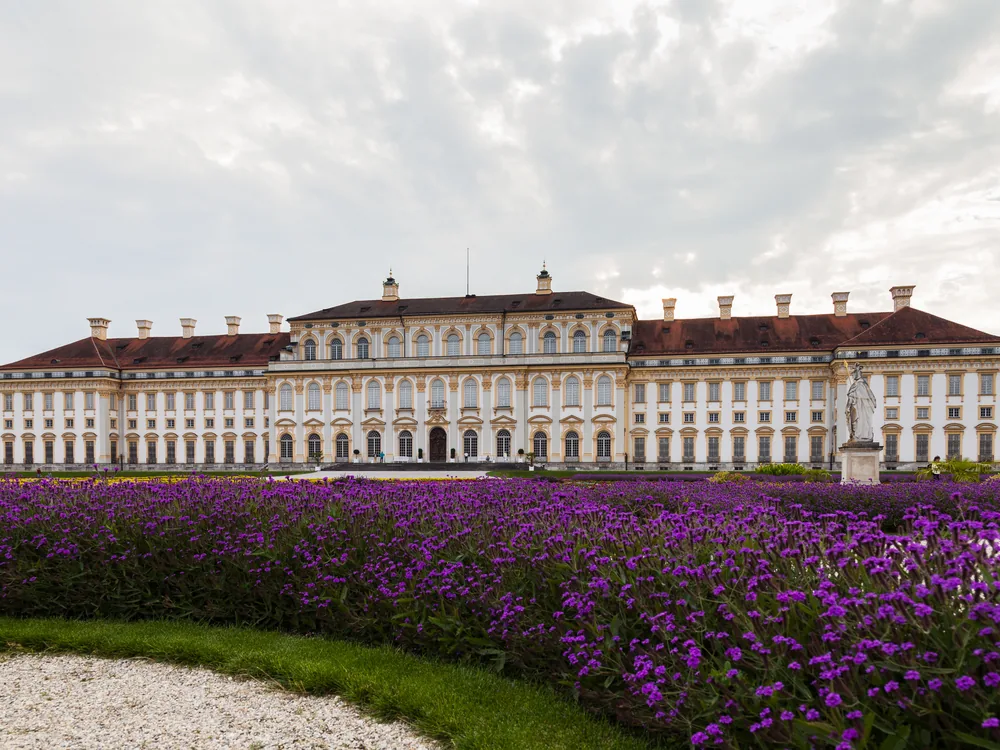
© Castles & Palaces
Quick Facts
- Hours
- Tue–Sun 09:00–18:00. Closed Mon
- Guided tour from
- €69
- Duration
- 2–3 hours (Neues Schloss + Lustheim + gardens); the evening concert is 2 hours
- Best time
- May to September
- Nearest city
- Munich
Featured Tour
Festive Concert at Schleißheim Palace with Residence-Soloists (Evening Concert)
Cancellation available · Instant confirmation
Highlights
- ✦The Neues Schloss (New Palace) — begun 1701 by Elector Max Emanuel, modeled on French Baroque palace design to project the status of a man who coveted the Holy Roman Imperial throne; the scale and formal vocabulary of the building reflect ambitions that were overtaken by military defeat and exile before the palace was complete
- ✦Lustheim Palace (1684–1689) — the first building of the Schleißheim complex, built for Max Emanuel's wedding to Maria Antonia, daughter of Holy Roman Emperor Leopold I; a complete Baroque pleasure palace at the far end of the axial canal, today housing Germany's most important Meissen porcelain collection
- ✦The Baroque garden and canal — a formal axial composition connecting the Neues Schloss to Lustheim Palace across a kilometre of clipped parterres, water features, and lime avenues; one of the most complete Baroque garden layouts surviving in Bavaria
- ✦Baroque painting collection — the Neues Schloss houses one of Bavaria's major state collections of 17th-century Baroque painting, with Flemish, Dutch, and Italian works accumulated by the Wittelsbachs; the gallery provides the most directly comparable context in Bavaria for the period when the palace was built
- ✦Evening concert — the Residence-Soloists perform chamber music in the palace's state rooms after the daytime visitors have left; a way to experience the Neues Schloss interiors in their intended atmospheric context, candlelit and music-filled, separate from the standard daytime museum visit
- ✦Wittelsbach dynasty context — Schleißheim completes the Munich Wittelsbach palace circuit alongside [Munich Residenz](/castles/germany/munich-residenz) and [Nymphenburg Palace](/castles/germany/nymphenburg-palace); the three together trace the dynasty's architectural ambition from the medieval urban residence to the full Baroque palace-in-a-park
Skip the queue with a guided tour
Skip-the-line tickets & expert guides
Schleißheim Palace is actually three buildings, one park, and one ambition that history refused to ratify. The ambition was Max Emanuel's — Maximilian II Emanuel, Elector of Bavaria from 1679, a man of extraordinary political aspiration who spent most of his life in pursuit of the Holy Roman imperial crown and died without it. The park and buildings at Oberschleißheim, 15 kilometres north of Munich, were the material expression of that aspiration: an ensemble deliberately scaled to match Versailles and consciously designed to project the status of a ruler who intended to govern Europe's most powerful throne.
The oldest element of the complex is the Altes Schloss (Old Palace), begun in 1616 under Duke Wilhelm V, which stands at the western end of the axial composition. Max Emanuel added nothing to this building; his attention was fixed on the new construction. In 1684, for his wedding to Maria Antonia — daughter of Holy Roman Emperor Leopold I, a match that placed Max Emanuel one step from the imperial succession — he commissioned the architect Enrico Zuccalli to design a pleasure palace at the eastern end of a new formal garden. The result was Lustheim, completed in 1689: a single-storey garden palace in the French manner, frescoed throughout, and positioned at the far end of a kilometre-long canal that would become the spine of the entire composition. Lustheim was not a primary residence but a fête venue, a garden building for summer festivities, and today it houses the most important Meissen porcelain collection in Germany — thousands of pieces accumulated across two centuries of Wittelsbach collecting displayed in a setting whose frescoed ceilings and painted rooms provide the ideal decorative context.
The Neues Schloss (New Palace) was Max Emanuel's true project — the building that would announce his imperial ambitions to the world. He commissioned Zuccalli to begin the design in 1701, the same year the War of the Spanish Succession broke out across Europe. Max Emanuel chose the wrong side: supporting France and the Bourbon candidate for the Spanish crown rather than the Habsburg-backed alternative. When Habsburg forces defeated the Franco-Bavarian alliance at the Battle of Blenheim in 1704, Max Emanuel was driven into exile in the Spanish Netherlands. Construction on the Neues Schloss stopped. The walls stood, incomplete, for a decade while their patron spent his exile at Versailles and Saint-Cloud, living at the courts he had modeled his palace to emulate.
Max Emanuel returned from exile in 1715. Construction resumed under the architect Joseph Effner, who completed the exterior and the principal interiors through the 1720s. The result is a palace whose scale still reflects the imperial ambitions that were never fulfilled: a 330-metre facade, a formal garden with three parterres and a canal, state rooms frescoed by Cosmas Damian Asam with allegorical programmes celebrating a Bavarian glory that never materialised. The paradox of Schleißheim is that the building is the proof of failure — too large for what Max Emanuel ultimately became, exactly right for what he had intended to be.
Today the Neues Schloss houses one of Bavaria's principal Baroque painting collections, with major Flemish, Dutch, and Italian works from the Wittelsbach collections displayed in the state rooms and galleries for which they were never originally intended but in which they sit naturally — the scale of the rooms and the quality of the pictures are well matched. Lustheim Palace houses the Meissen porcelain collection of the Bavarian state.
For visitors planning a Munich palace circuit: Schleißheim is the third Wittelsbach palace in the sequence. [Munich Residenz](/castles/germany/munich-residenz), in the city centre, was the dynasty's principal urban seat from the 16th century and contains the most varied collection of interiors, from Renaissance to Neoclassical, of any German royal palace. [Nymphenburg Palace](/castles/germany/nymphenburg-palace), four kilometres west of the city centre, was the dynasty's primary summer residence after 1664 and combines a large Baroque palace with an extensive park containing several pavilions. Schleißheim adds the dimension of thwarted imperial ambition — a palace that shows what the Wittelsbachs aspired to become, rather than what they were.
**Entry note:** The standard daytime combination ticket (Neues Schloss + Altes Schloss + Lustheim, including the Meissen collection) is €11 regular / €9 reduced. This is the main way to visit the complex during museum hours (Tuesday–Sunday, 09:00–18:00 summer). The GetYourGuide evening concert product is a separate evening event — a chamber music performance in the palace state rooms by the Residence-Soloists — that takes place after the daytime museum closes. The concert is an optional atmospheric add-on for evenings, not the primary way to see the palace.
History
The first building on the Schleißheim estate was a hermitage-style country retreat commissioned by Duke Wilhelm V in 1616 — modest by the standards of what would follow. The transformation of the site into Bavaria's rival to Versailles was the project of his grandson, Elector Max Emanuel, who began it in 1684 with Lustheim Palace, built by Enrico Zuccalli as a hunting lodge to celebrate his marriage to Maria Antonia, daughter of Holy Roman Emperor Leopold I. The alliance with the Habsburgs proved temporary; the ambition it expressed did not.
In 1701, Max Emanuel commissioned Zuccalli to begin the Neues Schloss on a scale calibrated to announce his imperial pretensions. Construction stopped almost immediately: the War of the Spanish Succession, in which Max Emanuel sided with France, brought military defeat at the Battle of Blenheim in 1704 and drove him into nine years of exile in the Spanish Netherlands. The half-built shell stood as a monument to overreach while its patron waited in exile for a reversal of fortune that never fully came. When Max Emanuel returned to Bavaria in 1715, he resumed construction under architect Joseph Effner, and the Neues Schloss was largely complete by 1726 — though the connecting wing he had planned between the three structures was never built. Max Emanuel died that same year; the Wittelsbach main electoral line ended in 1777, and Bavaria passed to the Palatine branch.
The Baroque painting collections installed in the Neues Schloss and the Meissen porcelain assembled in Lustheim in the 19th and 20th centuries gave both buildings a second life as exhibition spaces. The ensemble is now managed by the Bayerische Schlösserverwaltung.
How to Visit
Getting there: Take S-Bahn line S1 from Munich Hauptbahnhof towards Freising and alight at Oberschleißheim (about 25 minutes). The palace is a 15–20 minute walk from the station, or a short taxi ride. By car, follow the B471 north from Munich's ring road — parking is available at the palace.
Tickets: Walk-up admission for the combination ticket (Neues Schloss + Altes Schloss + Lustheim with the Meissen porcelain collection) costs €11 regular and €9 reduced; children are free. Buy at the ticket office or online at schloesser.bayern.de. For an evening alternative, the GetYourGuide "Festive Concert at Schleißheim Palace with Residence-Soloists" presents 2-hour chamber music concerts in the palace state rooms on selected evenings from April to October.
Practical tips: The palace is closed on Mondays. Allow 2–3 hours to cover the Neues Schloss state rooms and the Lustheim Meissen porcelain collection, connected by the formal canal garden. Visit on a weekday morning to avoid weekend crowds; summer afternoons can be busy.
Combine with: Munich Residenz in the city centre and Nymphenburg Palace to the west — together the three Wittelsbach palaces trace the full arc of Bavarian royal ambition from medieval fortress to Baroque garden palace.
Frequently Asked Questions
The daytime combination ticket (€11 regular) covers the full palace complex — Neues Schloss, Altes Schloss, and Lustheim — as a standard museum visit during opening hours. The GetYourGuide evening concert is a chamber music performance in the palace state rooms by the Residence-Soloists, taking place after the museum closes; it is a ticketed cultural event, not a guided palace tour. The concert offers the atmosphere of candlelit state rooms with live Baroque music but does not cover independent museum access to all parts of the complex. The two can be combined on the same day — visit the palace during the day and attend the concert in the evening — or the concert can be attended independently.
Location
Max-Emanuel-Platz 1, 85764 Oberschleißheim, Germany
Nearby Castles
Tours & Tickets
Powered by GetYourGuide
From
€69/ person