
Koroni Castle
Κάστρο Κορώνης
Greece · Messenia, Peloponnese — Koroni, Messenian Gulf · Near Kalamata
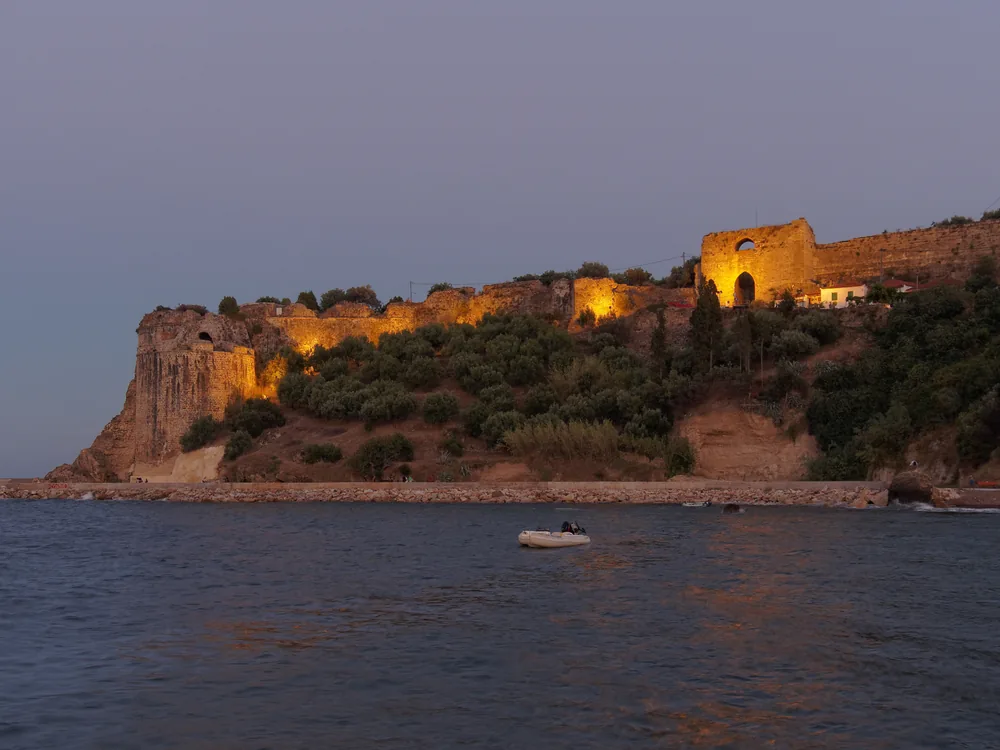
Built 1204 · Venetian naval fortification developed over Byzantine and ancient foundations — Venice acquired the site after the Fourth Crusade of 1204 and built the first major Venetian fortification on the existing Byzantine and possibly ancient Greek structure; the castle circuit encloses a promontory at the southern tip of the western Messenian peninsula, exploiting the natural defensive advantage of the elevated coastal headland; the walls were reinforced and extended across successive Venetian administrations (13th–15th century), with additional work by Ottoman builders after the fall of 1500; the most distinctive characteristic of Koroni is that it functions as a living fortified settlement — the monastery of Timios Prodromos (St. John the Baptist) has operated continuously inside the walls since the Byzantine era, and tower-houses, residential buildings, and village structures from successive centuries remain standing and in some cases inhabited within the circuit, giving the castle a character fundamentally different from the cleared ruins of its counterpart Methoni Castle across the bay
This page is part of an independent travel guide and is not affiliated with, endorsed by, or operated by Koroni Castle.
© Castles & Palaces
Quick Facts
- Hours
- Daily 08:00–20:00
- Guided tour from
- €96
- Duration
- 1–1.5 hours (castle circuit, monastery, and harbor views); 5 hours (GetYourGuide combined Methoni and Koroni tour)
- Best time
- April to October
- Nearest city
- Kalamata
Featured Tour
Pylos: Methoni Castle & Koroni Castle Tour
Cancellation available · Instant confirmation
Highlights
- ✦'The eyes of the Republic' — Venice described its two fortresses at the southern tips of the Peloponnese, Koroni and Methoni, as the 'occhi di Romania' (eyes of the Levant): the two naval bases that allowed Venetian galleys to navigate from Venice to Crete, Cyprus, and the Holy Land without exposing themselves to hostile coastlines; from these two anchorages, Venice controlled the eastern Mediterranean shipping lanes for nearly three centuries
- ✦A living fortified settlement — unlike Methoni across the bay, which is a magnificent cleared ruin with ramparts and towers but no permanent habitation inside the walls, Koroni is a functioning community within its circuit; the monastery of Timios Prodromos (St. John the Baptist) has operated continuously since the Byzantine era; tower-houses and residential buildings from Venetian, Ottoman, and later periods remain standing inside the walls; some are inhabited; the contrast between the two fortresses is one of the most significant in the Peloponnese
- ✦The 1500 fall to Ottoman Sultan Bayezid II — in the same campaign that took Methoni across the bay, Ottoman forces under Bayezid II captured Koroni in 1500; the simultaneous fall of both 'eyes of the Republic' was one of the most significant strategic reversals in Venetian Mediterranean history, closing the southern Peloponnese to Venetian naval operations and signaling the terminal decline of Venetian power in the eastern Mediterranean
- ✦The monastery of Timios Prodromos — the monastery of St. John the Baptist inside the castle walls has functioned as a religious community since the Byzantine era, predating the Venetian fortification; the church and monastic buildings occupy the interior of the castle circuit alongside the tower-houses and residential structures; the presence of a functioning monastery inside a medieval castle gives Koroni an interior atmosphere found nowhere else on the Peloponnesian coast
- ✦Views over the Messenian Gulf toward the Mani peninsula — from the castle promontory, the Messenian Gulf stretches north toward Kalamata; across the water the southern tip of the Mani peninsula, one of the most distinctive landscapes in Greece, is visible on clear days; Methoni Castle is directly across the bay on the opposite peninsula, the two 'eyes' visible to each other across the water they once guarded
- ✦GetYourGuide private Pylos tour with Methoni and Koroni — 5-hour circuit explicitly including entrance fees at both castles; pickup from Kalamata cruise port
Skip the queue with a guided tour
Skip-the-line tickets & expert guides
The Venetian Republic described its two fortresses at the southern tip of the Peloponnese with a phrase that carries both strategic precision and a faint poetic vanity: the 'occhi di Romania,' the eyes of the Levant. Koroni and Methoni — facing each other across the Messenian Gulf from opposite peninsulas, each controlling one of the two sea lanes that ships used to round the southern Peloponnese on the voyage from Venice to Crete, Cyprus, and the Holy Land — were the sentinels of the eastern Mediterranean galley route. For nearly three centuries, every Venetian trading or military fleet passed within sight of one or both of them.
Venice acquired the site at Koroni in the aftermath of the Fourth Crusade of 1204 — the crusade that, in one of medieval history's stranger outcomes, never reached Jerusalem but instead captured and dismembered the Byzantine Empire. The Crusader states divided the former Byzantine territories among themselves, with Venice taking the maritime assets it most needed: Crete, the Ionian Islands, and the strategically critical ports along the route between them. Koroni and Methoni, at the southern tips of the Peloponnese, were the most valuable of these — natural harbors on elevated promontories that could be defended with relatively modest garrisons while providing secure anchorage for fleets of any size.
The Venetian administration at Koroni over the following three centuries built and reinforced the castle circuit that still stands: walls that enclose the promontory, towers at the corners and gate, and the internal buildings that housed the garrison and the colonial administration. Unlike the medieval castle complexes in the interior of the Peloponnese, Koroni was not a feudal hilltop stronghold but a naval logistics base — its purpose was to provide fresh water, provisions, and safe anchorage for Venetian galleys on the multi-week voyage to the Levant, and its defensive works were sized accordingly. The commerce they protected was the trade that financed the Venetian Republic.
Coroni and Methoni fell in the same 1500 campaign. Ottoman Sultan Bayezid II, having consolidated the Ottoman position in Anatolia and the Balkans, turned to the final elimination of Venetian naval power in the eastern Mediterranean. His forces took Methoni first, then Koroni, in the summer of 1500 — the simultaneous loss of both 'eyes' was one of the most significant strategic defeats in Venetian history, closing the southern sea route to Venetian operations and beginning the long retreat that would end with the loss of Crete in 1669. Venice briefly recovered Koroni in the early 16th century and lost it again; the Ottoman administration held it for most of the subsequent period.
What makes Koroni different from Methoni is what happened inside its walls across this long history. Methoni, now a cleared ruin with dramatic ramparts and towers but no permanent habitation within the circuit, is a magnificent monument to Venetian military architecture in its emptied state. Koroni, by contrast, accumulated a living community inside its walls across successive administrations. The monastery of Timios Prodromos — St. John the Baptist — has functioned as a religious community since the Byzantine era, predating the Venetian fortification by centuries; it still operates, with the church and monastic buildings occupying the interior of the castle circuit alongside tower-houses and residential structures from Venetian, Ottoman, and later periods. Some of the buildings inside the walls are inhabited. The village that has grown up within the fortification is not a reconstruction or a heritage presentation — it is a community that has simply continued living inside its medieval walls because that is where the community has always been.
The monastery is accessible to respectful visitors during daylight hours, and the castle circuit can be walked without restriction. From the promontory walls, the Messenian Gulf stretches north toward Kalamata; across the water, on the opposite peninsula, the walls and towers of Methoni Castle are visible on clear days — the two 'eyes' looking at each other across the water they were built to guard.
The GetYourGuide private tour from Kalamata covers both Koroni and Methoni in a five-hour circuit, with entrance fees explicitly included for both castles.
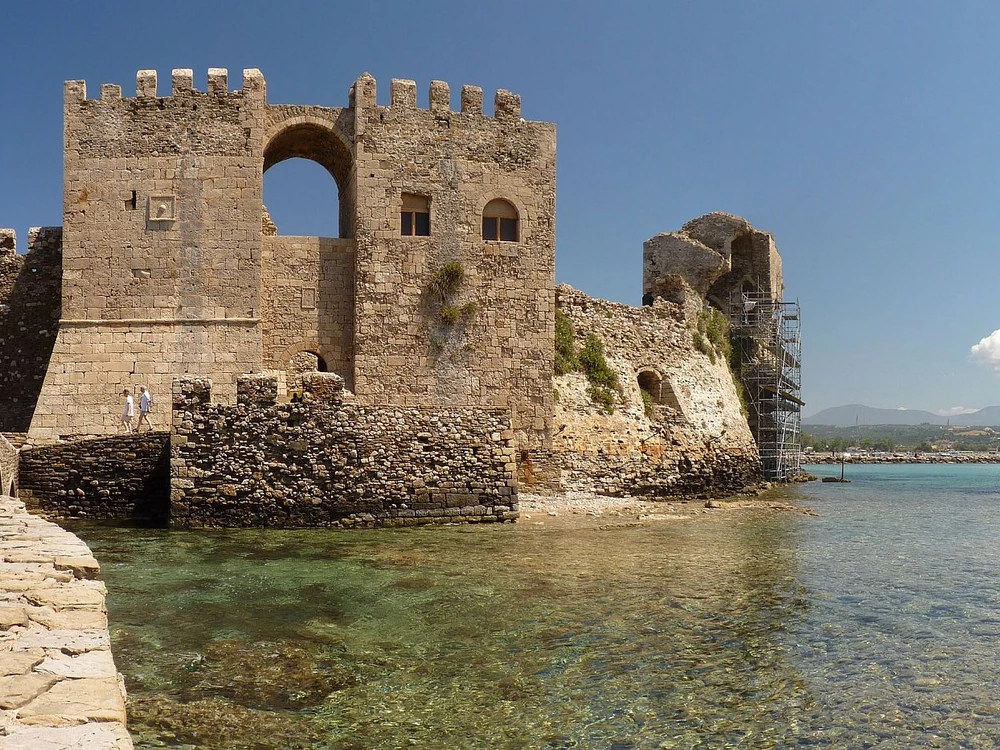
[Methoni Castle](/castles/greece/methoni-castle), directly across the Messenian Gulf, is the other half of the Venetian 'eyes of the Republic' — its cleared-ruin character of ramparts, towers, and the famous Bourtzi sea-tower creates a contrast with Koroni's living settlement; the two fortresses share the same Venetian strategic history, the same 1500 fall to Bayezid II, and the same GetYourGuide tour product.
History
A Byzantine fortification and the monastery of Timios Prodromos (St. John the Baptist) occupied the headland at the southern tip of the Messenian peninsula before the event that would define Koroni's medieval history. The Fourth Crusade of 1204 gave Venice the site as part of the partition of the Byzantine Empire, and Venetian engineers immediately set about developing the headland into one of the two naval bases that would anchor the Republic's eastern Mediterranean trade routes. Over the following two and a half centuries, Venice reinforced and extended the castle circuit, making Koroni a key resupply station on the galley route from Venice to Crete, Cyprus, and the Levant — the route that sustained Venetian commercial dominance in the eastern Mediterranean.
The fall came in 1500, when Ottoman forces under Sultan Bayezid II captured both Koroni and its partner fortress at Methoni in the same campaign. The simultaneous loss of both southern Peloponnese bases — the 'eyes of the Republic' — was a severe strategic blow for Venice; it meant the loss of the resupply infrastructure that made long-distance galley voyages to the Levant viable. Venice briefly reacquired Koroni in the early 16th century before Ottoman administration resumed for most of the period that followed.
Greek independence in 1828 returned Koroni and the Messenian region to Greek sovereignty. The castle walls and monastery remain open to visitors, and a small inhabited community continues to live within the castle circuit.
How to Visit
Getting there: Koroni is approximately 45 km southwest of Kalamata by car (about 55 minutes on the coastal road via Petalidi). No direct public transport serves Koroni from Kalamata — a car or a guided tour are the practical options.
Tickets: The castle circuit and the village within the walls are freely accessible during daylight hours. The monastery of Timios Prodromos welcomes respectful visitors (dress modestly; small donation box inside the church). The GetYourGuide guided tour (no ratings yet) covers both Koroni and Methoni Castle on a 5-hour circuit from Kalamata, with entrance fees explicitly included for both castles; pickup is available from Kalamata cruise port.
Practical tips: Visit the monastery in the morning when it is quietest. From the promontory walls, Methoni Castle is visible across the Messenian Gulf on clear days — the two Venetian 'eyes of the Republic' looking at each other across the water they were built to guard.
Combine with: Methoni Castle directly across the Messenian Gulf — the two fortresses share the same Venetian history and the same GetYourGuide tour, making them a natural full-day pairing.
Frequently Asked Questions
Venice's trading empire was built on the galley routes connecting the Venetian lagoon to the ports of Crete, Cyprus, Beirut, and Alexandria. These routes required secure stopping points where galleys could take on fresh water, provisions, and crew — multi-day sea voyages in the medieval and early modern period could not be sustained without intermediate anchorages. Koroni and Methoni, positioned at the southern tips of the two peninsulas of the southwestern Peloponnese, controlled the two sea lanes that ships used to round the southern Peloponnese. Every Venetian fleet heading east passed within sight of them. The phrase 'occhi di Romania' — eyes of the Levant — captured both their surveillance function (they could observe and report on shipping in both directions) and their critical importance to the entire eastern trading system. The simultaneous loss of both to the Ottomans in 1500 was not merely a military defeat but a strategic catastrophe that permanently altered the economics of Venetian trade.
Location
Koroni Castle, Koroni, 24004, Messenia, Peloponnese, Greece
Nearby Castles
Tours & Tickets
Powered by GetYourGuide
From
€96/ person