
Naxos Castle
Κάστρο Νάξου (Kastro)
Greece · Cyclades — Naxos island, Kastro district of Naxos Town (Chora) · Near Naxos Town
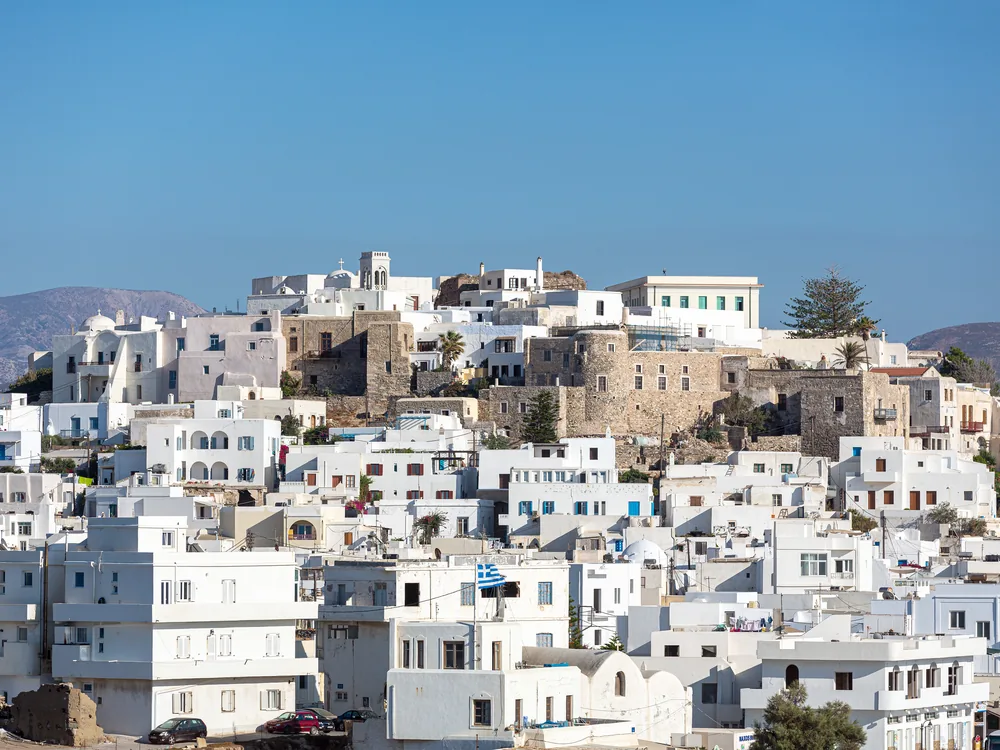
Built 1207 · Venetian kastro (fortified hilltop settlement) constructed from 1207 as the administrative and military centre of the Duchy of the Archipelago; the defensive perimeter follows the form of Venetian Aegean fortification — a roughly pentagonal enceinte of thick rubble-and-mortar walls with controlled gate passages (the pyrgos system) designed to limit access to the hilltop; the streets within the kastro retain their Venetian layout, marble-paved and narrow, with the Catholic Cathedral of the Assumption at the centre; the residential towers (pyrgoi) of the Venetian noble families survive as inhabited private houses, their heavy lower-storey masonry contrasting with later Ottoman-period modifications; the kastro as a whole is a working document of Venetian colonial urbanism in the Aegean, integrating military, ecclesiastical, and residential functions within a unified defensive perimeter
This page is part of an independent travel guide and is not affiliated with, endorsed by, or operated by Naxos Castle.
© Castles & Palaces
Quick Facts
- Hours
- Mon–Sun Open (castle district freely accessible; Venetian Museum: check locally)
- Guided tour from
- €30
- Duration
- 1.5–2 hours (castle district walking tour + panoramic views)
- Best time
- April to June and September to October
- Nearest city
- Naxos Town
Featured Tour
Naxos Castle Walking Tour and Sunset at the Portara
Cancellation available · Instant confirmation
Highlights
- ✦The living Venetian urban fabric — the kastro is not a ruin or a museum but an inhabited neighbourhood, with the original Venetian defensive perimeter, marble-paved lanes, and noble tower houses still in daily use; it is one of the most complete examples of Venetian colonial urbanism surviving in the Cyclades, experienced as a living place rather than a heritage site
- ✦The view of the Portara from the kastro walls — the massive marble doorway of the unfinished 6th-century BC Temple of Apollo stands on the causeway below Naxos Town, framed by the Aegean; viewing the Portara from the kastro walls creates a direct visual dialogue between the island's ancient Greek and medieval Venetian histories, separated by seventeen centuries but visible simultaneously from the same vantage point
- ✦The Catholic Cathedral and the Duchy of the Archipelago — the Cathedral of the Assumption at the centre of the kastro contains heraldic markers of the Venetian noble families who ruled the Duchy of the Archipelago; the Catholic architecture, Venetian coats of arms, and Cycladic building materials together tell the story of Frankish colonialism in the Aegean in compressed, material form
- ✦The Nikos Kazantzakis connection — the former Jesuit school within the kastro, where the author of Zorba the Greek and The Last Temptation of Christ studied as a child, links the medieval Venetian castle to one of the 20th century's most widely read Greek writers; the building now houses the Naxos Archaeological Museum
- ✦The guided kastro and Portara walking tour — the GetYourGuide tour covers the kastro lanes and Venetian noble architecture before moving down to the Portara causeway for sunset, giving a guided narrative of the Duchy of the Archipelago and Naxos's layered history in a single 2.5-hour experience
Skip the queue with a guided tour
Skip-the-line tickets & expert guides
The Kastro of Naxos occupies the summit of Naxos Town (Chora), the island's principal port and capital, and is one of the most complete surviving examples of Venetian colonial urbanism in the Cyclades. It is not a castle in the conventional sense — it is a fortified hilltop neighbourhood that has been continuously inhabited for more than eight centuries, its marble-paved lanes, Venetian noble tower houses, and Catholic cathedral coexisting with the domestic and commercial life of the town below.
The founding of the Duchy of the Archipelago in 1207 by Marco Sanudo of Venice gave the Cyclades their defining medieval identity. Sanudo arrived in the aftermath of the Fourth Crusade's sack of Constantinople (1204), when the collapse of Byzantine authority across the Aegean created an opening for Venetian adventurers to claim territory. He built his kastro on the highest point of Naxos Town — a commanding hilltop above the natural harbour — constructing a perimeter of thick rubble-and-mortar walls with controlled gate passages, and establishing within those walls the administrative, religious, and residential structures of a miniature Venetian colonial court. The Duchy that Sanudo founded would survive, through various dynastic successions and political pressures, until the Ottoman conquest of Naxos in 1566.
What survives today is a neighbourhood of considerable historical density and architectural complexity. The original defensive perimeter is largely intact, with the Venetian gate passages still functioning as the kastro's main entrances from the lower town. The Catholic Cathedral of the Assumption — one of the oldest in the Cyclades — stands at the centre of the hilltop, its interior bearing the heraldic markers of the noble families who sheltered within the kastro during the centuries of Frankish rule. The former Jesuit school attached to the cathedral carries an unexpected biographical resonance: Nikos Kazantzakis, the author of Zorba the Greek and The Last Temptation of Christ, studied here as a child, and the building now serves as the Naxos Archaeological Museum.
The views from the kastro walls are among the finest in the Cyclades. Looking down from the western parapet, the massive marble doorway of the Portara stands on the causeway below Naxos Town — the surviving portal of an unfinished Temple of Apollo begun in the 6th century BC, the most photographed monument on the island. The Portara and the kastro together define Naxos's layered historical identity: an island where an ancient Greek sanctuary and a medieval Venetian castle are visible simultaneously from the same viewpoint, both integrated into a working port town.
For visitors exploring the Cyclades, the kastro is freely accessible as a living neighbourhood — entry costs nothing, and the marble lanes reward unhurried exploration at any time of day. The GetYourGuide guided walking tour of the kastro and sunset at the Portara (approximately 2.5 hours) provides contextual narrative for visitors who want the Duchy of the Archipelago explained as they move through the spaces where it was exercised. The castle's position makes a sunset visit the natural choice: the narrow westward-facing lanes fill with warm light in the hour before dusk, and the Portara below catches the last light of the Aegean sun.
History
The story of Naxos Castle begins with one of medieval history's most consequential acts of organised plunder. The Fourth Crusade's sack of Constantinople in 1204 fractured Byzantine authority across the Aegean and created a political vacuum that Venetian entrepreneurs moved quickly to exploit. Marco Sanudo, a Venetian nobleman with the resources and ambition to act on that opportunity, sailed into the Cyclades in 1207 and established himself as Duke of the Archipelago from the fortified hilltop above Naxos Town, constructing the kastro that still shapes the island's skyline. The Duchy he founded would govern the Cyclades for more than three and a half centuries, outlasting the immediate political context of the Fourth Crusade to become a durable fixture of Aegean geopolitics. Successive ducal dynasties — the Sanudo line, then the Crispi family — maintained Venetian Catholic rule over a predominantly Greek Orthodox island population, the two communities living in the uneasy but durable arrangement characteristic of Frankish Aegean lordship. The Ottoman conquest of Naxos in 1566 ended the Duchy, but the kastro endured as an inhabited settlement — the Venetian noble families who remained adapted to Ottoman rule, and their marble lanes, tower houses, and Catholic cathedral survived into the modern era as the most tangible legacy of Frankish colonialism in the Cyclades. The former Jesuit school within the walls, where Nikos Kazantzakis studied in the late 19th century, is an emblem of this layered continuity: a medieval Venetian institution that became a Greek educational one, in a building that is now a state archaeological museum.
How to Visit
Getting there: Naxos is served by regular ferry connections from Piraeus (Athens) — Blue Star Ferries and Seajets run multiple daily departures in summer, with journey times of approximately 3.5 to 5 hours depending on the service. From Athens airport, Piraeus port is approximately 45 minutes by metro (line 1 to Piraeus) or taxi. The kastro is a 10-minute uphill walk from the Naxos Town ferry terminal — follow the marble lanes rising above the main waterfront promenade toward the hilltop.
Tickets: The kastro district is freely accessible as a living neighbourhood — no entry ticket is required to walk the lanes, visit the Catholic Cathedral (free, with donations welcomed), or take in the views from the walls. The GetYourGuide guided walking tour of the Venetian kastro and sunset at the Portara is a 2.5-hour guided experience of the kastro and the walk down to the Portara — castle grounds are the focus, museum access subject to opening hours. The Venetian Museum and the Naxos Archaeological Museum within the kastro charge separate entry fees.
Practical tips: Arrive at the kastro roughly an hour before sunset and make your way down to the Portara causeway as the light falls — the sunset from the Portara is the signature Naxos experience, and the westward-facing kastro lanes glow in the pre-sunset light before you descend. The narrow marble lanes are cool and shaded in summer afternoon heat, making the kastro a natural refuge from the busiest hours on the waterfront. July and August bring heavy Cycladic crowds — the kastro itself is quieter than the main town, but ferries and accommodation should be booked well in advance for peak season.
Combine with: Chlemoutsi Castle (Peloponnese — Greece's largest surviving Frankish castle and the principal monument of the Crusader-era Principality of Achaea; a natural comparison piece for anyone tracing the Venetian and Frankish presence in medieval Greece).
Frequently Asked Questions
The kastro district is a living residential neighbourhood with freely accessible public streets — there is no admission charge to walk the lanes, visit the Catholic Cathedral (free, with donations welcomed), or take in the views from the walls. The Venetian Museum inside the kastro charges a separate entry fee, as does the Naxos Archaeological Museum in the former Jesuit school. The GetYourGuide guided walking tour covers the kastro streets and the Portara with a guide but is not required for independent visitors.
Location
Kastro, Naxos 843 00, Greece
Nearby Castles
Tours & Tickets
Powered by GetYourGuide
From
€30/ person