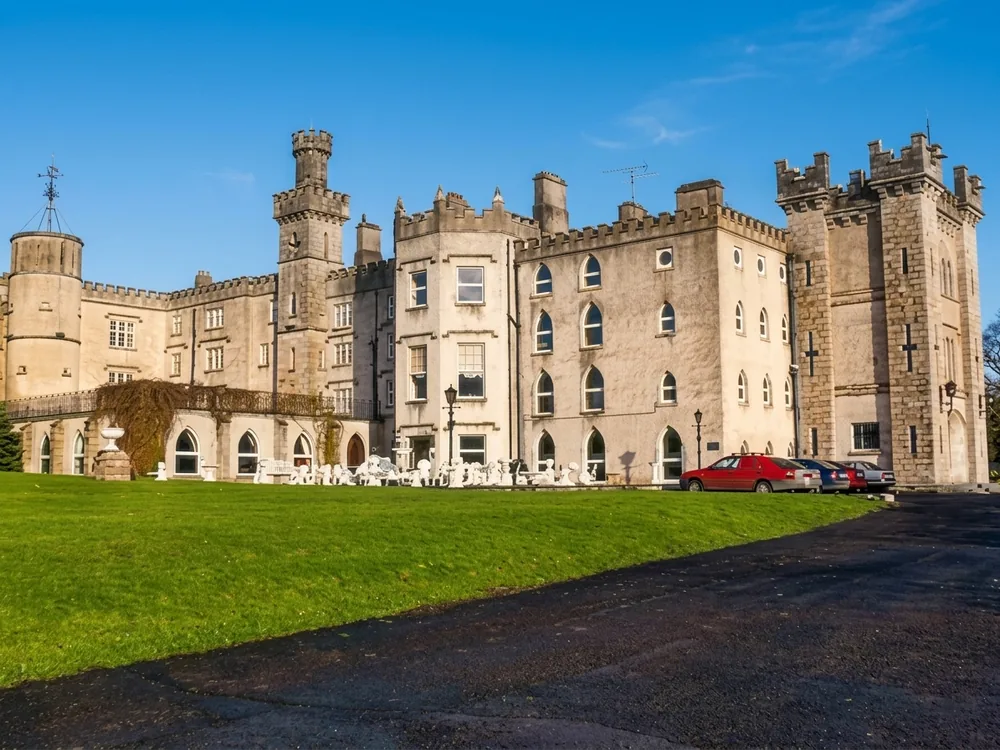
Cabra Castle
Caisleán na Cabraí
Ireland · Kingscourt, County Cavan · Near Kingscourt
Built 1810 · Neo-Norman/Gothick castle built in the first decade of the 19th century, originally known as 'Cormey Castle,' renamed 'Cabra Castle' around 1820
This page is part of an independent travel guide and is not affiliated with, endorsed by, or operated by Cabra Castle.
© Castles & Palaces
Quick Facts
- Rooms from
- €189 / night
- Hotel rating
- 4-Star Hotel
- Duration
- Overnight stay only — no day-visit access
- Best time
- Year-round
- Nearest city
- Kingscourt
Stay Here
Cabra Castle Hotel
4-Star HotelBooked via Booking.com · Free cancellation on most rates
Open to day visitors without booking a room — see How to Visit below.
Highlights
- ✦The land originally belonged to the Gaelic O'Reilly family, with evidence of fortification as early as the 12th century; confiscated and granted to Colonel Thomas Cooch, a Cromwellian ally, in the mid-17th century
- ✦Cooch's daughter inherited the estate and married Joseph Pratt in 1686, beginning the Pratt family's association with the property, which they held continuously from 1699
- ✦The present neo-Norman/Gothick castle was built in the first decade of the 19th century for the Foster family, whose construction costs drove them into bankruptcy; the wealthier Pratts bought it in 1813 and renamed it 'Cabra Castle' around 1820 (originally called 'Cormey Castle')
- ✦The last member of the Pratt dynasty to own the castle was Tan Sri Dr. Mervyn Sheppard, a British colonial official in Malaysia
- ✦Today a 4-star hotel with 113 rooms, some within the castle itself and others in converted 17th-century courtyard buildings on the estate
Stay in the castle itself
Book a room via Booking.com
Cabra Castle stands near Kingscourt in County Cavan, and its land carries a documented history reaching back to the Gaelic O'Reilly family, who held this territory with evidence suggesting some form of fortification present as early as the 12th century. The O'Reillys were among the significant Gaelic ruling families of medieval Ulster and its borderlands, and their long association with this land came to an end through the familiar mid-17th-century pattern of confiscation, when the property was granted to Colonel Thomas Cooch, an ally of Oliver Cromwell, as part of the broader redistribution of Irish land to Cromwellian supporters following the conquest of Ireland.
The estate's ownership passed into a new family line through marriage: Cooch's daughter inherited the property and married Joseph Pratt in 1686, establishing a connection between the Pratt family and this Cavan estate that would prove remarkably durable. The Pratts held the property continuously from 1699 onward, beginning a tenure that would eventually span more than two centuries and see the estate through its most significant architectural transformation.
That transformation, somewhat ironically, was not initially the Pratts' own doing. The castle standing on the site today, built in the neo-Norman and Gothick style fashionable in the early 19th century, was constructed during the first decade of the 1800s for the Foster family — a considerable architectural undertaking whose costs proved genuinely ruinous, driving the Fosters into bankruptcy not long after the building's completion. This pattern of ambitious country-house construction outstripping a family's actual financial resources was a recurring feature of the Anglo-Irish landed gentry's history, and Cabra Castle stands as a particularly clear example of a building whose construction directly destroyed the fortunes of the family who commissioned it.
The financially struggling Fosters sold the castle in 1813 to the considerably wealthier Pratt family — the same family whose earlier marriage-based connection to this land dated back to 1686, now returning to direct ownership of a grander building than anything their predecessors had occupied. The Pratts renamed the property 'Cabra Castle' around 1820; the building had originally been known as 'Cormey Castle' under the Fosters, and this renaming reflected the Pratts' assumption of full ownership and their intent to stamp their own identity onto the estate going forward.
The Pratt family's long tenure at Cabra eventually produced one of the more unusual final owners found among the properties in this collection: the last member of the Pratt dynasty to hold the castle was Tan Sri Dr. Mervyn Sheppard, a British colonial official who served in Malaysia — a genuinely unexpected geographic connection linking this County Cavan estate to the history of British colonial administration in Southeast Asia, and a reminder of how far the personal and professional lives of Anglo-Irish landed families could range beyond their ancestral Irish estates during the height of the British Empire.
Today Cabra Castle operates as a 4-star hotel offering 113 rooms, distributed between the castle building itself and a set of converted 17th-century courtyard buildings elsewhere on the estate — meaning the property's accommodation genuinely spans several distinct architectural periods, from the older courtyard structures predating the current castle's own early 19th-century construction, through to the Gothick castle building itself. This layered building history gives guests staying at Cabra a choice between rooms of noticeably different character and period, depending on which part of the wider estate they are accommodated within.
County Cavan occupies a quieter part of Ireland's border midlands region, characterised by a distinctive drumlin landscape of small rounded hills and numerous lakes, offering visitors a genuinely different rural Irish landscape from the more dramatic coastal and mountain scenery found in counties like Kerry or Donegal. For visitors interested in a genuinely eventful single-estate history — spanning Gaelic O'Reilly ownership, Cromwellian confiscation, one family's financial ruin through overambitious construction, and an eventual connection to British colonial Malaysia — Cabra Castle offers a compelling and unusually far-reaching narrative within the quieter setting of rural County Cavan.
History
Cabra Castle's land originally belonged to the Gaelic O'Reilly family, with evidence of fortification from as early as the 12th century, before being confiscated and granted to Colonel Thomas Cooch, a Cromwellian ally, in the mid-17th century. Cooch's daughter married Joseph Pratt in 1686, and the Pratt family held the property continuously from 1699. The present neo-Norman/Gothick castle was built in the first decade of the 19th century for the Foster family, whose construction costs bankrupted them; the Pratts bought the castle in 1813 and renamed it Cabra Castle around 1820, having originally been called Cormey Castle. The last Pratt family owner was Tan Sri Dr. Mervyn Sheppard, a British colonial official in Malaysia.
Frequently Asked Questions
The castle was built in the first decade of the 19th century for the Foster family under the name 'Cormey Castle.' After the construction costs bankrupted the Fosters, the wealthier Pratt family bought the property in 1813 and renamed it 'Cabra Castle' around 1820, reflecting their new ownership.
Location
Kingscourt, Co. Cavan, A82 XW26, Ireland
Nearby Castles
Rooms from
€189/ night