Castlemartyr Resort
Caisleán Mhártain
Ireland · Castlemartyr, County Cork · Near Cork
Built 1210 · 17th-century Manor House built by the Boyle family, with the ruins of a 1210 Knights Templar castle tower preserved as an ornamental feature in the gardens — two distinct structures on one estate
This page is part of an independent travel guide and is not affiliated with, endorsed by, or operated by Castlemartyr Resort.
© Castles & Palaces
Quick Facts
- Rooms from
- €236 / night
- Hotel rating
- 5-Star Hotel
- Duration
- Overnight stay only — the ruined tower is visible from the gardens as a separate historical feature
- Best time
- Year-round
- Nearest city
- Cork
Stay Here
Capella at Castlemartyr Resort
5-Star HotelBooked via Booking.com · Free cancellation on most rates
Open to day visitors without booking a room — see How to Visit below.
Highlights
- ✦The original castle was built in 1210 by the Knights Templar under the leadership of Richard de Clare ('Strongbow'), controlling a strategic crossing between Cork city and the Blackwater river
- ✦The 4th Earl of Ormond made the castle the official seat of the Seneschal of Imokilly; following a 1578 rebellion, the confiscated Desmond (FitzGerald) lands were granted to Sir Walter Raleigh, who sold them to Richard Boyle, 1st Earl of Cork, in 1602
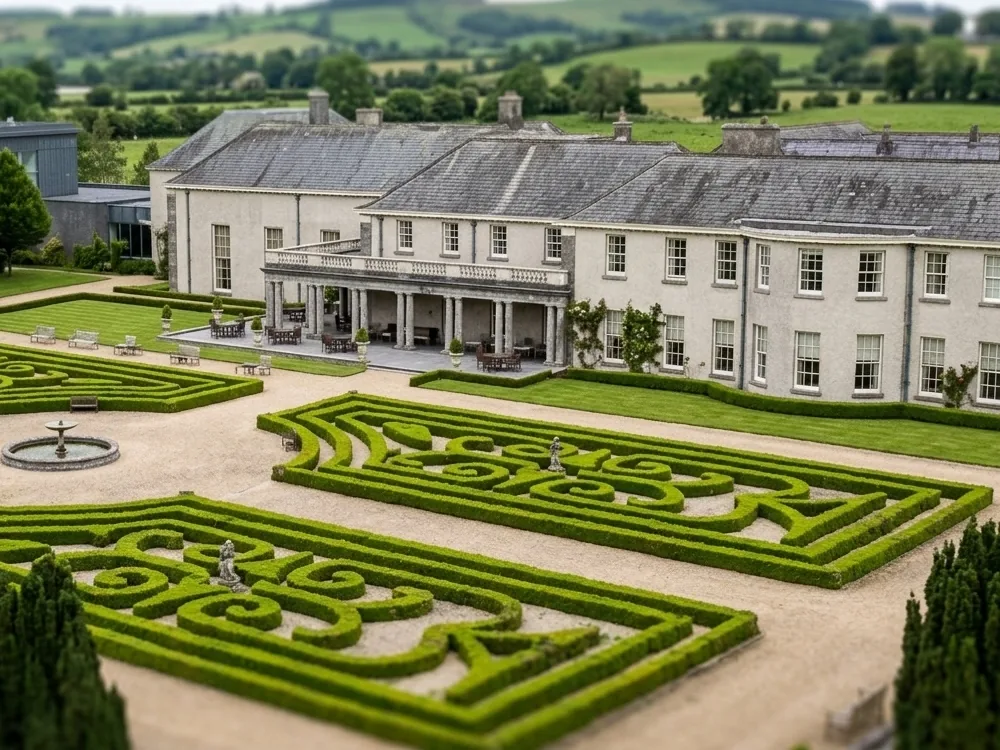
- ✦Under the Boyles, the 17th-century Manor House that today forms the heart of the resort was built — the original castle tower survives only as an ornamental ruin in the gardens, a distinct structure from the hotel building itself
- ✦Today a 5-star resort set on 220 acres, with the ruined tower visible from the gardens as a separate historical feature
- ✦The same layered site pattern found at Brecon Castle in Wales and Lough Eske Castle in Donegal — a genuine medieval ruin standing apart from the later building guests actually stay in
Stay in the castle itself
Book a room via Booking.com
Castlemartyr Resort occupies a substantial 220-acre estate in County Cork, and its history opens with a genuinely early and militarily significant chapter: the original castle was built in 1210 by the Knights Templar, the famous medieval military order, under the leadership of Richard de Clare — better known to history as Strongbow, the Anglo-Norman lord whose invasion of Ireland in 1170 opened the country to centuries of English involvement. The Templar castle controlled a strategically vital crossing point between Cork city and the Blackwater river, giving it genuine military importance within the wider network of Anglo-Norman fortifications securing this part of Munster.
The castle's medieval administrative significance grew further when the 4th Earl of Ormond made it the official seat of the Seneschal of Imokilly, a senior local administrative and judicial office within the surrounding barony. The property's ownership took a dramatic turn following a rebellion in 1578: the lands of the Earl of Desmond, a member of the FitzGerald dynasty, were confiscated as punishment for the rebellion and granted to Sir Walter Raleigh, the celebrated English courtier, soldier and explorer whose Irish landholdings formed part of his broader career under Elizabeth I. Raleigh, however, did not retain Castlemartyr for long, selling the property in 1602 to Richard Boyle, who would go on to become the 1st Earl of Cork and one of the most powerful and successful English settlers in early modern Ireland.
It was under the Boyle family's ownership that Castlemartyr received its most significant architectural addition: a substantial Manor House, built during the 17th century, which today forms the genuine heart of the resort guests experience. It is important to be precise about the relationship between this Manor House and the original medieval castle: the 1210 Templar castle tower survives today only as an ornamental ruin standing within the resort's gardens, a physically separate structure from the 17th-century Manor House that actually houses the hotel's guest rooms and public spaces. This pattern — a genuine medieval ruin preserved as a garden feature alongside, rather than incorporated into, a later hotel building — mirrors the same layered site history found at Brecon Castle in Wales and Lough Eske Castle in County Donegal elsewhere in this collection, and visitors should understand this distinction clearly rather than assuming the hotel building itself dates to the 13th century.
Today Castlemartyr Resort operates as a 5-star luxury property, its 220-acre grounds combining the historic 17th-century Manor House with more contemporary hotel wings, extensive gardens, a golf course and full resort amenities including a spa and indoor pool. The scale of the estate and the quality of its facilities place Castlemartyr firmly among Ireland's premier luxury castle-estate hotels, drawing on centuries of documented history stretching from the Knights Templar through the Earls of Desmond, Sir Walter Raleigh, and the powerful Boyle family.
The ruined Templar tower remains visible from the resort's gardens, offering guests a tangible, walkable connection to the estate's earliest and most militarily significant chapter even as they enjoy the considerably more comfortable amenities of the modern resort. This combination of a genuine medieval military ruin and a fully realised contemporary luxury hotel experience, set within one of the largest single estates in this collection, gives Castlemartyr a genuinely layered historical depth matched by relatively few other properties.
For visitors exploring East Cork, an area known for its food heritage, coastal towns and proximity to Cork city itself, Castlemartyr offers a compelling base combining genuine medieval and early modern Irish history with the full resources of a modern luxury resort — a place where the ghost of a Knights Templar fortress and the accumulated wealth of one of early modern Ireland's most powerful families share the same 220 acres of Munster parkland.
Richard Boyle, the 1st Earl of Cork whose purchase of Castlemartyr in 1602 set the estate on its path toward the Manor House that guests occupy today, was among the most successful and controversial figures of the early 17th-century English settlement of Ireland, amassing an enormous fortune and extensive landholdings across Munster through a combination of shrewd land dealing and outright opportunism. His descendants would go on to play significant roles in Irish and British political life for generations, and Castlemartyr's association with the Boyle name places the estate within the wider story of how a small number of powerful settler families came to dominate landownership across large parts of southern Ireland during the 17th century.
History
Castlemartyr's original castle was built in 1210 by the Knights Templar under Richard de Clare ('Strongbow'), controlling a strategic crossing between Cork city and the Blackwater river. The 4th Earl of Ormond made it the seat of the Seneschal of Imokilly. Following a 1578 rebellion, the confiscated Desmond lands were granted to Sir Walter Raleigh, who sold them to Richard Boyle, 1st Earl of Cork, in 1602. Under the Boyle family, a 17th-century Manor House was built, which today forms the heart of the resort — the original castle tower survives only as an ornamental ruin in the gardens, distinct from the hotel building.
Frequently Asked Questions
No. The 1210 Knights Templar castle tower survives today only as an ornamental ruin in the resort's gardens, a physically separate structure from the 17th-century Manor House that actually houses the hotel — the same layered site history found at Brecon Castle in Wales and Lough Eske Castle in Donegal.
Location
Castlemartyr, Co. Cork, P25 Y329, Ireland
Nearby Castles
Rooms from
€236/ night