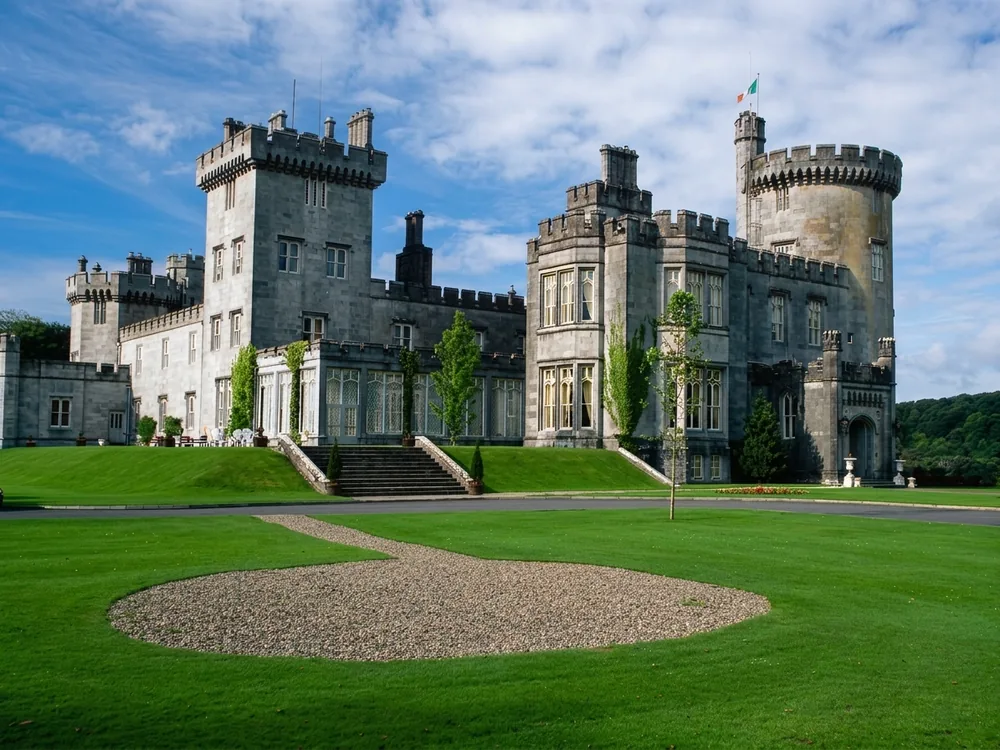
Dromoland Castle
Caisleán Dhroim Fhinn
Ireland · Newmarket-on-Fergus, County Clare · Near Shannon
Built 1826 · 19th-century Gothic Revival/Baronial castle built on the site of an earlier O'Brien tower house, the seat of the O'Brien family, descendants of Brian Boru, High King of Ireland
This page is part of an independent travel guide and is not affiliated with, endorsed by, or operated by Dromoland Castle.
© Castles & Palaces
Quick Facts
- Rooms from
- €420 / night
- Hotel rating
- 5-Star Hotel
- Duration
- Overnight stay only — no day-visit access
- Best time
- Year-round
- Nearest city
- Shannon
Stay Here
Dromoland Castle
5-Star HotelBooked via Booking.com · Free cancellation on most rates
Open to day visitors without booking a room — see How to Visit below.
Highlights
- ✦Ancient seat of the O'Brien family, direct descendants of Brian Boru, the 11th-century High King of Ireland; the surrounding territory took the name Thomond ('North Munster') under the kingdom founded by Brian Boru's descendants in 1118
- ✦Murrough O'Brien, the 57th and last King of Thomond, submitted to Henry VII of England, becoming Baron of Inchiquin and 1st Earl of Thomond — the formal end of the local Gaelic royal line
- ✦Dromoland has been the O'Brien family seat since at least the 16th century
- ✦The present Gothic Revival/Baronial castle dates to the 19th century; it has operated as a luxury hotel since 1962, following the O'Brien family's sale of the estate
- ✦A 5-star hotel with extensive gardens and grounds open to guests, on the same estate as Shannon Airport, making it one of Ireland's most accessible historic castle hotels for international visitors
Stay in the castle itself
Book a room via Booking.com
Dromoland Castle sits on a substantial estate near Newmarket-on-Fergus in County Clare, and its history reaches back to one of the most consequential figures in all of Irish history: Brian Boru, the High King of Ireland who unified much of the island under his rule in the 11th century before his death at the Battle of Clontarf in 1014. Dromoland was the ancestral seat of the O'Brien family, Brian Boru's direct descendants, and the connection between the family and this land runs through the very name of the surrounding territory — Thomond, meaning 'North Munster,' the kingdom founded by Brian Boru's descendants in 1118 and ruled by the O'Brien line as its hereditary kings for centuries afterward.
The O'Brien kings of Thomond held genuine political authority over this part of Ireland for generations, a Gaelic royal line whose rule long predated and then persisted through the early phases of Anglo-Norman involvement in Ireland. That royal lineage came to its formal end with Murrough O'Brien, the 57th and last King of Thomond, who made the consequential decision to submit to King Henry VII of England rather than continue resisting the expanding reach of the English crown. In exchange for his submission, Murrough O'Brien was created Baron of Inchiquin and 1st Earl of Thomond, trading a Gaelic royal title for an English aristocratic one — a transaction that closed the book on centuries of independent Gaelic kingship in this region while simultaneously securing the O'Brien family's continued status and landholding under the new political order.
Dromoland itself has served as the O'Brien family's seat since at least the 16th century, meaning the estate carries a documented family connection stretching back many generations beyond the present building. The castle visitors see today, however, is considerably more recent: a 19th-century construction in the Gothic Revival and Scottish Baronial styles fashionable among wealthy landed families of the period, built on or near the site of an earlier O'Brien tower house. The 19th-century castle's turrets, crenellations and romantic silhouette reflect the same broader Victorian taste for castellated architecture found across the British Isles and Ireland during this era, applied here to a family seat with genuinely ancient royal roots rather than to a newly wealthy family seeking to manufacture an aristocratic image.
The O'Brien family's long tenure at Dromoland eventually ended in the 20th century, when the estate was sold and the castle began its transformation into the hotel it remains today. Dromoland Castle has operated as a luxury hotel since 1962, and over the following decades it built a reputation as one of Ireland's premier castle hotel experiences, regularly hosting prominent international guests and functioning as a flagship example of Irish country-house hospitality at its most polished. The hotel today holds 5-star status, reflecting the scale of investment made in maintaining and elevating the property since its conversion from private family seat to commercial hotel.
Dromoland's estate includes extensive gardens and grounds, open to hotel guests, along with the kind of leisure amenities — golf, falconry, equestrian activities and fine dining — that have become standard features of Ireland's grand castle hotel category. No day-visit ticket or public tour product is documented for Dromoland Castle; access to the estate and its historic grounds runs through an overnight stay rather than a separate paid visitor attraction, distinguishing it from castles in this collection that offer both hotel accommodation and an independent day-visit product.
One further practical detail sets Dromoland apart within this collection: the estate sits within easy reach of Shannon Airport, one of Ireland's main international gateways, making Dromoland Castle unusually convenient for visitors arriving from overseas compared to castle hotels requiring a longer transfer from Dublin or Cork. For visitors seeking to begin or end an Irish trip with a genuinely historic castle stay connected to one of the most significant royal lineages in Irish history, Dromoland's combination of deep O'Brien and Brian Boru ancestry with straightforward international access makes it one of the more distinctive entries in Ireland's castle hotel landscape.
History
Dromoland Castle was the ancestral seat of the O'Brien family, direct descendants of Brian Boru, the High King of Ireland who died at the Battle of Clontarf in 1014. The surrounding territory took the name Thomond under the kingdom founded by Brian Boru's descendants in 1118, ruled by the O'Brien line as hereditary kings of Thomond. Murrough O'Brien, the 57th and last King of Thomond, submitted to Henry VII of England, becoming Baron of Inchiquin and 1st Earl of Thomond. Dromoland has been the O'Brien family seat since at least the 16th century. The present 19th-century Gothic Revival castle has operated as a luxury hotel since 1962, following the O'Brien family's sale of the estate.
Frequently Asked Questions
No day-visit ticket or public tour product is documented for Dromoland Castle. Access to the estate's grounds and historic gardens runs through an overnight hotel stay rather than a separate paid visitor attraction.
Location
Dromoland, Newmarket-on-Fergus, Co. Clare, V95 Y3X2, Ireland
Nearby Castles
Rooms from
€420/ night