Kilkea Castle
Caisleán Chill Chaoich
Ireland · Castledermot, County Kildare · Near Athy
Built 1180 · Norman motte-and-bailey built in 1180, largely rebuilt in the 15th century after 1426 by the FitzGerald Earls of Kildare, widely considered Ireland's oldest continuously inhabited castle
This page is part of an independent travel guide and is not affiliated with, endorsed by, or operated by Kilkea Castle.
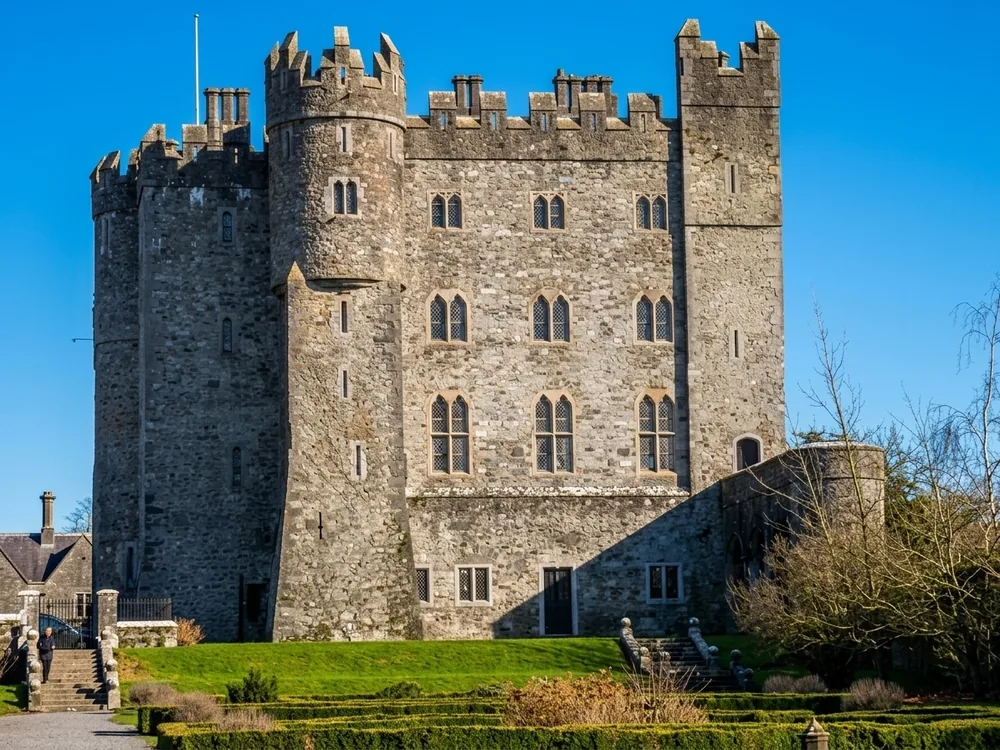
© Castles & Palaces
Quick Facts
- Rooms from
- €150 / night
- Hotel rating
- 4-Star Hotel
- Duration
- Overnight stay only — no day-visit access
- Best time
- Year-round
- Nearest city
- Athy
Stay Here
The Lodges at Kilkea Castle
4-Star HotelBooked via Booking.com · Free cancellation on most rates
Open to day visitors without booking a room — see How to Visit below.
Highlights
- ✦A motte-and-bailey castle built in 1180 for Walter de Riddlesford, on the orders of Hugh de Lacy, Chief Governor of Ireland
- ✦Passed by marriage to the FitzGerald family, Earls of Kildare, who inhabited it for more than 700 years, eventually rising to become Marquesses of Kildare and Dukes of Leinster — the most senior dukedom in the Irish peerage
- ✦Widely considered Ireland's oldest continuously inhabited castle; the present tower dates largely to the 15th century, rebuilt by John FitzGerald, 6th Earl of Kildare, after 1426
- ✦Legend of the 'Wizard Earl': Gerald, 11th Earl of Kildare, known for his interest in alchemy, is said by tradition to return to the castle every seven years riding a white horse shod in silver
- ✦Sold by the family in the 1960s, beginning its first period as a hotel
Stay in the castle itself
Book a room via Booking.com
Kilkea Castle stands near Castledermot in County Kildare, and its claim to being Ireland's oldest continuously inhabited castle rests on a documented history stretching back to 1180, when a motte-and-bailey fortification was built here for Walter de Riddlesford, acting on the orders of Hugh de Lacy, the Chief Governor of Ireland under the Anglo-Norman administration. This early date places Kilkea's origins firmly within the first generation of Norman castle-building in Ireland, and the continuity of habitation on the site from that point forward, largely unbroken across more than eight centuries, gives Kilkea a genuinely rare claim among Irish historic buildings.
The castle passed by marriage into the hands of the FitzGerald family, who would go on to become the Earls of Kildare — one of the most powerful and enduring Anglo-Norman dynasties in Irish history. The FitzGeralds inhabited Kilkea for more than 700 years, an extraordinarily long single-family tenure that saw the family's status rise dramatically over the centuries, eventually reaching the rank of Marquesses of Kildare and, ultimately, Dukes of Leinster — the most senior dukedom within the entire Irish peerage, representing the absolute pinnacle of the Anglo-Irish aristocratic hierarchy. Few families anywhere in Ireland can claim both such a lengthy tenure at a single castle and such an elevated eventual social rank.
The tower that visitors see today dates largely to the 15th century, the product of a substantial rebuilding undertaken by John FitzGerald, the 6th Earl of Kildare, following 1426. This rebuilding gave Kilkea much of its present architectural form, and the continuity of FitzGerald occupation through this reconstruction and beyond is precisely what underpins Kilkea's widely cited claim to being Ireland's oldest continuously inhabited castle — not merely the oldest surviving castle structure, but one where habitation has genuinely continued across the centuries rather than being interrupted by long periods of abandonment or ruin, as has happened at many other historic Irish castles.
Kilkea's long FitzGerald history has also generated one of Irish folklore's more memorable legends, directly connected to the castle itself. Gerald, the 11th Earl of Kildare, developed a genuine personal interest in alchemy during his lifetime, earning him the popular nickname the 'Wizard Earl.' Tradition holds that this alchemically-minded earl returns to Kilkea Castle every seven years, riding a white horse shod in silver — a genuinely evocative piece of folklore that has attached itself specifically to this castle and this individual FitzGerald ancestor, adding a layer of local legend to the family's already well-documented historical record.
The FitzGerald family's remarkable multi-century tenure at Kilkea finally came to an end when the family sold the property in the 1960s, marking the beginning of the castle's first chapter as a hotel rather than a private aristocratic residence. Today Kilkea Castle offers guests several distinct types of accommodation: rooms and suites within the historic castle itself, courtyard rooms converted from the castle's old outbuildings, and separate lodges set across the wider 180-acre estate — giving visitors a choice of staying in genuinely different architectural settings, from the oldest inhabited castle structure in Ireland through to more contemporary lodge accommodation on the same grounds.
For visitors interested in Ireland's deepest and most continuous castle-habitation history, combined with the genuine folkloric colour of the Wizard Earl legend and the documented rise of the FitzGerald family to the very top of the Irish peerage as Dukes of Leinster, Kilkea Castle offers one of the most historically substantial stays available anywhere in this collection — a castle where the claim to continuous habitation since 1180 is not merely a marketing phrase but a genuinely well-documented historical fact.
The FitzGerald family's broader historical footprint across Ireland extends well beyond Kilkea itself, with branches of the dynasty holding significant power across multiple counties for centuries and playing central roles in numerous pivotal episodes of Irish medieval and early modern history, including periods of open rebellion against English authority as well as long stretches of close cooperation with the Crown. Kilkea's specific role as the family's principal seat for so many of those centuries gives the castle a claim to be considered one of the true epicentres of FitzGerald power, even as other branches of the family held estates and titles across the country.
History
Kilkea Castle's motte-and-bailey was built in 1180 for Walter de Riddlesford, on the orders of Hugh de Lacy, Chief Governor of Ireland. It passed by marriage to the FitzGerald family, Earls of Kildare, who inhabited it for more than 700 years, eventually becoming Marquesses of Kildare and Dukes of Leinster. The present tower dates largely to the 15th century, rebuilt by John FitzGerald, 6th Earl of Kildare, after 1426, and the castle is widely considered Ireland's oldest continuously inhabited castle. The family sold the property in the 1960s, beginning its first period as a hotel.
Frequently Asked Questions
Kilkea's motte-and-bailey was built in 1180, and the FitzGerald family, Earls of Kildare, inhabited it continuously for more than 700 years after acquiring it by marriage — a genuinely unbroken record of habitation, unlike many Irish castles that fell into ruin and abandonment for long periods before restoration.
Location
Kilkea, Castledermot, Co. Kildare, R14 XR38, Ireland
Nearby Castles
Rooms from
€150/ night