
Russborough House
Russborough House
Ireland · County Wicklow · Near Blessington
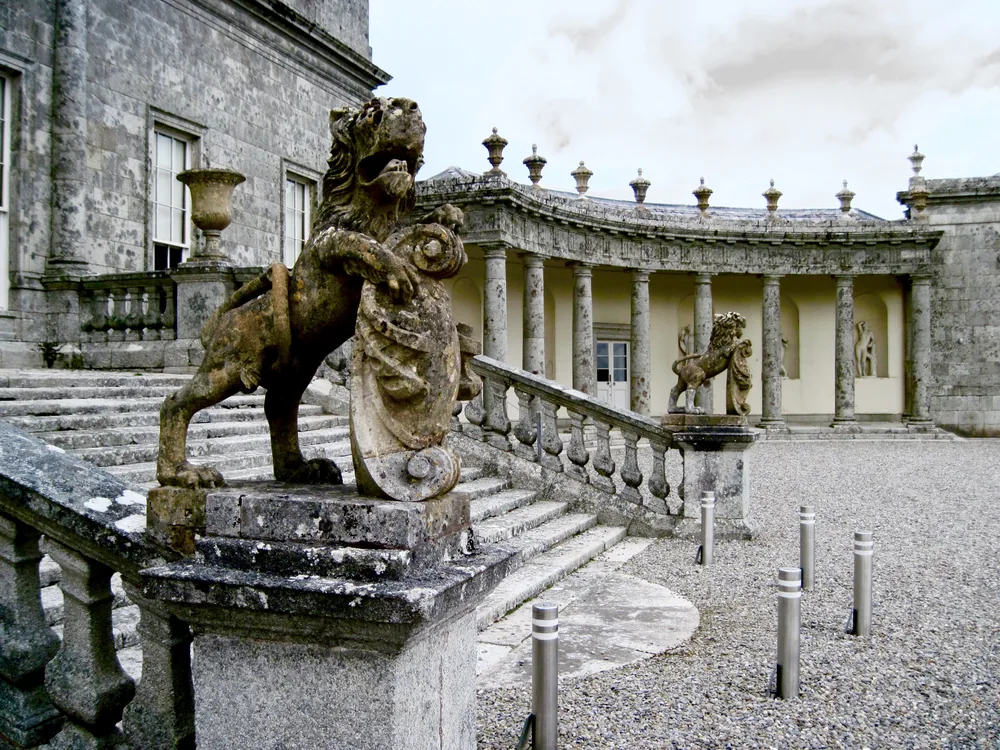
Built 1741 · Palladian; Richard Cassels (Richard Castle) 1741–1755; commissioned by Joseph Leeson, later 1st Earl of Milltown; one of Ireland's finest Palladian houses; 213-metre frontage makes it one of the longest house facades in Ireland
This page is part of an independent travel guide and is not affiliated with, endorsed by, or operated by Russborough House.
© Castles & Palaces
Quick Facts
- Hours
- Daily 10:00–17:00
- Guided tour from
- €16
- Duration
- 1 hour (guided tour only)
- Best time
- May to September
- Booking
- Required — book 3+ days ahead
- Nearest city
- Blessington
Featured Tour
Wicklow: Russborough House Guided Tour Ticket
Cancellation available · Instant confirmation
Highlights
- ✦A 213-metre Palladian frontage in grey Wicklow granite, designed by Richard Cassels and among the longest house facades in Ireland
- ✦Built for Joseph Leeson, a Dublin wine-merchant's son who toured Italy buying Old Masters and needed a house adequate to display them
- ✦Rococo plasterwork by the Swiss-Italian Lafranchini brothers, among the finest stucco work surviving in Ireland
- ✦The Beit collection, brought to the house in 1952 by Sir Alfred Beit, once including Vermeer's Lady Writing a Letter with her Maid
- ✦Robbed four times since 1974, including by the IRA and by Dublin crime boss Martin Cahill — the most burglarised significant house in Irish history
Skip the queue with a guided tour
Skip-the-line tickets & expert guides
Set in 200 acres of Wicklow parkland south of Dublin, backed by the gentle slopes of the Wicklow mountains, Russborough House extends 213 metres from end to end — one of the longest house frontages in Ireland. It is a measured, stately Palladian composition in grey Wicklow granite, built for a man who had recently made a large fortune and wanted the world to know it. The house is beautiful, the setting is serene, and its recent history involves more armed robberies than almost any other building in Europe.
Richard Cassels, also spelled Castle, was German-born and arrived in Ireland around 1728. He became Ireland's most prolific and accomplished architect of the mid-18th century, designing Leinster House (now the Irish Parliament), Powerscourt House and Westport House among others. Russborough, begun in 1741, was his masterpiece. The design follows Palladian principles exactly: a central house block flanked by curved colonnades, or quadrants, connecting to lower wings, the whole composition unified by the consistent use of local granite. The interior plasterwork, by the Swiss-Italian Lafranchini brothers who worked on several great Irish houses of the period, is among the finest Baroque-Rococo stucco work surviving in Ireland.
Joseph Leeson was the son of a Dublin wine merchant who had accumulated one of the largest fortunes in Ireland during the early 18th century. Joseph undertook two Grand Tours of Italy, buying paintings in Rome and Venice, and returned with a collection that included works attributed to Velázquez, Murillo, Rubens and Dutch masters. He needed a house adequate to display them, and Russborough was conceived as a gallery as much as a residence.
In 1952, Sir Alfred Beit, grandson of Alfred Beit, the diamond magnate and co-founder of De Beers, purchased Russborough and brought with him one of the most significant private art collections in the world. The Beit collection included Vermeer's Lady Writing a Letter with her Maid, along with works by Rubens, Goya, Gainsborough and Metsu. The combination of Leeson's original acquisitions with the Beit collection made Russborough one of the finest repositories of European Old Master painting in the British Isles.
What makes Russborough unique in the annals of Irish heritage — and what must be addressed directly in any honest account of the house — is its record as the most burglarised significant house in Ireland. It has been robbed four times. The first robbery, in 1974, was carried out by the IRA under Bridget Rose Dugdale; 19 paintings were taken and held for ransom. The second, in 1986, was carried out by Martin Cahill, known as 'The General', the Dublin crime boss who later became the subject of John Boorman's film of the same name. A third robbery occurred in 1987, and a fourth in 2001. Most works were eventually recovered, though some were damaged in the process. After the 2001 robbery, the Alfred Beit Foundation transferred the most significant and vulnerable works, including the Vermeer, to the National Gallery of Ireland, where they remain on permanent loan. What Russborough displays today is consequently a portion of the original Beit collection, the rest having moved to a more secure public institution.
Russborough is managed today by the Alfred Beit Foundation and is open to visitors via guided tours, which cover the ground-floor State Rooms, the surviving Leeson and Beit collections, and the extraordinary stucco work of the entrance hall and staircase. The landscape garden, largely informal, with views of Blessington Lake in the middle distance, surrounds the house and is walkable. The formal facade is reflected in a ha-ha, a sunken boundary wall that creates an unobstructed view from the front rooms across the parkland beyond.
History
Joseph Leeson, heir to a substantial Dublin wine-trading fortune, commissioned architect Richard Cassels to build Russborough House beginning in 1741, intending it partly as a gallery for the Old Master paintings he had acquired during two Grand Tours of Italy. Construction continued until 1755, producing one of the finest Palladian houses in Ireland, with Rococo plasterwork by the Lafranchini brothers among its principal interior features. Leeson was later created 1st Earl of Milltown, and the house remained associated with his descendants for generations.
In 1952, Sir Alfred Beit purchased Russborough and brought a major private art collection to the house, including Vermeer's Lady Writing a Letter with her Maid. The house subsequently became the target of four separate robberies between 1974 and 2001, involving both paramilitary and organised crime figures, the most notable being a 1974 raid by IRA member Bridget Rose Dugdale and a 1986 raid by Dublin crime boss Martin Cahill. Following the final robbery in 2001, the Alfred Beit Foundation transferred the collection's most valuable and vulnerable works to the National Gallery of Ireland for safekeeping, where they remain on permanent loan, while Russborough continues to operate as a heritage attraction managed by the Foundation.
How to Visit
Getting there: Russborough is 35 km south of Dublin — approximately 40 minutes by car. From Dublin, Bus Éireann route 65 runs directly to Blessington village (3 km away), from where a taxi or bicycle covers the last stretch. Car is the most practical option for flexibility.
Tickets: €17 adult / €9 child for the guided tour (the only way to see the interior); advance booking at russborough.ie is recommended in summer as tour slots are limited. The GetYourGuide Russborough House Guided Tour Ticket covers the same 1-hour guided circuit of the State Rooms.
Practical tips: The guided tour is the sole means of accessing the interior — plan to arrive in time for your scheduled slot. Prioritise the entrance hall and staircase stucco by the Lafranchini brothers and the surviving Beit paintings in the dining room; the guide explains the four robberies in detail (the 1974 IRA raid and 1986 Martin Cahill heist are the most dramatic). The parkland and ha-ha views are freely walkable outside tour hours.
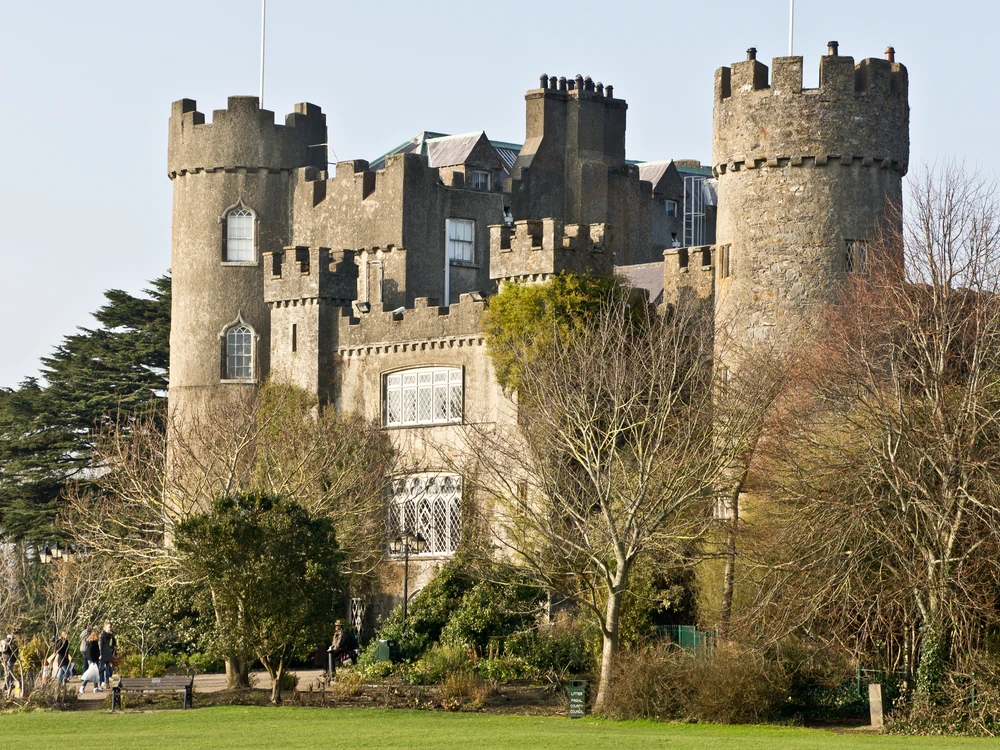
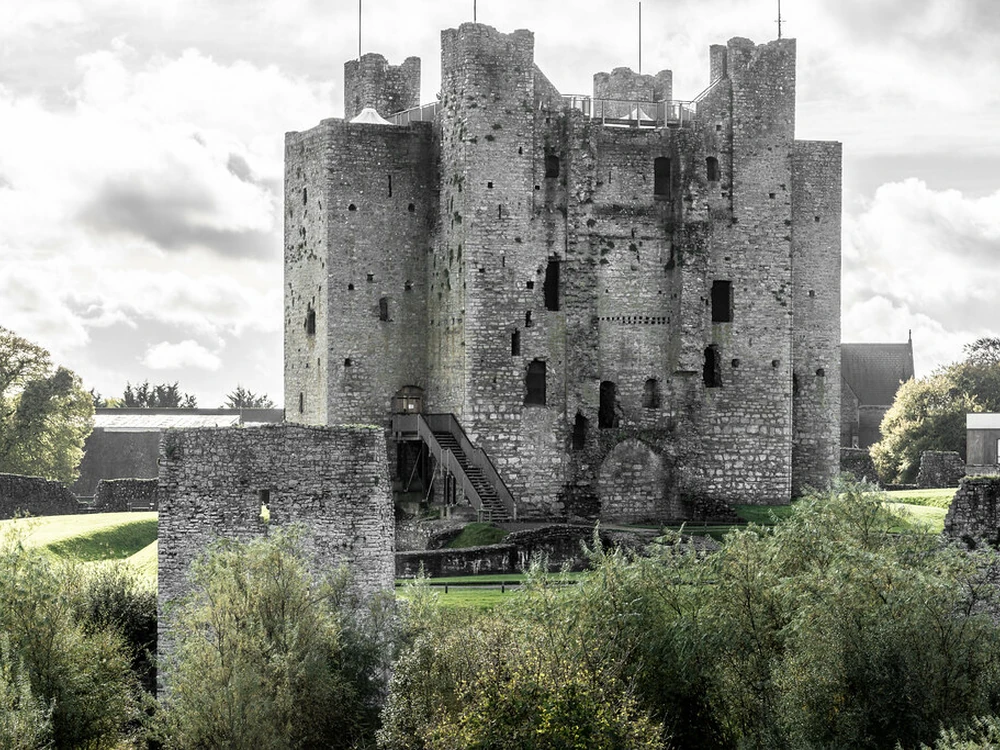
Combine with: Malahide Castle in County Dublin, 50 km north, and Trim Castle in County Meath, 60 km northwest, complete a Dublin-day-trip circuit that spans Palladian grandeur, medieval Norse-Norman power, and 800-year family occupation.
Frequently Asked Questions
Russborough's combination of an exceptional, internationally significant art collection and a relatively remote rural setting made it a recurring target for both paramilitary and organised crime groups between 1974 and 2001. The collection's fame — including works once attributed to Vermeer, Rubens and Goya — made stolen paintings valuable enough to attempt ransoming or selling, motivating four separate robberies over almost three decades. Following the 2001 robbery, the most valuable and vulnerable works were permanently transferred to the National Gallery of Ireland for safekeeping.
Location
Russborough, Blessington, Co. Wicklow, Ireland
Nearby Castles
Tours & Tickets
Powered by GetYourGuide
From
€16/ person