
Buonconsiglio Castle
Castello del Buonconsiglio
Italy · Trentino, Trento · Near Trento
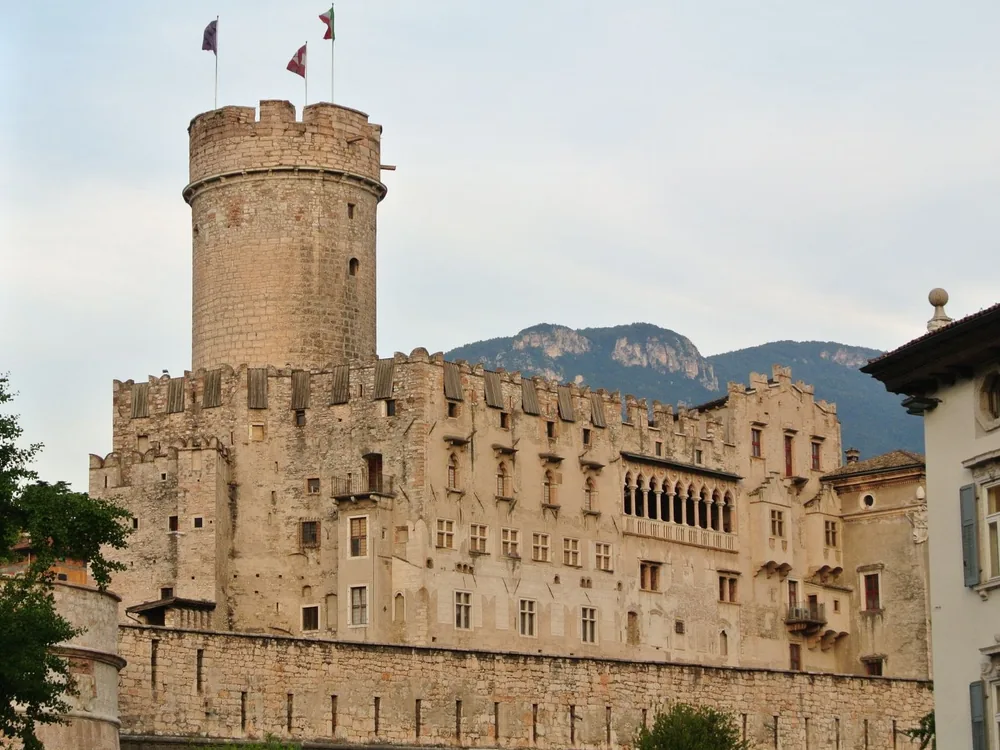
Built 1239 · Medieval residential castle with Renaissance and Mannerist additions — built 1239–1255 on a rocky rise above Trento's eastern edge as the fortified residence of the city's prince-bishops; the original Castelvecchio (Old Castle) component retains its 13th-century tower and courtyard; the Magno Palazzo (Great Palace), added by Prince-Bishop Bernardo Clesio between 1528 and 1536, is the dominant Renaissance wing and reflects Clesio's ambition to create a residence comparable to the great Italian humanist courts; the Torre Aquila (Eagle Tower), added in the 14th century by Prince-Bishop Georg von Liechtenstein and connected to the main complex via the former city battlements, contains the Ciclo dei Mesi (Cycle of the Months) frescoes, c.1400, the complex's most celebrated artistic element
This page is part of an independent travel guide and is not affiliated with, endorsed by, or operated by Buonconsiglio Castle.
© Castles & Palaces
Quick Facts
- Hours
- Tue–Sun 10:00–18:00. Closed Mon
- Guided tour from
- €175
- Duration
- 1.5–2.5 hours
- Best time
- March to October
- Nearest city
- Trento
Featured Tour
Trento: Guided Tour of Buonconsiglio Castle (Private Group, up to 25 people)
Cancellation available · Instant confirmation
Highlights
- ✦The Ciclo dei Mesi (Cycle of the Months), c.1400, in the Torre Aquila — eleven surviving fresco panels (March is lost) depicting both peasant labour and aristocratic leisure across the calendar year; painted by an artist of probable Bohemian origin working in the International Gothic style; considered one of the most complete and vivid cross-sections of late-medieval life in any European secular painting programme
- ✦Five centuries of unbroken institutional tenure — the castle served as the residence of Trento's prince-bishops from 1255 until the secularization of the episcopate in 1803; no other institution held a single Italian castle continuously for this long without military interruption
- ✦Torre Aquila (Eagle Tower) — added to the complex in the 14th century by Prince-Bishop Georg von Liechtenstein; originally connected to the main castle by a walkway along the city battlements; the tower's interior was painted with the Ciclo dei Mesi, effectively a private aristocratic picture book of the seasons, agriculture, and court life
- ✦Magno Palazzo — the Renaissance wing added by Prince-Bishop Bernardo Clesio (1528–1536), a humanist cardinal close to Emperor Charles V who transformed the medieval castle into a palace comparable to the great Italian princely courts; frescoed halls by Dosso and Battista Dossi, among others
- ✦National Museum and Provincial Gallery of Art — since its post-war restoration and progressive reopening, the complex has housed the province's principal art collection; the Provincial Gallery of Art has been based here since 1992, with significant Trentino and Alpine painting collections
Skip the queue with a guided tour
Skip-the-line tickets & expert guides
Buonconsiglio Castle rises on a rocky outcrop at the eastern edge of Trento, where the Adige valley narrows between the mountains of Trentino and the beginning of the broader Po plain. It was built between 1239 and 1255 as the fortified seat of Trento's prince-bishops — an ecclesiastical institution with temporal authority over the city that was itself part of the Holy Roman Empire's complex system of church-governed territories. From this castle, the prince-bishops administered Trento for over five and a half centuries, a tenure so long and so uninterrupted that the building became, layer by layer, a palimpsest of successive architectural ambitions: the original 13th-century tower and courtyard of the Castelvecchio, the 14th-century Torre Aquila with its extraordinary frescoed interior, the full Renaissance remaking under Bernardo Clesio in the 16th century, and the later Baroque additions and adaptations.
The Torre Aquila is the complex's most celebrated single element. The Eagle Tower was added to the castle complex in the late 14th century by Prince-Bishop Georg von Liechtenstein, who connected it to the main castle buildings via a walkway along the city's defensive battlements — a private route from the residential halls to an outwork tower that was simultaneously part of Trento's city walls and a detached element of the bishop's palace. Liechtenstein commissioned the decoration of the tower's interior with a cycle of frescoes known as the Ciclo dei Mesi — the Cycle of the Months — painted around 1400 by an artist whose origins appear to be Bohemian, working in the late International Gothic style that circulated across the courts of central Europe in the decades around 1400. Eleven of the twelve monthly panels survive; the March panel was lost to later modifications. The cycle is exceptional in the breadth of its subject matter: most medieval calendar cycles depict seasonal agricultural labour alone, but the Ciclo dei Mesi divides each month between two social registers — peasants performing the seasonal work of the fields and vineyards on one side, and the nobility engaged in the courtly pleasures appropriate to the season (hunting, tournaments, feasting, garden games) on the other. The result is one of the most complete visual cross-sections of late-medieval life in any secular European painting, a picture of an entire feudal world in which the labour of the base and the leisure of the peak are shown as two faces of the same agricultural and courtly economy.
The Magno Palazzo (Great Palace) represents the second major transformation of the complex. Prince-Bishop Bernardo Clesio, who held the bishopric from 1514 to 1539, was a humanist cardinal, a close ally of Emperor Charles V, and a man whose cultural ambitions matched those of the Italian princely courts that were reshaping Renaissance architecture across the peninsula. Between 1528 and 1536 Clesio rebuilt the southern wing of the complex as a proper Renaissance palace, engaging Romanese Malacrino to design a building with frescoed state rooms, a loggia, and a formal courtyard comparable in scale and ambition to the great Este and Gonzaga complexes further south. Dosso and Battista Dossi of Ferrara painted the principal halls; the Grotesque Hall (Loggia and Hall of the Black, White and Green) survives as one of the most complete Mannerist interiors in the Alpine zone.
After the Congress of Vienna returned Trentino to Habsburg Austria in 1815, Buonconsiglio served for decades as Austrian military barracks and subsequently as a prison — a fate common to former aristocratic residences that lost their function after the Napoleonic reorganisation of Italy. It was within the castle's prison section that three Italian irredentist activists — Cesare Battisti, Fabio Filzi, and Damiano Chiesa — were executed by Austrian authorities in 1916, during the First World War; the castle became a symbol of Italian resistance to Austrian rule, and its restoration after Trentino's incorporation into Italy in 1918 was partly a political act, reclaiming a building associated with Habsburg authority for the Italian national heritage.
The castle complex today functions as a national museum, with the Provincial Gallery of Art installed since 1992. The collections include the Ciclo dei Mesi in the Torre Aquila — the primary reason most art historians visit — as well as the Magno Palazzo's frescoed halls, an archaeological collection covering the Trento area's prehistoric and Roman periods, and the historical prison section where the 1916 executions took place.
The GetYourGuide private group tour (€175 per group of up to 25 people — this is group pricing, not a per-person rate) provides a 2-hour guided visit of the complex with a specialist guide. The €200 price is for the group as a whole, making it economical for families or groups of up to 25; individual visitors should use the standard museum entry ticket (approximately €12 adult).
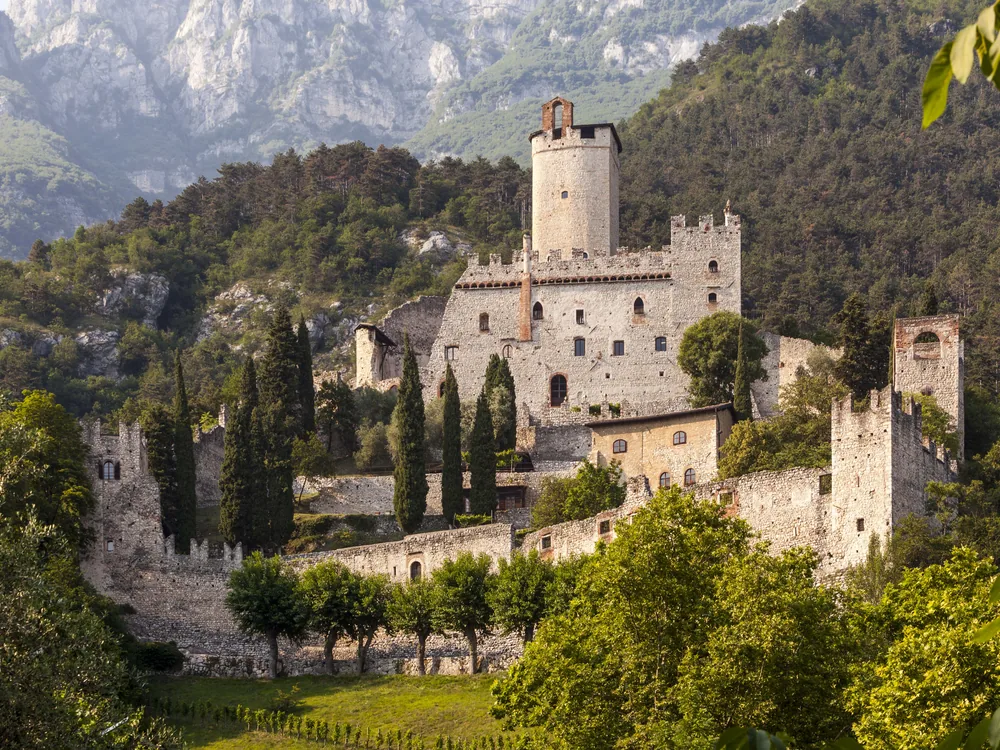
[Castello di Avio](/castles/italy/castello-di-avio), approximately 35 kilometres south in the lower Adige valley at Sabbionara d'Avio, is the other major Trentino castle covered on this site — a FAI (Italian National Trust) property with exceptionally well-preserved 13th–14th century frescoes and military architecture, and the southern counterpart to Buonconsiglio's princely urban complex.
History
The prince-bishops of Trento built the Castelvecchio — the old castle nucleus of what would become Buonconsiglio — between 1239 and 1255, establishing their temporal authority over the Adige valley from a fortified rocky rise at the eastern edge of the city. Prince-Bishop Georg von Liechtenstein added the Torre Aquila in the 14th century and commissioned the Ciclo dei Mesi frescoes around 1400, one of the most complete late-medieval fresco cycles to survive in the Italian-speaking world.
The most transformative phase came under Prince-Bishop Bernardo Clesio, who held the see from 1514 to 1539 and commissioned the Magno Palazzo — the Great Palace — between 1528 and 1536. Clesio was a humanist cardinal of European connections, and the Magno Palazzo reflected his ambitions: a fully articulated Renaissance court complex that made Buonconsiglio competitive with the most sophisticated Italian princely residences of the period. The castle's moment at the centre of European history came immediately after: the Council of Trent, which met from 1545 to 1563 to formulate the Catholic Church's response to the Protestant Reformation, was hosted at Buonconsiglio throughout its sessions.
Napoleonic pressure ended the Trento episcopate's temporal authority in 1803, after more than five centuries. Austrian Habsburg authority restored in 1815 converted the castle to barracks and prison use — in which capacity it was used in 1916 for the execution of the Italian irredentists Cesare Battisti, Fabio Filzi, and Damiano Chiesa. Trentino's incorporation into Italy in 1918 began the restoration work that continues today. The complex was reopened as a national monument in 1924 and hosts the Provincial Gallery of Art.
How to Visit
Getting there: Buonconsiglio is at the eastern edge of Trento's historic centre, approximately 10 minutes' walk from the main train station (Trento FS). Trento is on the main Brenner railway line between Verona (1 hour south) and Innsbruck (1.5 hours north) — extremely well connected.
Tickets: Entry costs €12 for adults (children €5); buy at the door or at buonconsiglio.it. The ticket covers the full complex: Magno Palazzo, Castelvecchio, Torre Aquila (Ciclo dei Mesi), and the Provincial Gallery of Art. The GetYourGuide private group guided tour (from €175 per group of up to 25) provides a 2-hour specialist-guided visit — roughly €7 per person for a full group.
Practical tips: The Ciclo dei Mesi frescoes in the Torre Aquila are the primary reason to visit; access can be limited during peak periods, so confirm availability before booking. Open Tuesday–Sunday; closed Mondays and major public holidays. Last entry 30 minutes before closing.
Combine with: Castello di Avio (35km south in the Adige valley) for a full Trentino castles day — Avio's 13th–14th-century frescoes and Buonconsiglio's Ciclo dei Mesi make a natural art-historical pairing.
Frequently Asked Questions
The Ciclo dei Mesi (Cycle of the Months) is a series of fresco panels commissioned around 1400 by Prince-Bishop Georg von Liechtenstein for the interior of the Torre Aquila. Painted by an artist of probable Bohemian origin working in the International Gothic style, the cycle depicts twelve months of the year — eleven panels survive, March is lost — each divided between peasant agricultural labour and aristocratic leisure. It is significant because most medieval calendar cycles show only the labour side of feudal life; the Ciclo dei Mesi shows both the working class and the nobility in parallel, creating an unusually complete picture of late-medieval social structure across the calendar year. Art historians regard it as one of the finest surviving examples of International Gothic secular painting north of the Po valley.
Location
Via Bernardo Clesio 5, 38122 Trento, Italy
Nearby Castles
Tours & Tickets
Powered by GetYourGuide
From
€175/ person