
Castello del Gallo
Castello del Gallo e Giardini di Orazio
Italy · Lazio — Rome Metropolitan Area, Mandela, Tivoli hills (Sabine Hills / Colli Tiburtini) · Near Tivoli
12th century · Medieval castle (12th-century origins) with Baroque church incorporated within the castle walls; three distinct garden types — Italian formal garden, romantic landscaped garden, and English-style garden — developed across the 17th to 19th centuries on the terraced hillside historically associated with Horace's Sabine farm; Grand Tour heritage site in the Sabine Hills east of Rome
This page is part of an independent travel guide and is not affiliated with, endorsed by, or operated by Castello del Gallo.
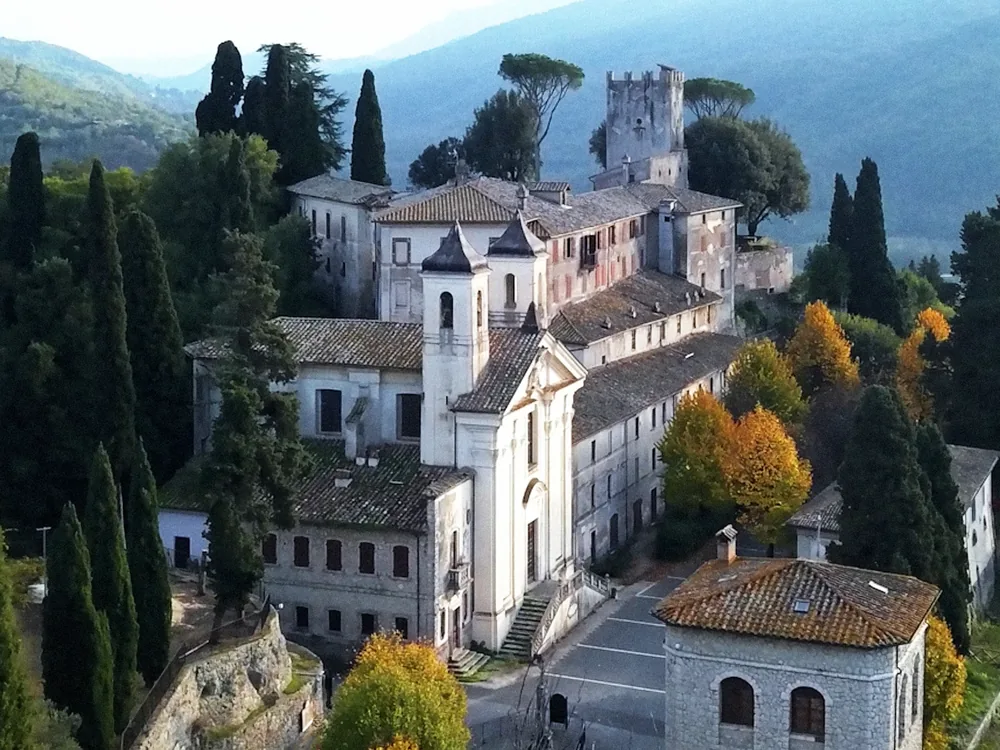
© Castles & Palaces
Quick Facts
- Hours
- Tue–Fri 10:00–17:00. Sat & Sun 10:00–18:00. Closed Mon
- Guided tour from
- €15
- Duration
- 2 hours (castle rooms + church + gardens)
- Best time
- April to June and September to October
- Booking
- Required — book 1+ days ahead
- Nearest city
- Tivoli
Featured Tour
Tivoli: Castello del Gallo e Giardini di Orazio Tour
Cancellation available · Instant confirmation
Highlights
- ✦The castle stands on the valley historically identified as the site of Horace's Sabine farm — the 'Giardini di Orazio' below the walls are the terraced hillside the Roman poet described with such affection in his Odes and Satires, making this one of the most literarily resonant landscapes in the Roman countryside
- ✦Three distinct garden types unfold across the castle's terraced hillside: an Italian formal garden in the Baroque tradition, a romantic landscaped garden of the 18th-century naturalistic school, and an English-style garden — a progression through three centuries of European garden design in a single visit
- ✦A Baroque church is incorporated within the castle walls, an unusual architectural survival that reflects the Counter-Reformation era investment in sacred architecture at the castle and is included in the guided tour
- ✦Castello del Gallo was a Grand Tour waypoint — 18th-century European travellers passed through the Sabine Hills on the route from Rome toward Naples, and the valley's association with Horace gave it a literary prestige that made it a standard destination for educated travellers of the period
- ✦The guided tour covers the castle rooms, the Baroque church, and all three garden areas in a single two-hour circuit — a format that makes the layered history of the site legible in a way that self-guided exploration rarely achieves
Skip the queue with a guided tour
Skip-the-line tickets & expert guides
Castello del Gallo occupies a hilltop above the village of Mandela in the Sabine Hills east of Rome, in a stretch of countryside that carries one of the most persistent literary associations in Italian landscape history. The valley below the castle — known as the 'Giardini di Orazio', the Gardens of Horace — is the territory that the Roman poet Quintus Horatius Flaccus described with unmistakable affection in his Odes and Satires: his Sabine farm, the retreat from the noise and heat of Rome that he returned to repeatedly across his career and celebrated in some of the most quoted lines in Latin literature. The precise location of Horace's farm has been disputed by scholars since the Renaissance, but the valley below Mandela has been the leading candidate for centuries, and that association gives the castle a cultural weight that purely medieval buildings rarely carry.
The castle itself dates to the 12th century, built on a hilltop position that commanded the approach routes from Rome toward the Apennines and the southeast. Within its walls, a Baroque church was added during the Counter-Reformation era — an unusual survival that the guided tour includes alongside the castle's residential rooms. The three gardens that now extend across the castle's terraced hillside were developed by successive owners across the 17th, 18th, and 19th centuries, each layer reflecting the garden aesthetics of its period: a formal Italian garden in the Baroque tradition, a romantic naturalistic landscape garden, and an English-style garden complete with the irregular plantings and picturesque compositions characteristic of that tradition.
The result is a site of unusual layering: Roman literary heritage at the base, medieval military architecture on the hilltop, Baroque sacred architecture within the walls, and three centuries of garden design across the terraces below. The guided tour that the GetYourGuide product covers is the correct way to experience the castle — a self-guided visit would leave too much of this layering unexplained. The two-hour circuit covers the castle rooms, the Baroque church, and all three garden areas, with guides who can locate each element within the long history of the site and its even longer association with the idea of the cultured retreat from the city.
For visitors in the Rome area with an interest in literary landscape, garden history, or Grand Tour heritage, Castello del Gallo is among the more rewarding half-day excursions within reach of the capital. The Sabine Hills east of Rome are cooler and less visited than the more famous Castelli Romani to the south, and Mandela is quiet enough that the gardens can be explored without the crowds that afflict more accessible sites.
History
The landscape around Mandela carries a history that begins long before the medieval castle on the hilltop. The Roman poet Horace held an agricultural property somewhere in this valley in the 1st century BC — a farm given to him by his patron Maecenas, which he farmed during the periods between his visits to Rome and to which he returned with evident relief throughout his mature career. His Sabine farm appears in the Odes, the Satires, and the Epistles with a consistency and warmth that made the Sabine Hills, and this valley specifically, one of the most celebrated landscapes in Latin literature. Grand Tour travellers in the 18th and early 19th centuries made pilgrimages to the valley specifically to stand in the countryside Horace had described, and that literary tourism gave Mandela a cultural prestige out of proportion to its size.
The medieval castle was built on the hilltop above the valley around the 12th century, occupying a commanding position over the road network of the Sabine Hills and the routes connecting Rome to the northeast. Like most of the smaller Lazio hilltop fortresses, it passed through the hands of various local noble families across the medieval and early modern periods, accumulating the Baroque church within its walls during the Counter-Reformation and attracting successive waves of garden investment from the 17th century onward as its owners became progressively more interested in the site's ancient literary associations. The three garden types — formal Italian, romantic landscaped, and English — represent the aesthetic preferences of different periods of that ownership and together constitute a layered record of how European garden culture evolved from the Baroque through the Romantic era.
How to Visit
Getting there: Mandela is approximately 40 kilometres east of Rome and 20 kilometres east of Tivoli. By car from Rome, take the A24 motorway toward L'Aquila and exit at Vicovaro–Mandela (approximately 45 minutes from central Rome); the castle is in the village centre. From Tivoli by car, follow the SR5 Tiburtina and then local roads eastward (approximately 30 minutes). There is no convenient public transport directly to Mandela; a car is strongly recommended. Alternatively, combine with a Tivoli day trip — Tivoli's Villa d'Este and Hadrian's Villa are 20 kilometres west and make a natural first stop before continuing to Mandela in the afternoon.
Tickets: Walk-up admission is €15 for adults and €8 for children. The GetYourGuide guided tour covers the castle rooms, the Baroque church, and all three garden areas in a two-hour circuit; advance booking is required. Book at least one day ahead via castellodelmandela.it or via the GetYourGuide booking link.
Practical tips: The three gardens are the main draw, and each is best in a different season — the Italian formal garden in spring, the romantic garden in high summer, the English-style garden in autumn. If you can only visit in one season, April and May are the safest choice. Wear comfortable walking shoes; the gardens are terraced and involve some slope and steps between levels. The tour is conducted in Italian and English — confirm the language at the time of booking.
Combine with: Castel Gandolfo (40 km southwest — the papal summer residence on the Alban Lake; both Castel Gandolfo and Castello del Gallo sit within the castelli romani and Sabine Hills arc around Rome, making a natural two-site Lazio hill-town circuit).
Frequently Asked Questions
The valley below the castle — known as the 'Giardini di Orazio', the Gardens of Horace — is the territory long identified as the site of Horace's Sabine farm: the agricultural retreat outside Rome that the poet Quintus Horatius Flaccus described in his Odes, Satires, and Epistles as the place he valued above all others. The precise location of the farm has been debated by scholars since the Renaissance, but the Mandela valley has been the leading candidate for centuries. The castle itself was built in the 12th century and has no direct Roman-era connection — it is the surrounding landscape, not the medieval structure, that carries the Horatian association.
Location
Mandela, 00020 Mandela RM, Lazio, Italy
Nearby Castles
Tours & Tickets
Powered by GetYourGuide
From
€15/ person