
Castello di Velona
Castello di Velona Resort Thermal Spa
Italy · Tuscany (Val d'Orcia) · Near Montalcino, Tuscany
Built 1150 · Medieval hilltop castle of Sienese-Florentine border-territory origin, documented from approximately the 12th century on a commanding ridge above the Orcia and Asso valleys near Montalcino; the historic fortified structure was substantially restored and integrated into a luxury resort and thermal spa complex in the late 20th and early 21st centuries; the castle's towers, walls, and principal rooms are preserved and form the architectural core of the resort; the surrounding estate overlooks Val d'Orcia UNESCO landscape and the Brunello di Montalcino vineyards; the GetYourGuide day pass grants access to the resort's thermal pool and spa facilities, not to a heritage tour of historic interiors
This page is part of an independent travel guide and is not affiliated with, endorsed by, or operated by Castello di Velona.
© Castles & Palaces
Quick Facts
- Hours
- Daily 10:00–19:00
- Guided tour from
- €104
- Hotel rating
- ★★★★★ 5-Star Hotel
- Duration
- Half day to full day
- Best time
- April to October
- Booking
- Required — book 3+ days ahead
- Nearest city
- Montalcino, Tuscany
Featured Tour
Castello di Velona Resort Spa Day Pass
Cancellation available · Instant confirmation
Stay Here
Castello di Velona Resort Thermal Spa & Winery
★★★★★ 5-Star HotelRooms are split between the historic building and a newer wing
Booked via Booking.com · Free cancellation on most rates
The GetYourGuide resort spa day pass is already covered above in How to Visit — not duplicated here.
Highlights
- ✦IMPORTANT: The GetYourGuide day pass is a resort spa day pass — it gives access to the thermal pools, infinity pool, and spa facilities of the luxury resort that now occupies the castle, not entry to a heritage tour of historic rooms or medieval interiors; this is a wellness experience with a remarkable castle setting
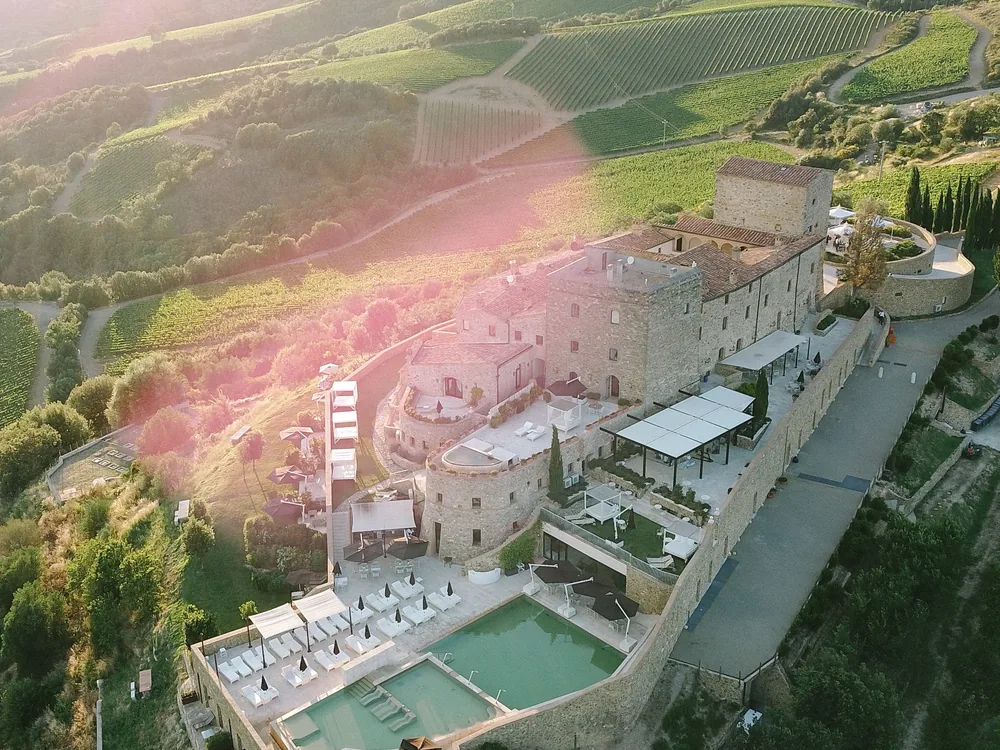
- ✦The infinity pool and thermal baths are positioned on the castle's ridge above Montalcino, with direct views over the Val d'Orcia UNESCO landscape and the Brunello vineyards — one of the most visually spectacular spa settings in Tuscany
- ✦Castello di Velona sits within the Brunello di Montalcino DOCG zone, Italy's most prestigious red wine appellation, whose Sangiovese Grosso wines (aged for a minimum of five years before release, including two in barrel) command prices that place them alongside Barolo and Amarone at the top of Italian wine hierarchy
- ✦The castle's medieval origins are documented from approximately the 12th century, when this ridge position above the Orcia valley marked one of the contested boundary zones between Sienese and Florentine territorial claims — the Val d'Orcia was a strategic landscape before it became a scenic one
- ✦The Val d'Orcia itself is a UNESCO World Heritage landscape (inscribed 2004) for its Renaissance-designed agricultural and urban landscape — Pienza, the 'ideal Renaissance city' designed for Pope Pius II, is approximately 20 km east; visiting the castle spa and Pienza in the same day gives the UNESCO landscape context from both sides
Skip the queue with a guided tour
Skip-the-line tickets & expert guides
A clarification before booking: the GetYourGuide day pass for Castello di Velona grants access to the resort's thermal pool and spa facilities — not to a heritage tour of the castle's historic rooms or medieval structure. The medieval castle exists and is preserved; it forms the architectural core and backdrop of a luxury resort built into and around the historic walls. But the day-pass experience is a wellness and relaxation visit to an exceptionally beautiful setting, not a castle-touring experience in the traditional sense. Readers arriving expecting illuminated manuscripts and knights' halls should recalibrate: the primary draw here is an infinity pool on a Tuscan ridge above the Brunello vineyards, with the castle as the scenographic backdrop.
The medieval origins of the site are real and documented. Castello di Velona appears in records from approximately the 12th century, when this ridge above the confluence of the Orcia and Asso valleys was a strategically valuable position in the contested borderland between Sienese and Florentine territorial claims. The Val d'Orcia in the medieval and early Renaissance period was not the serene cultural landscape that UNESCO designated in 2004 — it was a zone of competing city-state jurisdiction, where hilltop positions like Velona determined whether a given stretch of the old Via Francigena (the pilgrim road from Canterbury to Rome) fell under one power or another. The Sienese republic held Montalcino and its surrounding territory for most of the medieval period, and Castello di Velona's ridge position reflects the Sienese interest in controlling the approaches to the Orcia valley from the south.
Montalcino itself — the hilltop town approximately 6 kilometres north-northwest — is best known today for Brunello di Montalcino, the wine appellation whose Sangiovese Grosso grapes produce what is considered one of Italy's two or three greatest red wines. Brunello requires a minimum of five years' ageing before release, of which at least two must be in oak barrel, and the resulting wines — intense, structured, capable of long cellaring — command prices that reflect both quality and scarcity. The DOCG zone covers the hills around Montalcino, and Castello di Velona sits within it; the estate produces its own wines, and the resort incorporates wine experiences into its programming. The relationship between the thermal spa setting and the surrounding vineyard landscape is not incidental: drinking Brunello while looking out at the hills where the grapes were grown is a specific Tuscan pleasure that the Velona experience is designed to provide.
The Val d'Orcia was inscribed as a UNESCO World Heritage landscape in 2004 for its exceptional Renaissance-era agricultural and urban landscape — a designed countryside in which the visual organisation of hills, farmland, and roads reflects deliberate 14th–15th-century planning, most explicitly in the town of Pienza, approximately 20 kilometres east. Pienza was transformed from the medieval village of Corsignano by Pope Pius II in the 1450s and 1460s into what humanist writers called the ideal city — a planned urban environment in which a cathedral, palace, episcopal residence, and town square were designed by Bernardo Rossellino as a demonstration of Renaissance urbanism. Visiting Pienza and Castello di Velona on the same day puts the UNESCO landscape in both its physical and its cultural context: the working agricultural countryside from the spa terrace, the urban planning ambition from Pienza's central piazza.
The resort's thermal pools are fed by natural mineral springs — the Val d'Orcia has a tradition of thermal bathing extending back to the Roman period, most visibly at the free-to-enter Bagni San Filippo hot springs and the established spa complex at Bagno Vignoni, both within approximately 20 kilometres. Castello di Velona's thermal facilities are resort-standard rather than rustic — heated indoor and outdoor pools, treatment rooms, and the signature infinity pool designed to frame the vineyard and valley views — but the mineral-water source is genuine. The combination of altitude (approximately 450 metres), ridge-top position, and southwest aspect gives the outdoor pool area exceptional light conditions in the afternoon, and the views extend across Val d'Orcia to the volcanic bulk of Monte Amiata in the south.
The GetYourGuide day pass includes access to the thermal pools and spa areas. It does not include meals, treatments, or wine tastings, which are charged separately. The resort's restaurant is available to day-pass guests for lunch, and the wine programme — including the estate's own Brunello and other Montalcino wines — can be explored through the cellar shop or by arrangement. Advance booking is essential: the day-pass capacity is limited and the resort's residential guests take priority for spa access on busy days.
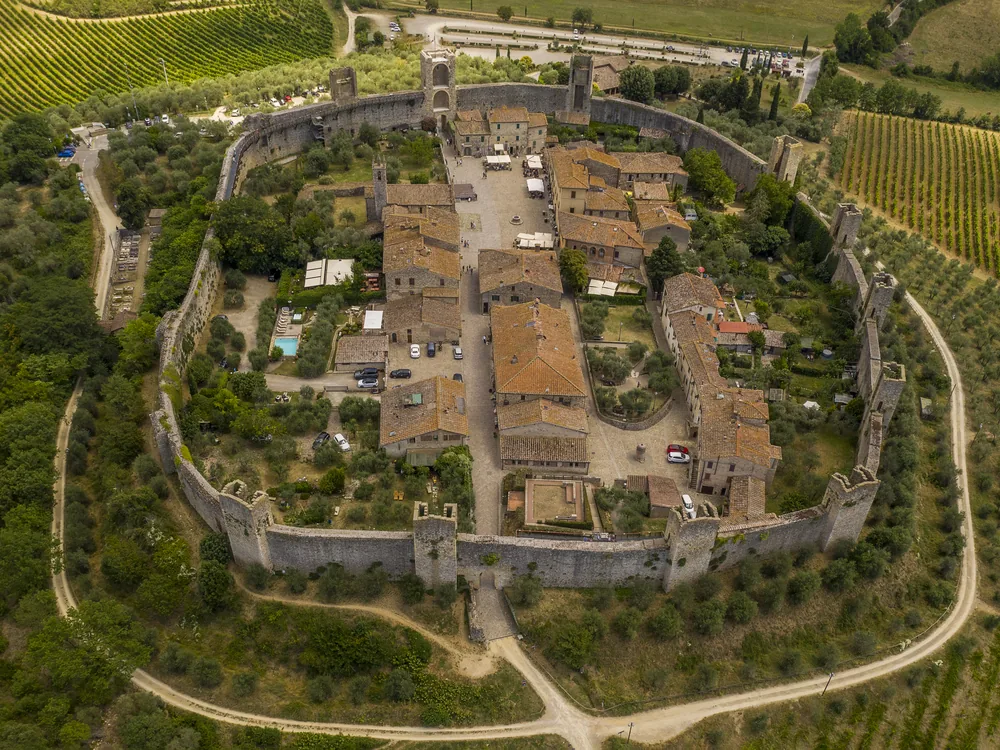
The drive from Montalcino is approximately 10 minutes on the SP14 road south toward Castelnuovo dell'Abate. From Siena: approximately 50 kilometres south on the SR2 (Via Cassia) then local roads to Montalcino; from Florence: approximately 115 kilometres, best by the A1 to Chiusi-Chianciano then north and west. There is no practical public transport access to the castle itself. Monteriggioni (already on this site at italy/monteriggioni), the perfectly preserved medieval walled town near Siena, is approximately 55 kilometres north and makes a logical architectural contrast for visitors combining Castello di Velona with a broader Sienese heritage day.
The Abbey of Sant'Antimo, approximately 10 kilometres south of Montalcino in the Val d'Orcia, is a Romanesque abbey in active use by Augustinian monks who chant the canonical hours in plainchant — the combination of an 11th-century Carolingian-tradition stone building and live liturgical music in daily use makes it one of the more unusual heritage experiences in Tuscany, and the 20-minute drive from Castello di Velona gives it reasonable proximity as a morning addition before the afternoon spa visit.
History
Castello di Velona is documented from approximately the 12th century as a fortified position on a ridge above the Orcia and Asso valleys near Montalcino, in the contested borderland between Sienese and Florentine territorial claims during the medieval period. The castle sat within the Val d'Orcia landscape that Siena controlled for much of this era and that was later inscribed as a UNESCO World Heritage Site for its Renaissance-designed agricultural landscape. The historic castle structure was preserved and integrated in the late 20th and early 21st centuries into a luxury resort and thermal spa, which now operates the site as a hospitality destination. The estate sits within the Brunello di Montalcino DOCG wine zone.
How to Visit
Getting there: By car from Montalcino: approximately 10 minutes south on the SP14 toward Castelnuovo dell'Abate. From Siena: approximately 50km south via the SR2, then local roads to Montalcino. No practical public transport access; a car or taxi from Montalcino is required.
Tickets: The GetYourGuide resort spa day pass grants access to the thermal pools, outdoor infinity pool, and spa facilities — this is a wellness day in a castle setting, not a heritage tour; the medieval structure is the scenographic backdrop. Meals, wine tastings, and treatments are charged separately. Advance booking is essential; book at least 2–3 days ahead as capacity is limited.
Practical tips: The outdoor infinity pool faces southwest over the Brunello vineyards and Val d'Orcia — afternoon sessions get the best light. The resort's restaurant is available to day-pass guests for lunch. The estate sits within the Brunello di Montalcino DOCG zone; the cellar shop and wine programme are worth exploring after the spa.
Combine with: Monteriggioni (55km north near Siena) for a medieval walled-town contrast, or Castel di Poggio above Fiesole for a broader Tuscany hilltop-castle itinerary.
How to Stay
Beyond the resort's celebrated spa day pass — already covered on this page — Castello di Velona also operates as a hotel, with accommodation split between the "historic zone," where the 12th-century watchtower and Renaissance loggia anchor rooms with genuine period character, and a newer wing built to house additional modern rooms alongside the restaurant and spa facilities. This split mirrors the property's dual identity: a preserved medieval fortress at its core, wrapped in resort infrastructure built to serve both overnight guests and day-pass visitors.
Getting there: Same access as How to Visit above — about 10 minutes by car from Montalcino via the SP14.
Rooms & rates: Accommodation split between the "historic zone" (rooms within or adjacent to the 12th-century tower and Renaissance loggia) and a newer wing with modern rooms, restaurant and spa. From €419/night.
On-site: Restaurant, thermal spa and pools (see How to Visit for day-pass details), on-site winery.
Good to know: Overnight guests have full access to the thermal pools and spa without the day-pass booking restrictions that apply to day visitors — worth noting for readers comparing a day visit vs. an overnight stay.
Combine with: Same recommendations as How to Visit — Monteriggioni and Castel di Poggio.
Frequently Asked Questions
The GetYourGuide day pass for Castello di Velona is a resort spa day pass — it gives access to the thermal pools, infinity pool, and spa facilities of the luxury resort that has been built into the historic castle structure. It is not an entry ticket to tour medieval rooms or a heritage museum. The castle architecture forms the backdrop and setting of the resort, but the visitor experience is primarily a wellness day in an exceptional Tuscan hilltop location, not a castle-touring experience.
Location
Loc. Velona, 53024 Montalcino SI, Italy
Nearby Castles
Tours & Tickets
Powered by GetYourGuide
From
€104/ person