
Civitella del Tronto Fortress
Fortezza di Civitella del Tronto
Italy · Abruzzo · Near Civitella del Tronto
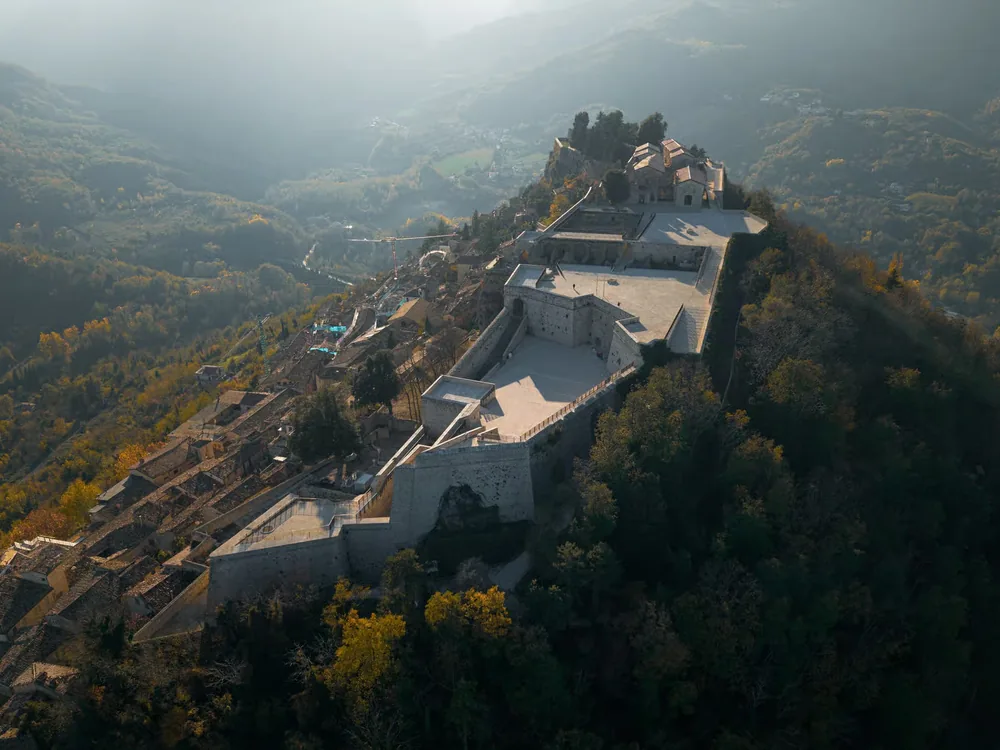
Built 1564 · One of the largest fortresses in Europe by footprint, extending approximately 500 metres along a narrow ridge above the village of Civitella del Tronto; the definitive bastioned form was established by Spanish military engineers in the 16th–17th centuries under the Viceroyalty of Naples, incorporating the angled bastion system designed to deflect artillery fire; the fortress includes barracks, magazines, cisterns, a governor's residence, and a church within its walls; the hilltop village of Civitella del Tronto is partly enclosed within and beneath the fortress perimeter, creating an inhabited military-civic complex unusual among Italian fortifications
This page is part of an independent travel guide and is not affiliated with, endorsed by, or operated by Civitella del Tronto Fortress.
© Castles & Palaces
Quick Facts
- Hours
- Mon–Fri 10:00–16:00. Sat & Sun 10:00–18:00
- Entry via GetYourGuide
- €11
- Duration
- 1.5–2 hours
- Best time
- April to October
- Nearest city
- Civitella del Tronto
Featured Tour
Civitella del Tronto Fortress - Entry Ticket
Cancellation available · Instant confirmation
Highlights
- ✦Civitella del Tronto Fortress was the final military position of the Bourbon Kingdom of the Two Sicilies to surrender during Italian unification — the garrison held out from October 1860 until March 20, 1861, weeks after the formal proclamation of the Kingdom of Italy on March 17, resisting long after Garibaldi's campaign had swept through the rest of the south, making this the literal last military act of the old Bourbon kingdom
- ✦The fortress extends approximately 500 metres along a ridge above the village, placing it among the largest fortresses in Europe by footprint — the scale is only apparent on foot, walking the full perimeter past bastions, magazines, cisterns, barracks, and artillery positions accumulated across three centuries of Spanish and Bourbon military engineering
- ✦The Spanish bastioned system used in the fortress's 16th–17th-century design represents the definitive military architecture of its period: angled bastions designed to eliminate the dead angles that medieval towers left, interlocking fields of fire, and thick earth-backed walls specifically engineered to absorb artillery impact rather than resist it with sheer mass
- ✦The hilltop village of Civitella del Tronto is partly enclosed within and beneath the fortress perimeter — an inhabited medieval settlement living under the shadow of military walls, the houses clustered on the slopes below the ramparts in a way that makes the relationship between the military installation and the civilian town legible in the landscape
- ✦Panoramic views from the fortress walls take in the Gran Sasso massif and the Apennines to the west and, on clear days, the Adriatic coast to the east — a visual range that explains both the fortress's strategic value as an observation post and its practical impregnability: any attacking force visible for kilometres in every direction
Skip the queue with a guided tour
Skip-the-line tickets & expert guides
The date March 20, 1861, is one of the more obscure but more specifically meaningful dates in the story of Italian unification. The Kingdom of Italy had been formally proclaimed on March 17, three days earlier, with Victor Emmanuel II as its first king. Garibaldi's campaign through Sicily and southern Italy had concluded months before. The last Bourbon king of the Two Sicilies, Francis II, had fled Naples in September 1860 and taken refuge at Gaeta, on the coast, where he held out until February 13, 1861. By the time Gaeta fell, the Bourbon kingdom was finished — except for one place.
Civitella del Tronto, a small hilltop town in northern Abruzzo near the border with the Marche, had been under siege since October 1860. The Spanish-designed fortress on the ridge above the village, garrisoned by Bourbon troops under the command of Colonel Luigi Mezzacapo, was holding. The garrison refused to surrender when Gaeta fell. It continued to hold when the Kingdom of Italy was proclaimed. It only capitulated on March 20, 1861 — three days after the new kingdom's formal proclamation — and only then because the commander received direct orders from the exiled Bourbon court to stop fighting. The last military act of the Kingdom of the Two Sicilies was the surrender of a garrison in Abruzzo that no one on the Piedmontese or Garibaldian side had managed to dislodge by force.
The fortress that made this possible is a remarkable military installation. Extending approximately 500 metres along a narrow ridge above the village of Civitella del Tronto, it is among the largest fortresses in Europe by footprint — a comparison that sounds like tourist marketing until you walk the full perimeter and realise that the comparison is literally accurate: Civitella is bigger, metre for metre of outer wall, than many of the fortifications that receive far more international attention. The scale is a product of the Spanish Viceroyalty of Naples's systematic investment in the southern Italian defensive system from the mid-16th century onward, as the Habsburg monarchy converted the kingdom's strategic fortifications to the bastioned trace italienne design that Spanish and Italian military engineers had developed in response to the spread of artillery warfare.
The bastion system at Civitella represents this transition at its most complete. The angled bastions projecting from the curtain walls are not decorative; they are solutions to a specific tactical problem. Medieval round towers left dead angles — zones at the base of the wall that defending fire could not reach and attacking troops could therefore exploit in safety. The angled bastion, positioned so that flanking fire from adjacent bastions covers the ground at the base of every section of wall, eliminates these dead angles. The fortress was designed so that no attacker could approach any section of the walls without being exposed to fire from multiple positions simultaneously. The 1860–1861 siege demonstrated that this design still worked three centuries after it was built.
Within the fortress walls, the installation includes barracks for several hundred soldiers, magazines for powder and ammunition, cisterns capable of supplying water for an extended siege, a governor's residence, and a church — everything required for an autonomous garrison to function indefinitely without external resupply. The village of Civitella del Tronto occupies the slopes immediately below the fortress walls, its houses clustered in the shadow of the military ramparts in a pattern that reflects centuries of coexistence between a civilian population and a permanent military installation above it.
For visitors today, the fortress is self-guided and walkable in its entirety. The circuit of the ramparts takes approximately 90 minutes at an unhurried pace, moving through bastions and along curtain walls with continuous views in every direction. To the west, the Gran Sasso and the main Apennine chain fill the horizon — the highest peaks of the Abruzzese mountains visible on clear days as a continuous wall of rock and snow. To the east, the Adriatic coast appears as a strip of blue on clear days, the coastal plain of Teramo province descending from the fortress hill toward the sea. The visual range in all directions explains both why the fortress was built here — an observation post covering the routes between the coast and the mountains — and why it was effectively impregnable: any attacking force was visible for many kilometres before it reached the walls.
The GetYourGuide entry ticket is valid for seven days, allowing multiple visits if the weather is poor for the rampart walk on the first day. The ticket covers access to the full fortress complex, including the barracks, internal structures, and the village beneath the walls. The nearest town of any size is Teramo, approximately 14 kilometres to the south, which has accommodation and restaurants.
For visitors interested in the Risorgimento specifically, Civitella del Tronto offers a dimension of the unification story that the more celebrated sites — Garibaldi's landing in Sicily, the Battle of Volturno, the meeting of Garibaldi and Victor Emmanuel II — do not provide: the view from the losing side, from the men who fought on after the cause was lost, who held a fortress for months past the point when any realistic military purpose remained, until a direct order from the court they were defending told them to stop. The garrison's 400 men surrendered with full military honours. They were permitted to march out with their weapons. It was, in the Italian phrase, una resa onorevole — an honourable surrender — and the date, three days after the kingdom they were defending ceased to exist, has a kind of absurdist precision that history rarely provides so neatly.
Rocca Calascio, the high-altitude Abruzzese fortress already on this site, offers the other pole of the Abruzzo fortification story: a medieval mountain fortress built for a different kind of warfare in a different landscape. The two sites are approximately 90 kilometres apart — a day's drive through the Gran Sasso range — and together they cover Abruzzo's remarkable density of hilltop military heritage.
History
Fortifications at Civitella del Tronto date to at least the medieval period, with the site used by various powers controlling the northern Abruzzo corridor. The Spanish Viceroyalty of Naples undertook major construction in the 16th century, establishing the bastioned trace italienne design that gave the fortress its definitive form by the early 17th century. Under Bourbon rule from 1734, the fortress was maintained as a major military installation. In 1860–1861, the fortress was the final Bourbon military position to surrender during Italian unification, holding out from October 1860 until March 20, 1861 — three days after the formal proclamation of the Kingdom of Italy. The fortress is now administered as a state monument.
How to Visit
Getting there: Civitella del Tronto is in Teramo province, Abruzzo, approximately 14 km north of Teramo. By car: the A24/A25 motorway system connects Rome (~2.5 hours) and Pescara (~1 hour) to the Teramo area. Public transport connections to Civitella itself are limited — car is recommended.
Tickets: GetYourGuide entry ticket valid 7 days. Walk-up entry also available.
Visit length: 1.5–2 hours for the full perimeter walk and internal structures.
Practical tips: April to October.
Combine with: Teramo city (14 km south) for lunch and the Roman amphitheatre. Rocca Calascio (90 km southwest, Gran Sasso area) as an Abruzzese hilltop-fortress day-trip extension.
Frequently Asked Questions
The fortress was the last military position of the Bourbon Kingdom of the Two Sicilies to surrender during the Risorgimento. While Garibaldi's campaign had swept through the south by autumn 1860 and the Kingdom of Italy was proclaimed on March 17, 1861, the Civitella garrison held out until March 20 — three days after the new kingdom's proclamation — surrendering only on direct orders from the exiled Bourbon court. It is the literal final military act of the old kingdom, making it the most historically specific 'last stand' site of the unification period.
Location
Via della Fortezza, 64010 Civitella del Tronto TE, Italy
Nearby Castles
Tours & Tickets
Powered by GetYourGuide
From
€11/ person