
Gargonza Castle
Castello di Gargonza
Italy · Tuscany — Monte San Savino, Arezzo Province · Near Arezzo
Built 1200 · Medieval fortified hamlet, first documented in the 13th century; feudal holding of the Ubertini family; restored as a resort in the 1970s by Count Roberto Guicciardini Corsi Salviati
This page is part of an independent travel guide and is not affiliated with, endorsed by, or operated by Gargonza Castle.
© Castles & Palaces
Quick Facts
- Rooms from
- €166 / night
- Duration
- Overnight stay only; the village's medieval layout can be explored on foot by guests
- Best time
- Year-round
- Nearest city
- Arezzo
Stay Here
Castello di Gargonza
Rooms are split between the historic building and a newer wing
Booked via Booking.com · Free cancellation on most rates
No confirmed independent day-visit product was found; the hamlet is private and access is primarily for hotel guests, though guests can explore the village's medieval layout on foot.
Highlights
- ✦According to some historians, hosted Dante Alighieri in 1304 during a meeting between Florentine and Arentine Guelphs
- ✦A feudal holding of the Ubertini, one of Arezzo's most powerful families, at the center of the Guelph-Ghibelline wars
- ✦A 500-hectare wooded estate with views over the Val di Chiana
Stay in the castle itself
Book a room via Booking.com
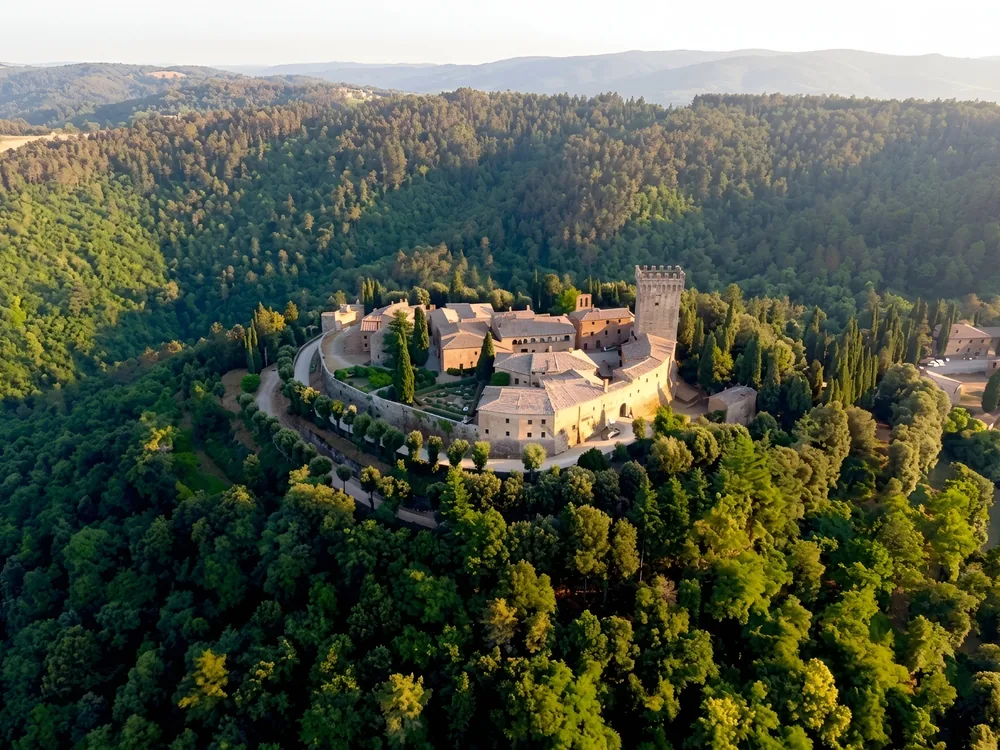
Of medieval origin, Gargonza's first mentions date to the 13th century. Because of its strategic position, this fortified hamlet was long at the center of the conflicts between Guelphs and Ghibellines, the two factions that divided medieval communal Italy. In the 13th century it was a feudal holding of the Ubertini family, one of Arezzo's most powerful, though its border location between the territories of Arezzo, Siena and Florence made it the subject of repeated disputes between these three city-states. According to some historians, Gargonza hosted Dante Alighieri in 1304, when he is said to have taken part in a meeting between Florentine and Arentine Guelphs.
After World War II, Gargonza was left uninhabited, but in the 1970s Count Roberto Guicciardini Corsi Salviati carried out a conservative restoration that preserved the architectural character of the old medieval village. With this intervention, Gargonza was transformed into an exclusive resort with rooms and apartments spread across the old village houses, preserving its tower, walls, 13th-century gate, and the 14th-century Romanesque church with its bell tower.
The Dante Alighieri association, while resting on historical tradition rather than definitive documentary proof, connects Gargonza to one of the most consequential political meetings of the early 14th century, when Florentine exile politics were shaped by exactly this kind of Guelph faction gathering.
Gargonza's border position between three competing medieval city-states — Arezzo, Siena and Florence — gave it a strategic significance disproportionate to its size, explaining the repeated disputes over its control during the Guelph-Ghibelline period.
The 1970s restoration under Count Guicciardini Corsi Salviati prioritized conservation over reconstruction, preserving the hamlet's genuine medieval fabric rather than reinventing it — a notably different approach from some of the more romantically "castellized" properties elsewhere in this collection.
The estate's 500 hectares of woodland, considerably larger than the typical castle-hotel garden, give guests staying at Gargonza a genuine sense of rural Tuscan landscape alongside the hamlet's own medieval architecture.
History
Gargonza is first documented in the 13th century as a fortified hamlet at the center of Guelph-Ghibelline conflicts, held by the Ubertini family of Arezzo. Some historians place Dante Alighieri here in 1304 for a meeting between Florentine and Arentine Guelphs. Left uninhabited after World War II, the village was conservatively restored in the 1970s by Count Roberto Guicciardini Corsi Salviati and transformed into a resort, with rooms and apartments spread across the old village's 13 historic buildings.
How to Stay
Getting there: About 15 minutes from Monte San Savino and 30 minutes from Arezzo by car; Florence's Peretola Airport (FLR) is about 1h10, roughly 70km north.
Rooms & rates: Rooms, suites and apartments spread across 13 historic buildings of the hamlet, including the Tower (Tower Suite and Tower Room, with a private terrace) and restored former peasant houses. From €166/night.
On-site: Restaurant, swimming pool, 500 hectares of woodland, a 14th-century Romanesque church.
Good to know: The village deliberately keeps an austere medieval atmosphere (no televisions in the rooms) — suited to those seeking genuine disconnection, not modern comforts.
Combine with: Monte San Savino (~15 min), Arezzo (~30 min), the Val di Chiana and its wine villages, Siena (~45 min).
Frequently Asked Questions
A whole fortified hamlet — rooms and apartments are spread across 13 distinct historic buildings (former peasant houses, the medieval tower, and others), all restored while preserving their original 13th-14th century structure.
Location
Località Gargonza, 52048 Monte San Savino AR, Italy
Nearby Castles
Rooms from
€166/ night