
Lambardi Tower of Magione
Torre dei Lambardi di Magione
Italy · Province of Perugia, Umbria — Magione, eastern shore of Lake Trasimeno · Near Perugia
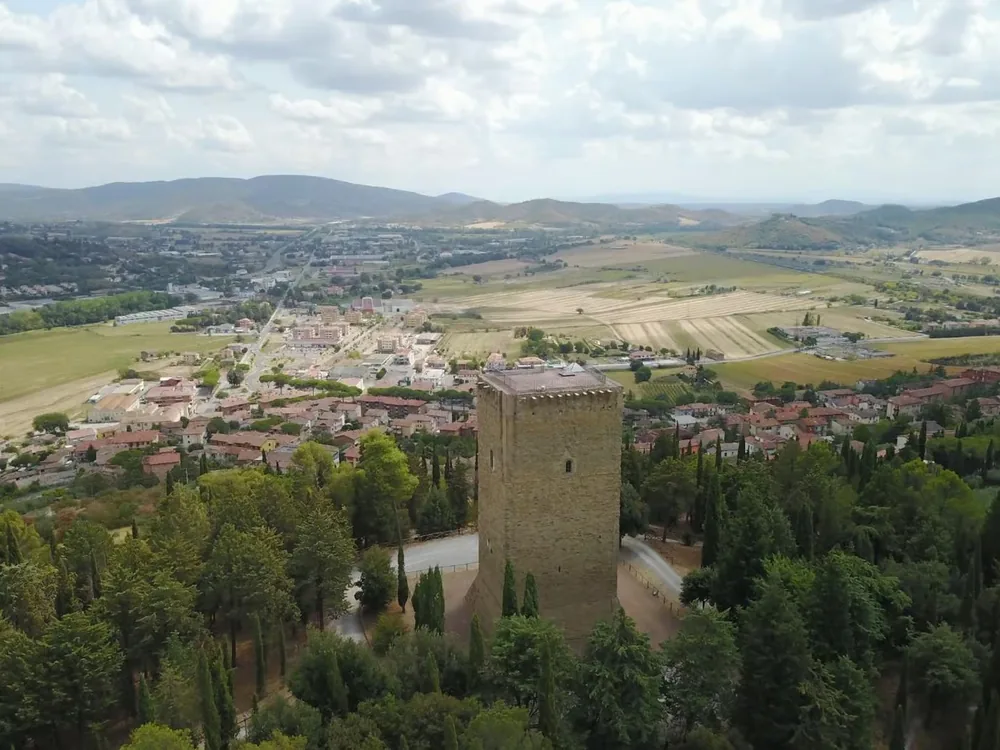
Built 1200 · Knights Hospitaller medieval tower, 12th–13th century — built by the Knights of Jerusalem (Knights Hospitaller) on a forested hillside above Magione's historic centre; a compact cylindrical structure of rough-cut Central Italian stone with minimal later exterior modification; the interior has been fitted with a contemporary immersive projection museum circuit while preserving the historic medieval shell; the nearby Castle of the Knights of Malta is a companion Hospitaller monument in the same town, giving Magione an unusual concentration of surviving Hospitaller architecture in Umbria
This page is part of an independent travel guide and is not affiliated with, endorsed by, or operated by Lambardi Tower of Magione.
© Castles & Palaces
Quick Facts
- Hours
- Tue–Fri 10:00–17:00. Sat & Sun 10:00–18:00. Closed Mon
- Entry via GYG
- €3
- Duration
- 45 minutes–1.5 hours (self-guided tower circuit with immersive projections, exterior terrace, and any current temporary exhibition)
- Best time
- April to June and September to October
- Nearest city
- Perugia
Featured Tour
Lambardi Tower of Magione: admission ticket
Cancellation available · Instant confirmation
Highlights
- ✦Giovanni da Pian del Carpine — Magione's pre-Marco-Polo traveller to the Mongol Empire — a Franciscan friar born in Magione around 1185, Giovanni undertook a papal diplomatic mission in 1245–1246 to the court of Great Khan Güyük in Karakorum, Mongolia; he returned to write the Historia Mongalorum, the first systematic European account of the Mongol Empire from direct observation — roughly 25 years before Marco Polo's more famous expedition
- ✦Knights of Jerusalem / Knights Hospitaller origins — the tower was constructed by the Knights Hospitaller between the 12th and 13th centuries as part of the order's territorial presence in Umbria; the nearby Castle of the Knights of Malta is a companion Hospitaller monument in the same town, making Magione an unusual concentration of surviving Hospitaller architecture in Central Italy
- ✦Immersive museum circuit on the Giovanni expedition and the tower's history — the interior hosts contemporary projection installations covering the tower's Hospitaller origins and Giovanni da Pian del Carpine's journey to Karakorum; rotating temporary exhibitions update 2–3 times annually, giving the visit a different character across the year
- ✦Lake Trasimeno views from the upper terrace — the view from the tower extends toward the fourth largest lake in Italy; the same lake shoreline was the site of Hannibal's ambush of the Roman consul Gaius Flaminius in 217 BCE, one of the most tactically decisive defeats in Roman military history
- ✦One of the most affordable heritage visits in Umbria — admission at approximately €3 is significantly below the average for comparable museum circuits in the region, and the site is rarely congested; a genuine hidden-gem alternative to the major Umbrian heritage destinations for visitors based in Perugia or at Lake Trasimeno
Skip the queue with a guided tour
Skip-the-line tickets & expert guides
The Torre dei Lambardi rises from a forested hillside above Magione, a small commune on the eastern shore of Lake Trasimeno. The lake — the fourth largest in Italy, set in a shallow bowl of hills between Umbria and Tuscany — gives this corner of central Italy a particular quality of light: blue and reflective in clear weather, grey and atmospheric when the mountains generate cloud. Most visitors who reach Lake Trasimeno concentrate on Castiglione del Lago to the west or take the ferry to Isola Maggiore. Magione, on the eastern bank, is quieter, and it retains more of the physical texture of a medieval Umbrian settlement.
The tower occupies a wooded promontory above the town centre, approached through holm oak and cypress — characteristically Umbrian landscape. The fortification was built by the Knights of Jerusalem, the military religious order also known as the Knights Hospitaller, during the 12th or early 13th century. The Hospitallers had a significant presence in this part of Umbria; the nearby Castle of the Knights of Malta is a companion monument from the same institution, and together the two structures give Magione an unusual concentration of surviving Hospitaller architecture in Central Italy. Both buildings stand as evidence of the order's territorial reach during the medieval period — the Hospitallers were simultaneously a military force, a religious community, and a major property-holding institution across Catholic Europe.
The connection that gives the Torre dei Lambardi its most unusual historical claim is not architectural but biographical. Magione was the birthplace, around 1185, of Giovanni da Pian del Carpine — a Franciscan friar who in 1245 undertook a diplomatic journey that no European of his era had attempted before and few have equalled since. Pope Innocent IV, alarmed by the Mongol invasions of Poland and Hungary in 1241 and uncertain about Mongol intentions toward Christian Europe, sent Giovanni eastward as a papal emissary. Giovanni was in his sixties, in poor health, and the journey he undertook was extraordinary even by medieval standards.
Travelling from Lyon through Poland and across the Eurasian steppe, spending more than a year on horseback, Giovanni reached the Mongol capital of Karakorum — in what is now central Mongolia — in time for the formal enthronement of the Great Khan Güyük in July 1246. He attended the ceremony, presented the Pope's letters, and received Güyük's reply — in effect a demand that the Pope and Christian rulers submit to Mongol authority. Giovanni returned to Europe and wrote the Historia Mongalorum, a systematic account of the Mongol Empire: its political structure, military methods, geography, religious practices, and the sheer territorial scale of the empire stretching from China to the borders of Hungary. The Historia is the earliest detailed European description of the Mongol Empire written from direct observation.
Marco Polo would not begin his journey until 1271 — roughly a quarter century after Giovanni had already returned from Karakorum and completed his written account. This sequence is not widely known outside specialist circles; Marco Polo's name and narrative have far eclipsed Giovanni's in cultural memory, though Giovanni's account preceded and in several respects surpassed the Venetian's in diplomatic precision and systematic intent. The museum circuit inside the Torre dei Lambardi addresses this directly. Immersive projection installations cover both the tower's medieval history as a Hospitaller fortification and Giovanni's eastern journey — the route across the Eurasian steppe, the Mongol court at Karakorum, the political context of the mid-13th century encounter between Latin Christendom and the Mongol Empire, and the figure of Giovanni himself.
The visit is self-guided and structured around the tower's interior rooms and the exterior terrace. The projections use period sources and contemporary cartography to trace the journey from the Umbrian hills where Giovanni was born to the Mongolian steppe where the Great Khan received him. Alongside the permanent installation, the tower hosts rotating temporary exhibitions; the programme changes two or three times annually, and the character of the visit shifts accordingly. Entry at approximately €3 is among the most affordable for any museum circuit of comparable historical reach in Umbria, and the site is rarely crowded — a genuine hidden-gem alternative to the major Umbrian heritage destinations.
From the tower's upper terrace, the view extends across Magione toward Lake Trasimeno. The lake is where, in 217 BCE, the Carthaginian general Hannibal ambushed and annihilated a Roman army under the consul Gaius Flaminius — one of the most tactically decisive defeats in Roman military history and one of Hannibal's most celebrated victories. Hannibal concealed his forces in the wooded hills above the lake shore and attacked the Roman column simultaneously from three sides as it passed below. The battle has no commemorative monument at Magione specifically, but the lake visible from the tower connects the contemporary visitor to an event that transformed the trajectory of the Second Punic War and, through it, the history of Rome.
Magione is approximately 25km from Perugia on the SS220, connected by regular regional bus services from Perugia's bus station. The town centre below the tower has small trattorias and a Saturday market. The tower is a short steep walk from the main piazza. The full circuit — travel from Perugia, the visit, and return — can be completed comfortably in a half day; visitors based in Perugia might combine the tower with a Lake Trasimeno circuit (ferry to Isola Maggiore, lunch at Castiglione del Lago) for a full day.
[Rocca Paolina](/castles/italy/rocca-paolina) — the vast subterranean papal fortress built by Pope Paul III beneath the streets of Perugia in the 1540s, its original medieval streets and buildings intact underground — is approximately 25km northwest of Magione. The Rocca Paolina is one of the most unusual fortress-museum experiences in Central Italy, its circuit running entirely below the city through the buried fabric of the medieval neighbourhood that was demolished to build the papal stronghold.
History
12th–13th century: Knights Hospitaller (Knights of Jerusalem) construct the Torre dei Lambardi on a forested hillside above Magione as part of the order's territorial presence in Umbria; the nearby Castle of the Knights of Malta is built in the same period. c. 1185: Giovanni da Pian del Carpine born in Magione; he will later become a Franciscan friar and diplomat. 1245–1246: Giovanni travels on papal mission from Lyon to the Mongol capital of Karakorum, attending the enthronement of Great Khan Güyük; returns with the Historia Mongalorum, the first systematic European account of the Mongol Empire. Late medieval period: Magione and Lake Trasimeno absorbed into the Papal States. 16th century: Papal States consolidate control of Umbria; the tower loses its military function. 19th century: unification of Italy; Umbria incorporated into the Kingdom of Italy. 20th–21st century: the Torre dei Lambardi conserved by the Comune di Magione; converted into a museum circuit with immersive projection installations documenting the tower's Hospitaller history and Giovanni da Pian del Carpine's Mongol expedition. Present day: open to visitors Tuesday–Sunday; permanent immersive projection circuit plus rotating temporary exhibitions.
How to Visit
Getting there: Magione is approximately 25 km southeast of Perugia. By bus: regular APM Perugia services from Perugia bus station to Magione (approximately 40 minutes). By car: SS220 from Perugia (30 minutes); limited parking in Magione town centre. No direct train connection — bus is the practical option from Perugia. The tower is a short steep walk from Piazza Fratamaggiore in the village centre.
Tickets: Walk-up entry €3 adult, free child. The GYG ticket (t1394566, from €3) covers the full self-guided tower circuit — immersive projections on the Hospitaller history and Giovanni da Pian del Carpine's 1245 Mongol expedition, plus any current temporary exhibition — book via GYG to confirm current hours before visiting.
Practical tips: Open Tuesday–Sunday, 10:00–17:00 (18:00 weekends; may extend to 19:00 in summer). The visit takes 45 minutes to 1.5 hours. Temporary exhibitions change 2–3 times a year — check the current programme before booking. The tower involves period stairs; not fully wheelchair accessible. Spring and autumn are the best seasons; the cypress-and-holm-oak hillside is particularly atmospheric in October.
Combine with: [Rocca Paolina](/castles/italy/rocca-paolina) — the underground papal fortress in Perugia, 25 km northwest, one of the most unusual fortress-museum experiences in central Italy.
Frequently Asked Questions
Giovanni da Pian del Carpine was a Franciscan friar born in Magione around 1185 who undertook a papal diplomatic mission to the Mongol Empire in 1245–1246 — roughly 25 years before Marco Polo's more famous journey. Pope Innocent IV sent him to the court of Great Khan Güyük in Karakorum (now central Mongolia), both to assess Mongol military intentions after the invasions of Poland and Hungary and to seek possible alliance against the Islamic powers of the Middle East. Giovanni travelled by horse across the Eurasian steppe, attended the enthronement of the Great Khan, received a reply letter (effectively demanding papal submission), and returned to write the Historia Mongalorum — the first systematic European account of the Mongol Empire. The tower's museum circuit documents his journey with immersive projections; his connection to Magione gives the site its most unusual historical claim.
Location
Via della Torre, 06063 Magione PG, Italy
Nearby Castles
Tours & Tickets
Powered by GetYourGuide
From
€3/ person