
Monterone Castle
Castello Di Monterone
Italy · Umbria — Monterone, near Perugia · Near Perugia
Built 1200 · Documented from the 11th-13th century; fortress proper built in the 13th century; traditionally linked to the Knights Templar; acquired by the Piceller family in the late 17th century
This page is part of an independent travel guide and is not affiliated with, endorsed by, or operated by Monterone Castle.
© Castles & Palaces
Quick Facts
- Rooms from
- €157 / night
- Duration
- Overnight stay only
- Best time
- Year-round
- Nearest city
- Perugia
Stay Here
Castello Di Monterone
Rooms are within the historic castle building itself
Booked via Booking.com · Free cancellation on most rates
No confirmed independent day-visit product was found; it operates as a private hotel, part of the TH Resorts chain.
Highlights
- ✦Documented from the 11th-13th century; traditional links to the Knights Templar, near the Templar church of San Bevignate
- ✦Damaged during 15th-16th century civil wars between noble families of Perugia
- ✦Acquired by the Piceller family in the late 17th century; first restoration inaugurated in 1849 in the presence of the future Pope Leo XIII
- ✦18 individually named and decorated rooms, all within the historic building
Stay in the castle itself
Book a room via Booking.com
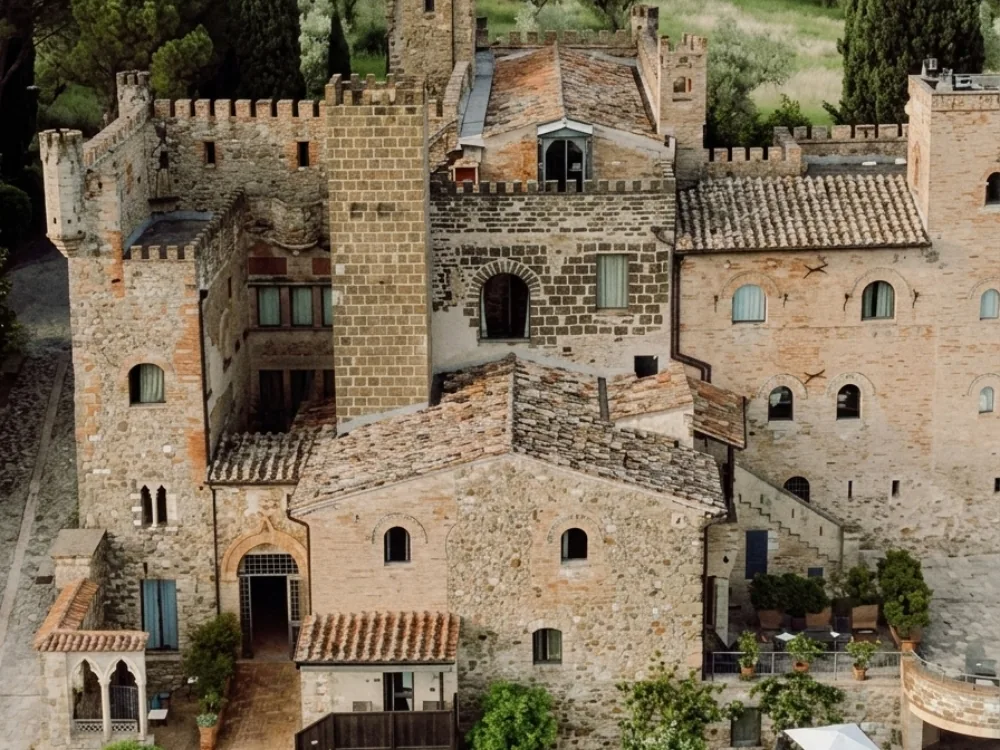
Documentation of a structure at Monterone dates back at least to the 11th century, with a specific building referenced in a document from January 1200 preserved in the Perugia State Archives; the fortress proper was built in the 13th century. Perugian scholarly tradition holds that the Knights Templar once owned the building, which stands just a few hundred meters from the Templar church of San Bevignate. The castle suffered significant damage during 15th- and 16th-century civil wars between rival noble families of Perugia.
The Piceller family acquired the castle at the end of the 17th century and made it their residence, carrying out the first major restoration in 1849 — inaugurated in the presence of Gioacchino Pecci, then Archbishop of Perugia and future Pope Leo XIII. Today the castle's 18 rooms, each individually named and decorated (la Giota, la Opretoia, dell'Etrusco, delle Chiavi, the Cardinal's Room, the Duke's Room with a Montefeltro emblem), sit entirely within the historic 13th-century building; a separate dependance on the grounds houses only the wellness area — sauna and Turkish bath — not guest accommodation, alongside a rose garden with roughly 250 plants across 20 varieties.
The traditional link to the Knights Templar, while not definitively documented, situates Monterone within a broader cluster of Templar-associated sites around Perugia, anchored by the nearby church of San Bevignate — one of the best-preserved Templar churches in Italy.
The 1849 restoration's connection to the future Pope Leo XIII, present at its inauguration while serving as Archbishop of Perugia, ties the castle's modern history to a figure who would go on to lead the Catholic Church for a quarter century, one of the longest pontificates in its history.
The clear separation between the historic castle (all 18 guest rooms) and the modern dependance (wellness facilities only) reflects a deliberate choice to keep new construction functionally distinct from the historic building, rather than blending guest accommodation across both.
Perugia's historic center, just 10 minutes away, gives guests staying at Monterone easy access to one of Umbria's largest and most historically rich cities, alongside the nearby town of Assisi.
History
Monterone is documented from at least the 11th century, with the fortress proper built in the 13th century and a traditional link to the Knights Templar. The castle suffered damage during 15th-16th century civil wars between Perugia's noble families. The Piceller family acquired it in the late 17th century, restoring it in 1849 in the presence of the future Pope Leo XIII. Today the castle's 18 individually named rooms are entirely within the historic building, with a separate dependance housing only the wellness area.
How to Stay
Getting there: About 10 minutes by car from central Perugia; roughly 30 minutes from Assisi and 1h from Gubbio.
Rooms & rates: 18 individually named and decorated rooms, all within the historic 13th-century castle building; a separate dependance houses only the wellness area (sauna, Turkish bath), not guest rooms. From €157/night.
On-site: Restaurant, outdoor pool, sauna and Turkish bath (in the dependance), rose garden.
Good to know: Each room has its own name and story rooted in the castle's history — worth asking about a specific room's history when booking.
Combine with: The historic center of Perugia and the town of Assisi.
Frequently Asked Questions
Yes — all 18 rooms are within the historic 13th-century castle building. A separate dependance on the grounds houses only the wellness area (sauna, Turkish bath), not guest rooms.
Location
Strada Montevile, 3, 06126 Perugia PG, Italy
Nearby Castles
Rooms from
€157/ night